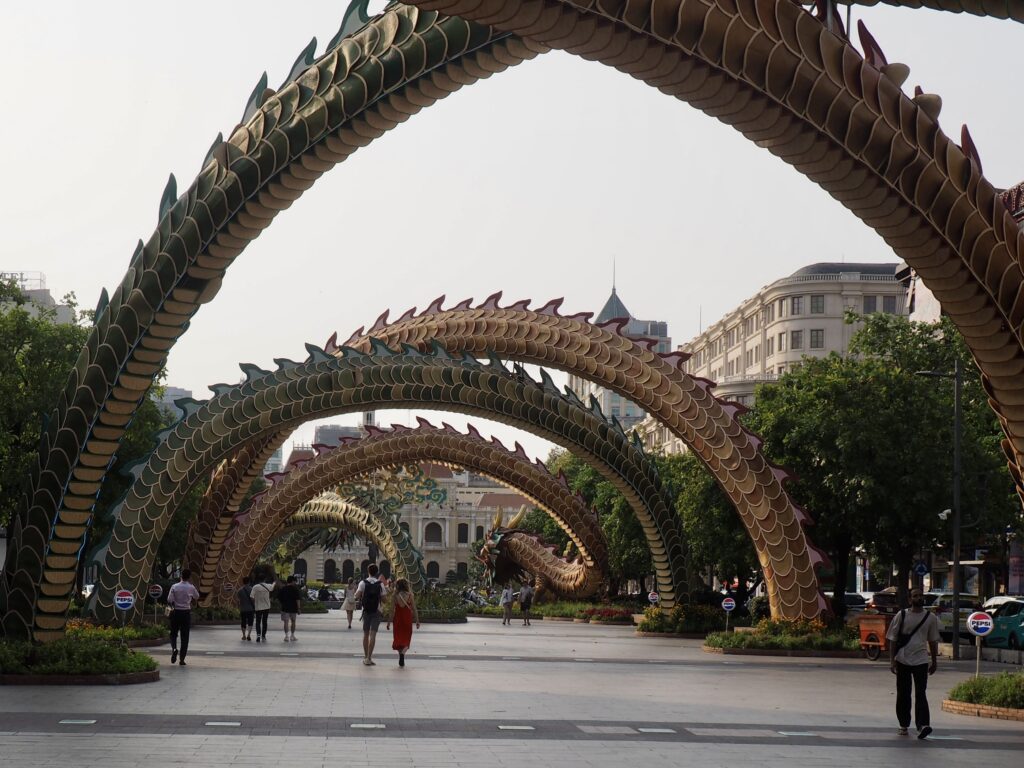
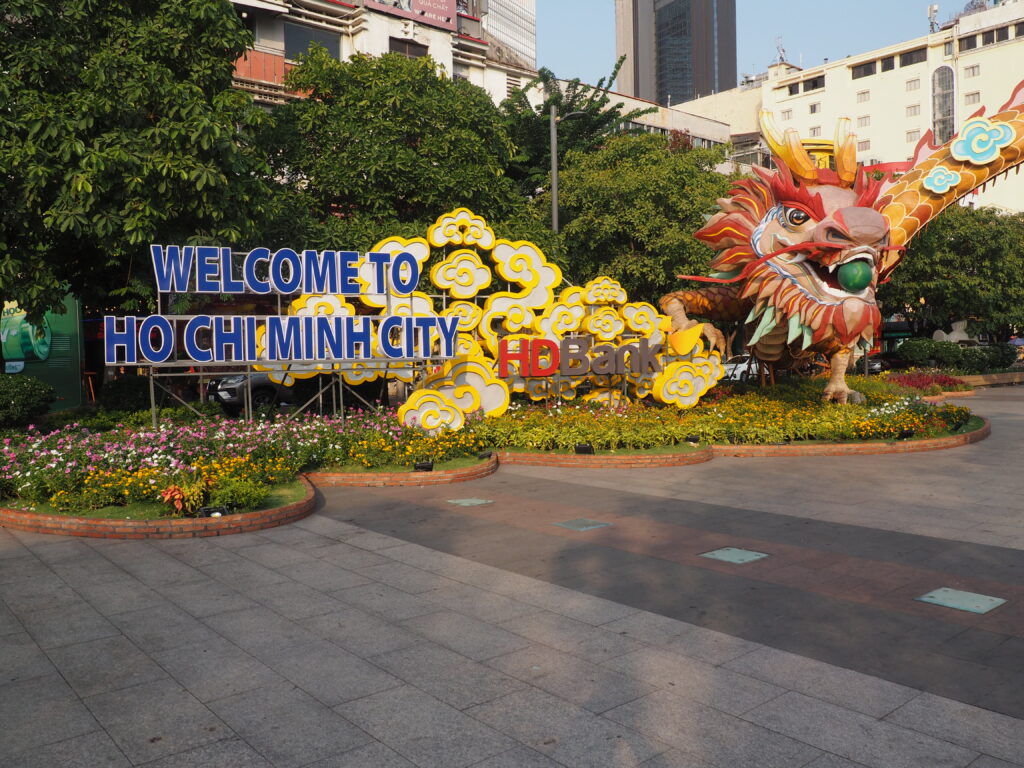
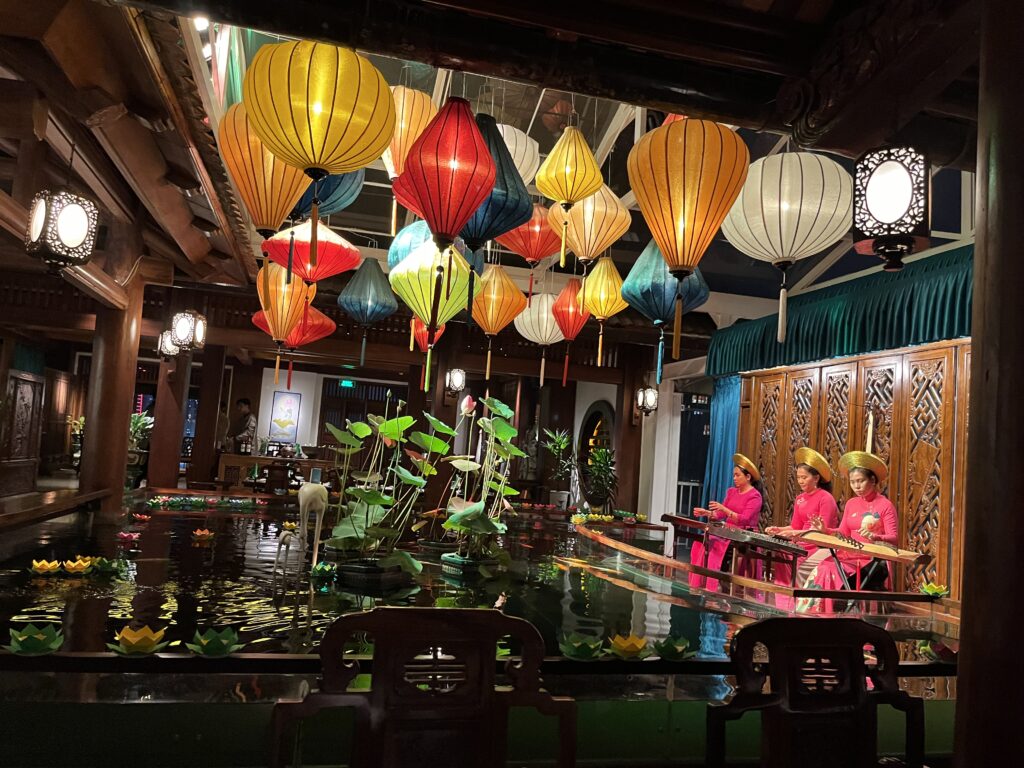
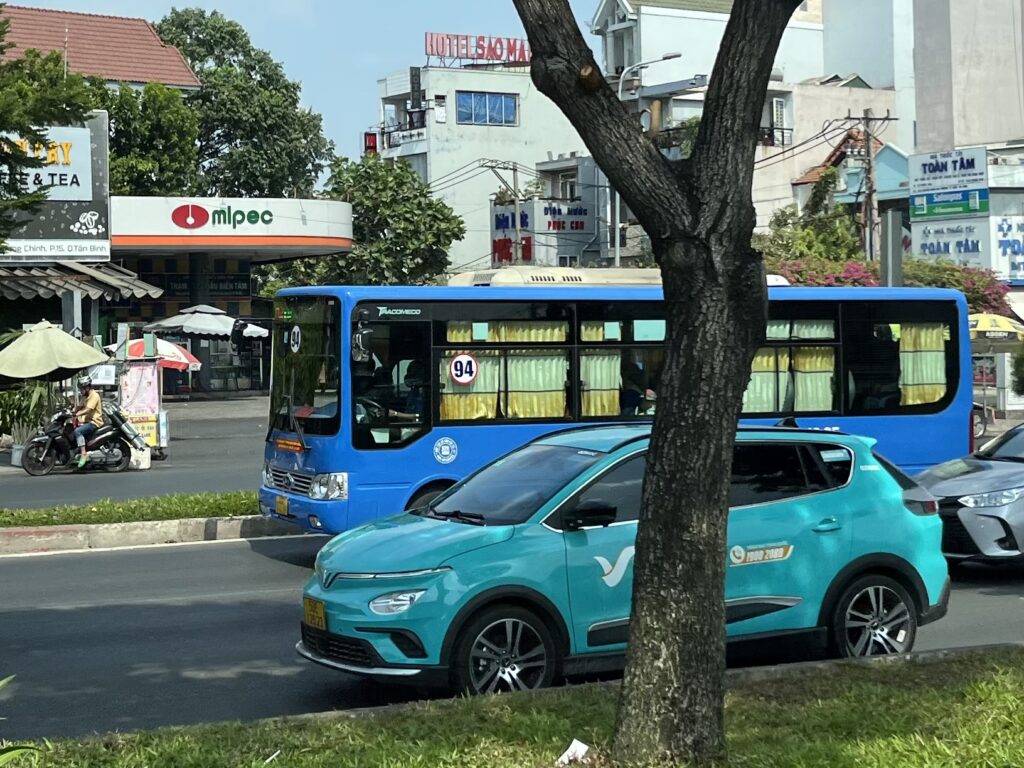
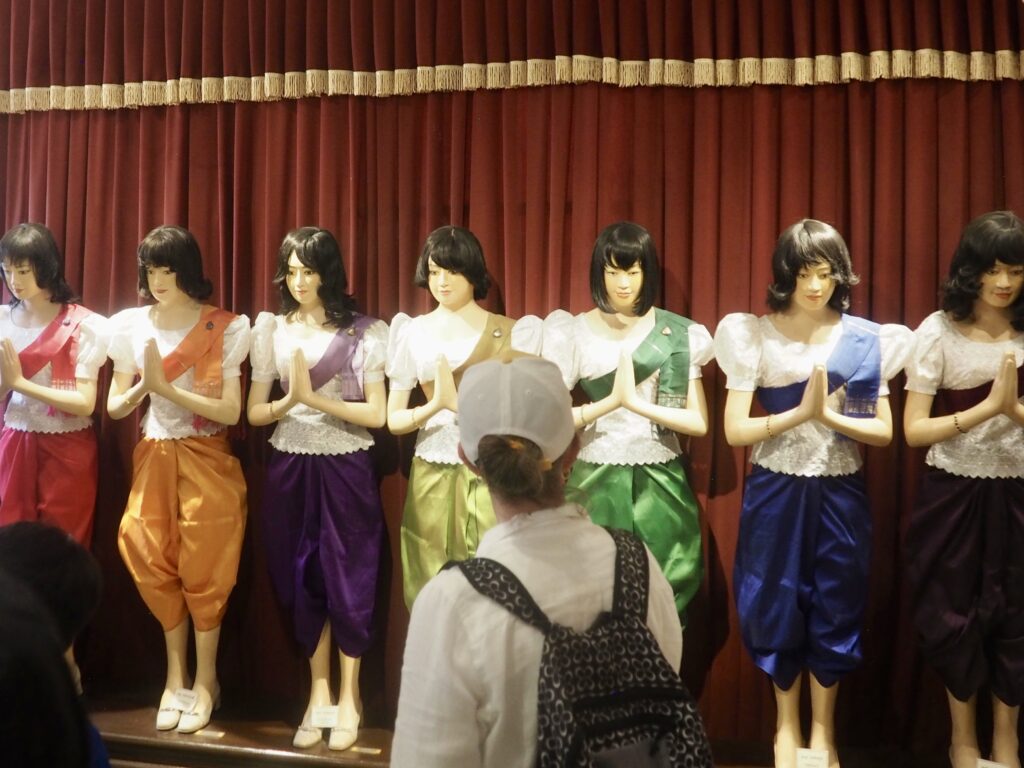
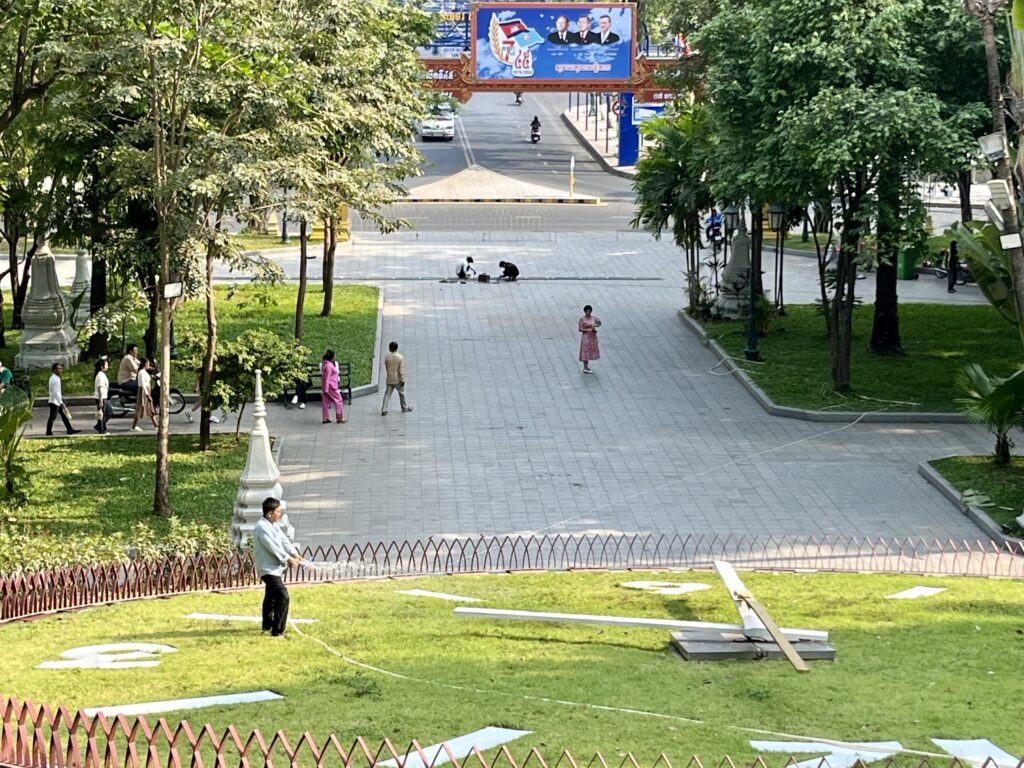
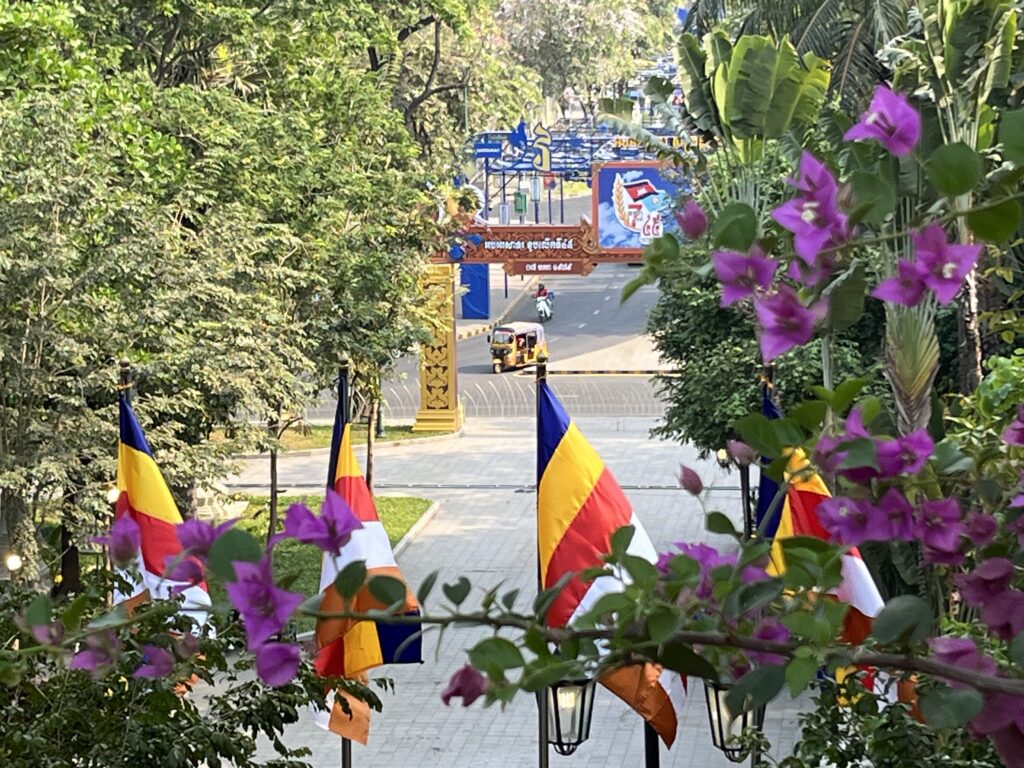
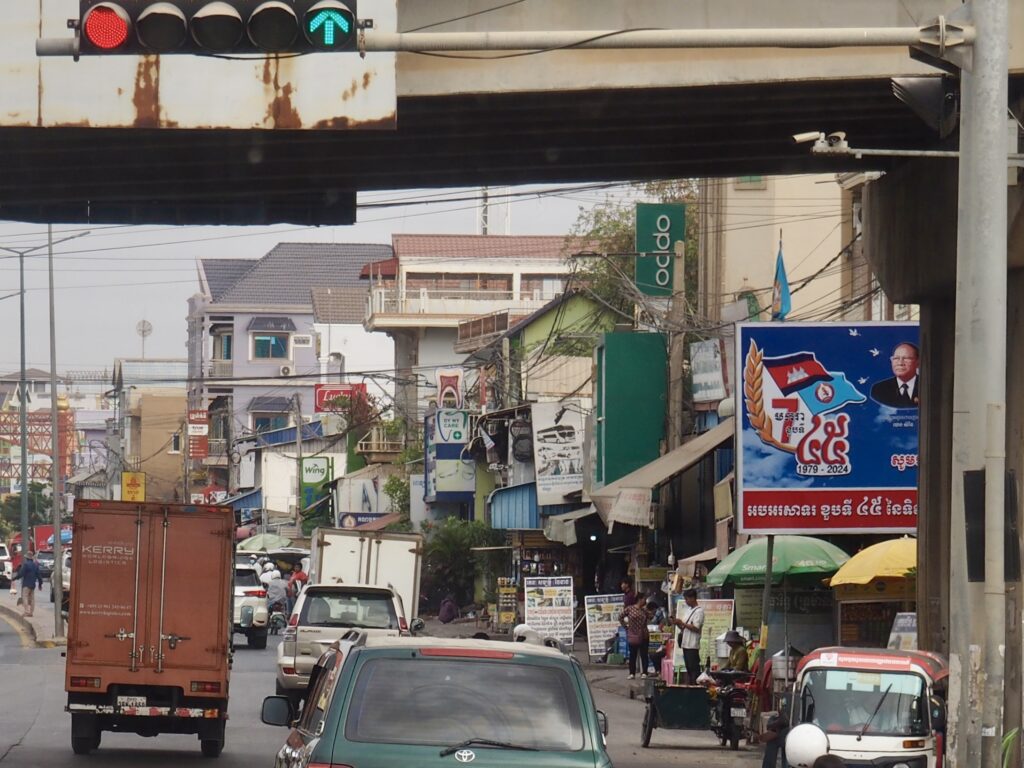
Yes, it’s an exuberant city. . . . . . and the Year of the Dragon!
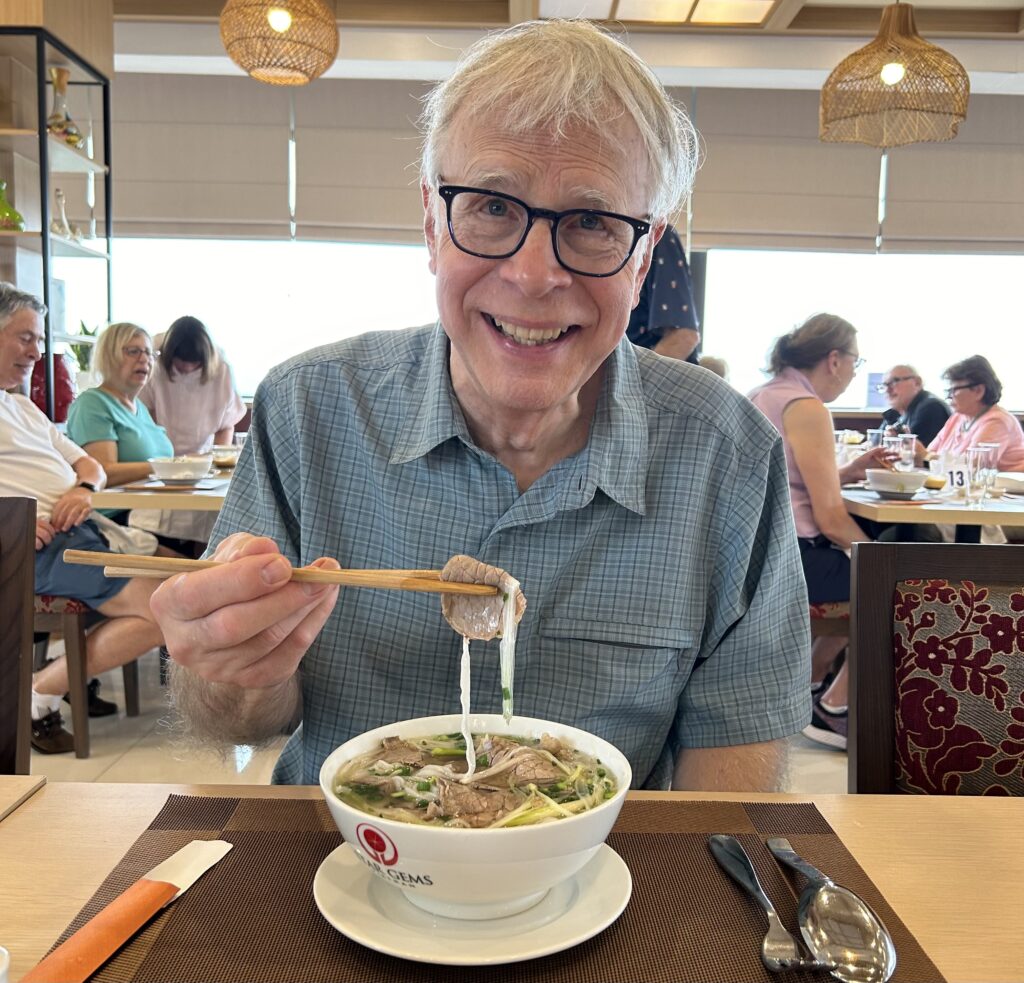
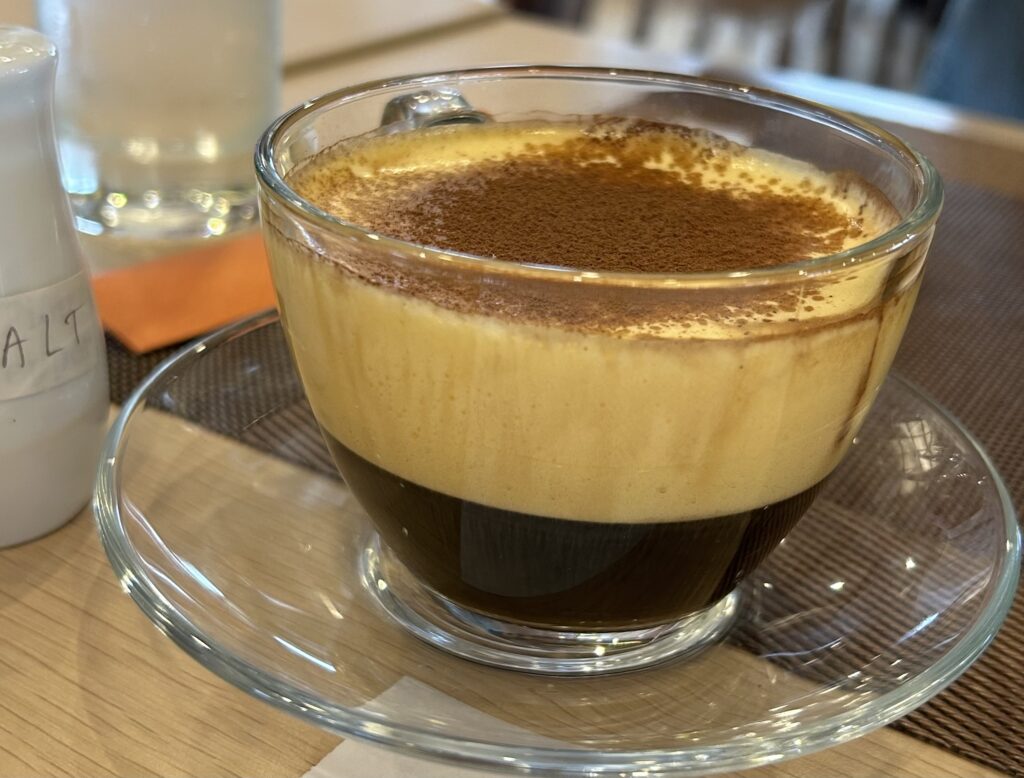
Land of Pho and Egg Coffee
We love our Pho!Beyond delicious!
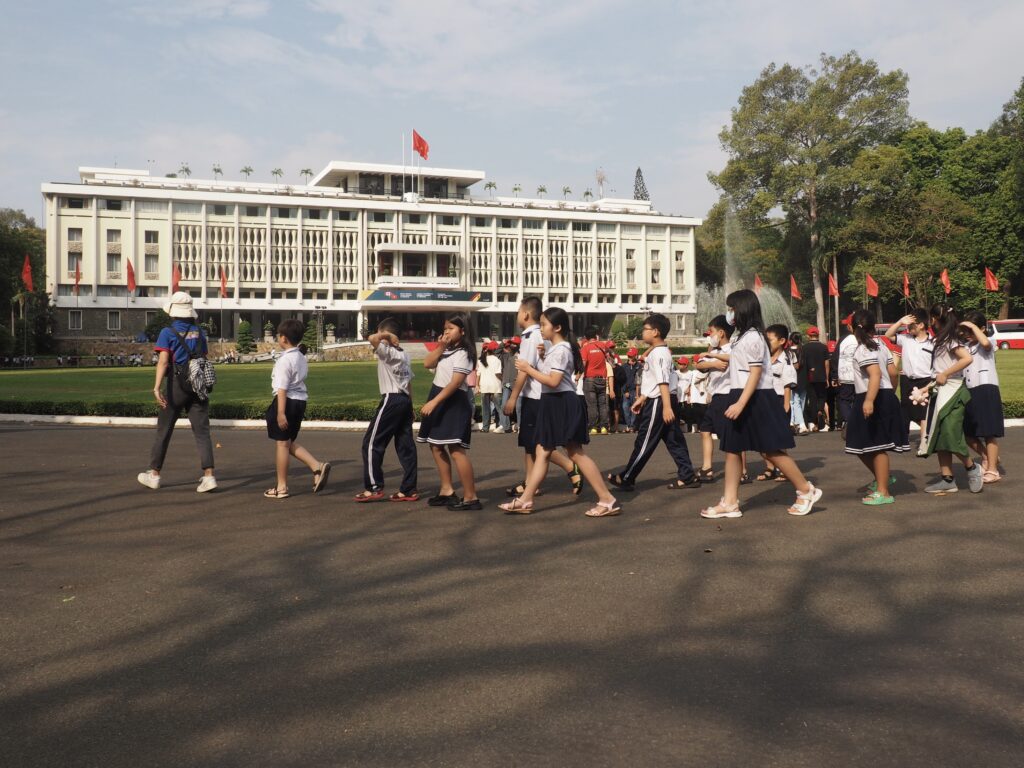
On to Independence Palace (now, Reunification Palace)
We join the schoolchildren in visiting Reunification Palace (and are asked “what’s your name?” countless times)
President Ngô Dinh Diêm started construction on the Palace in 1962 after the old one was bombed by dissident pilots, although his assassination in a coup d’etat the following year bequeathed the honor of living there as head of state to the head of the military junta General Nguyen Van Thiêu who lived (and worked) there from 1967 until April 1975 when he fled the country during the collapse of the Republic of Vietnam.
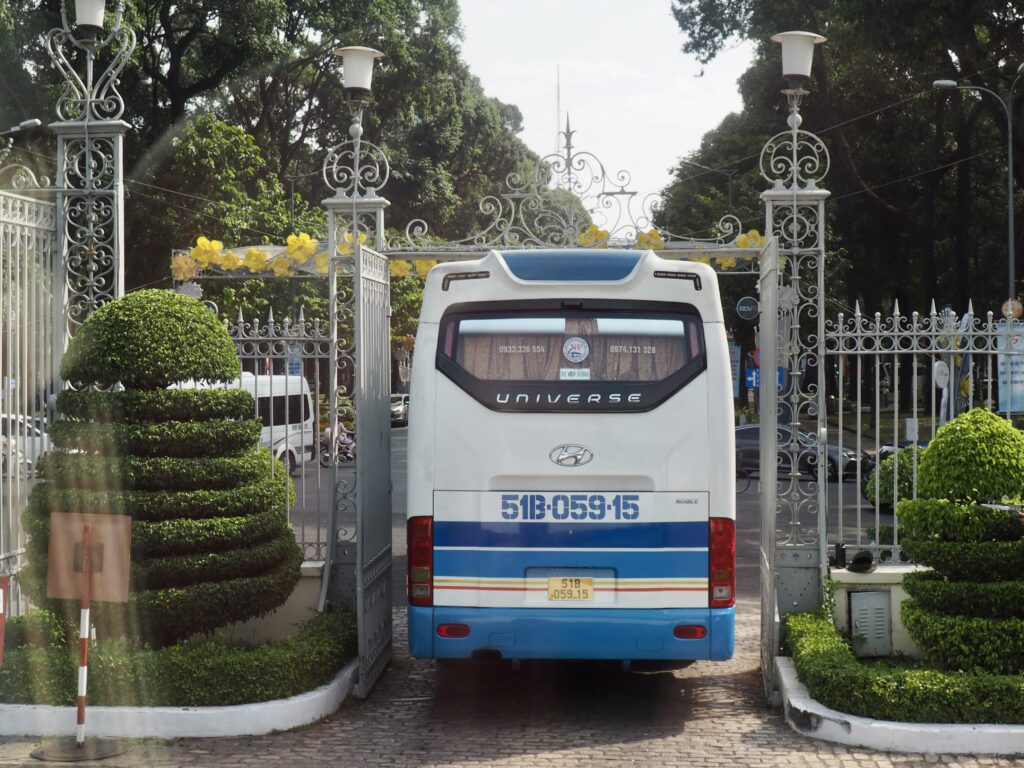
The South Vietnamese government fell whena North Vietnamese tank crashed these gates
The area of the Palace for receiving dignitaries and other guests was quite posh and formal.
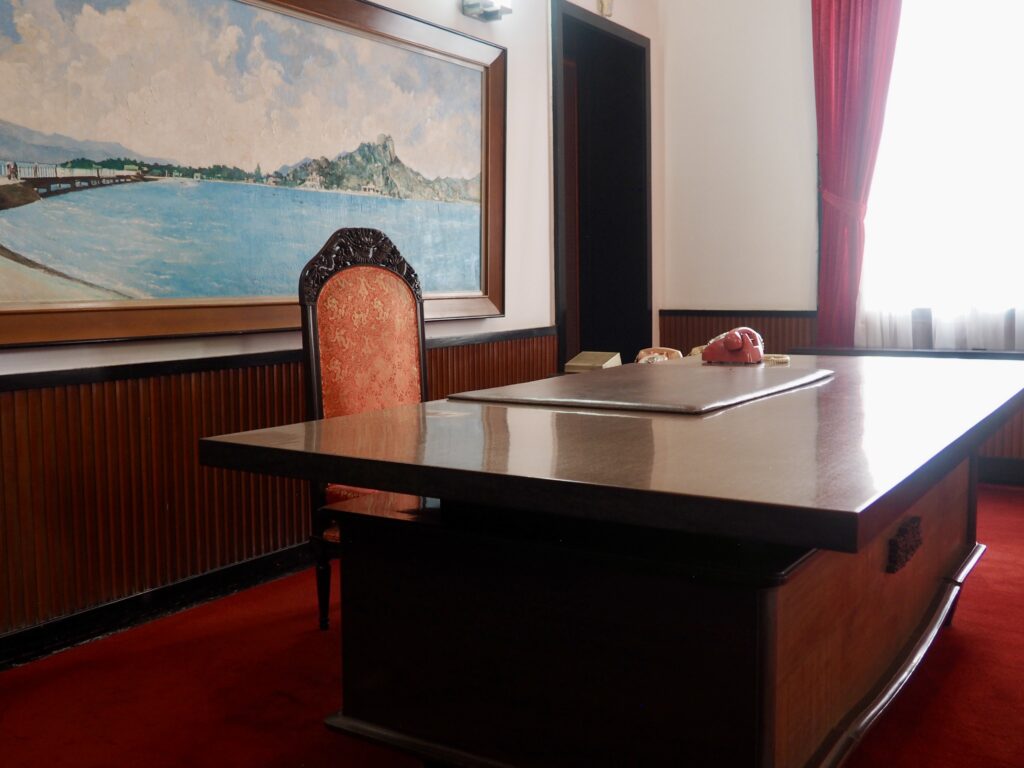
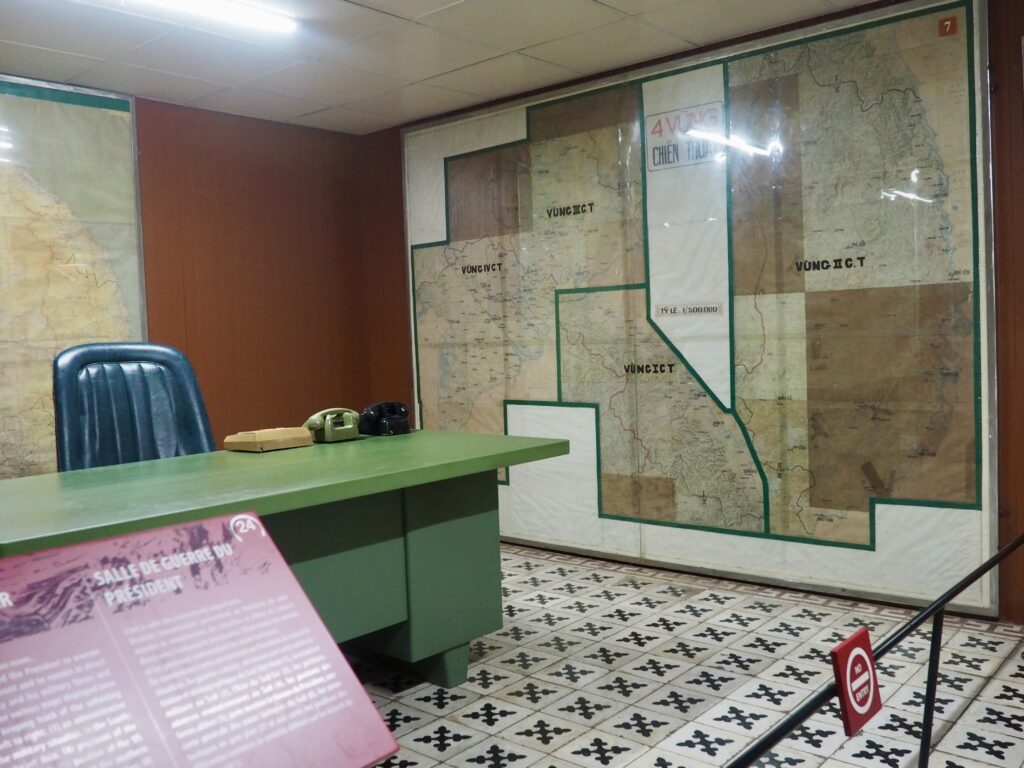
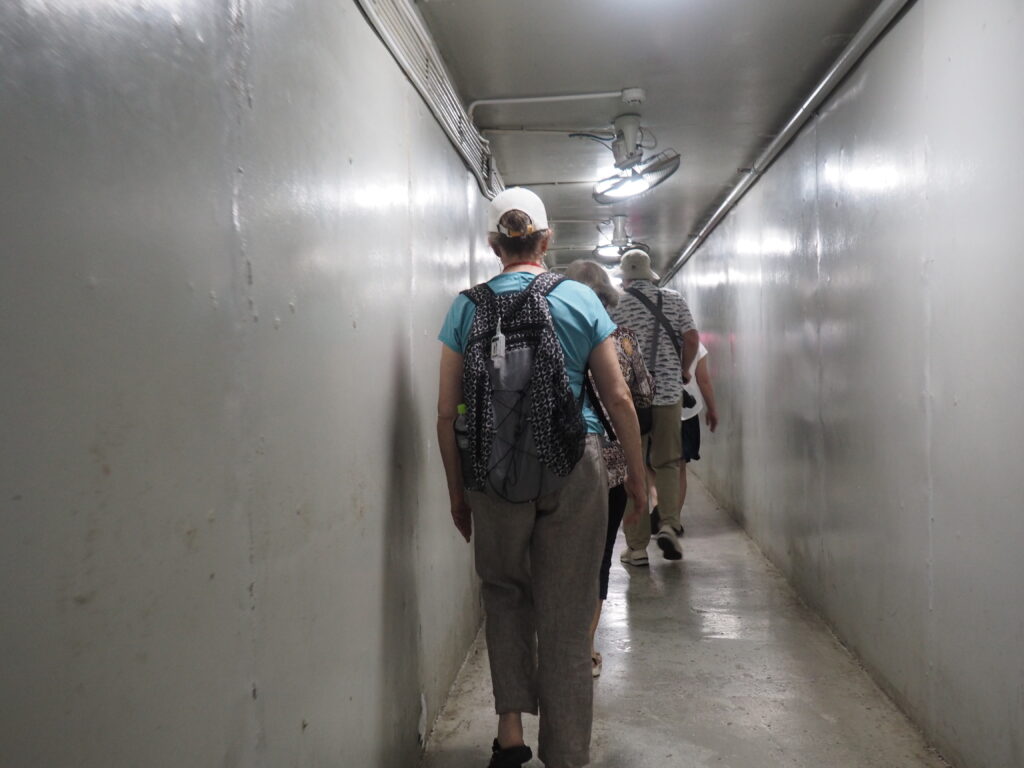
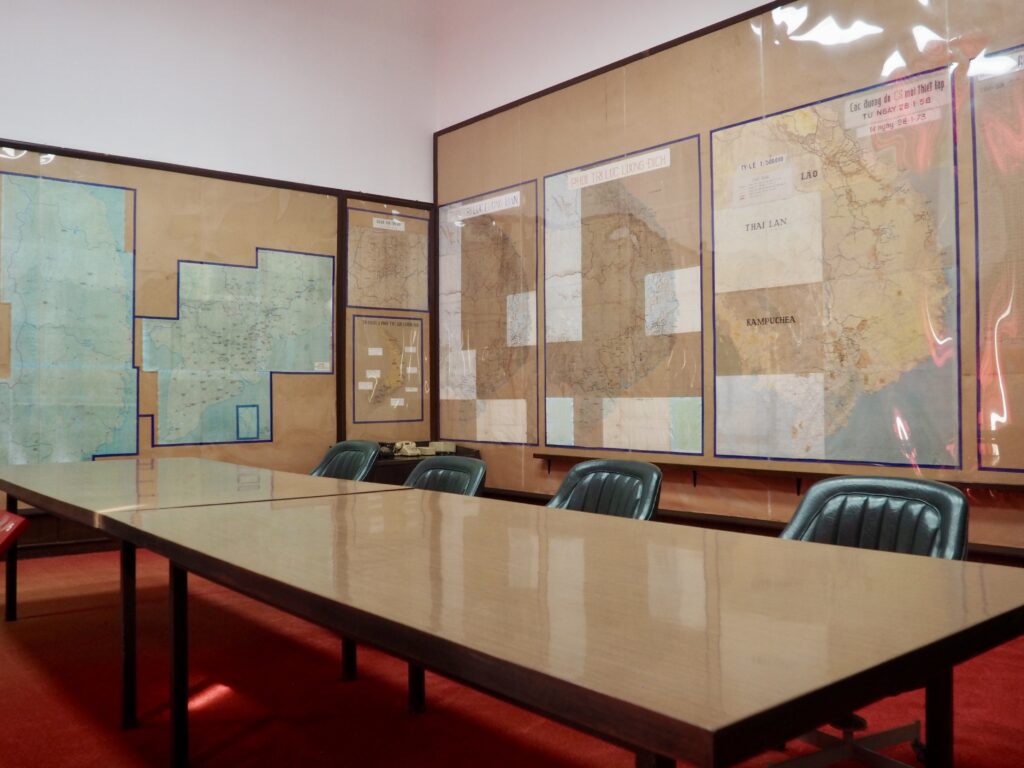
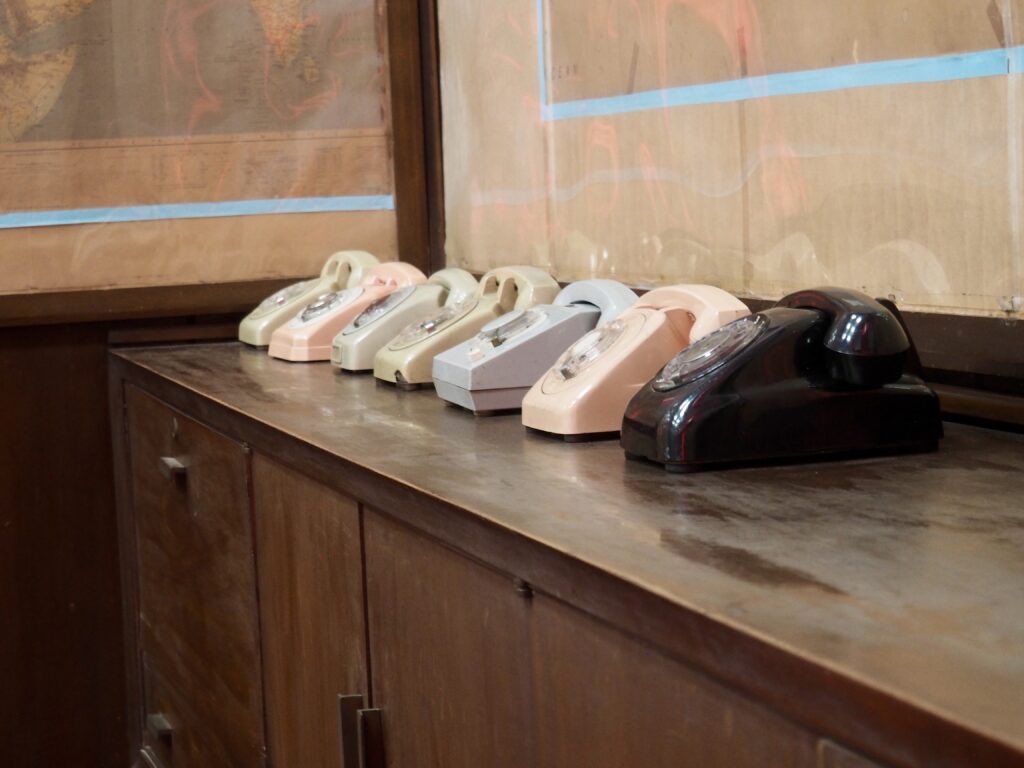
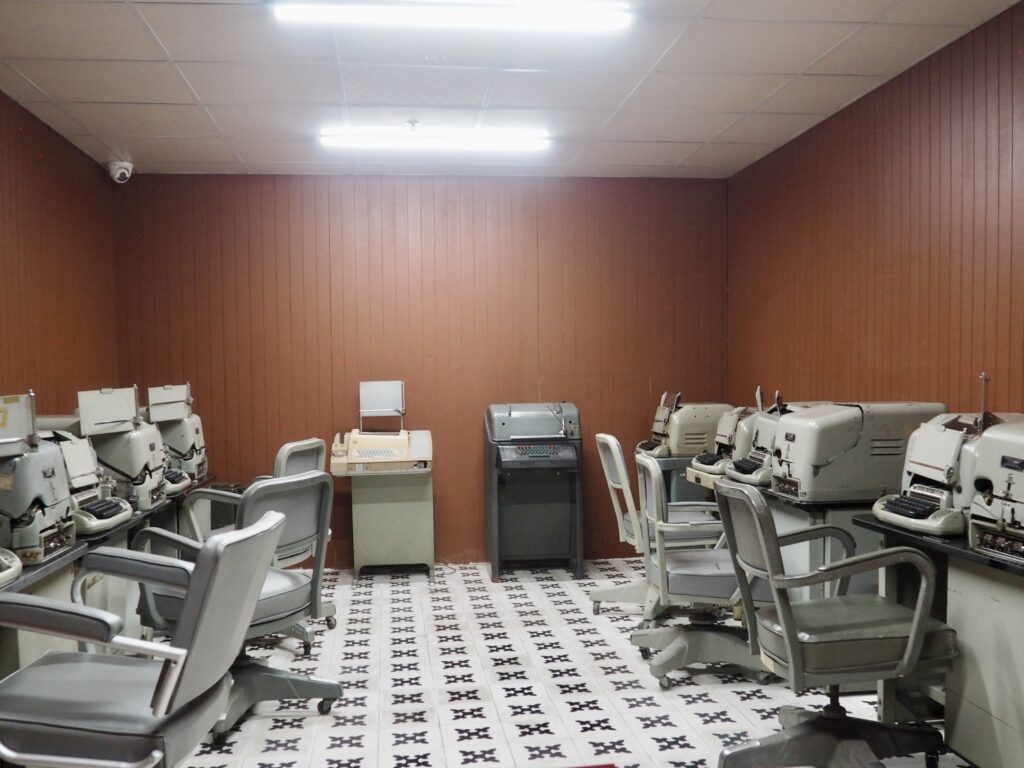
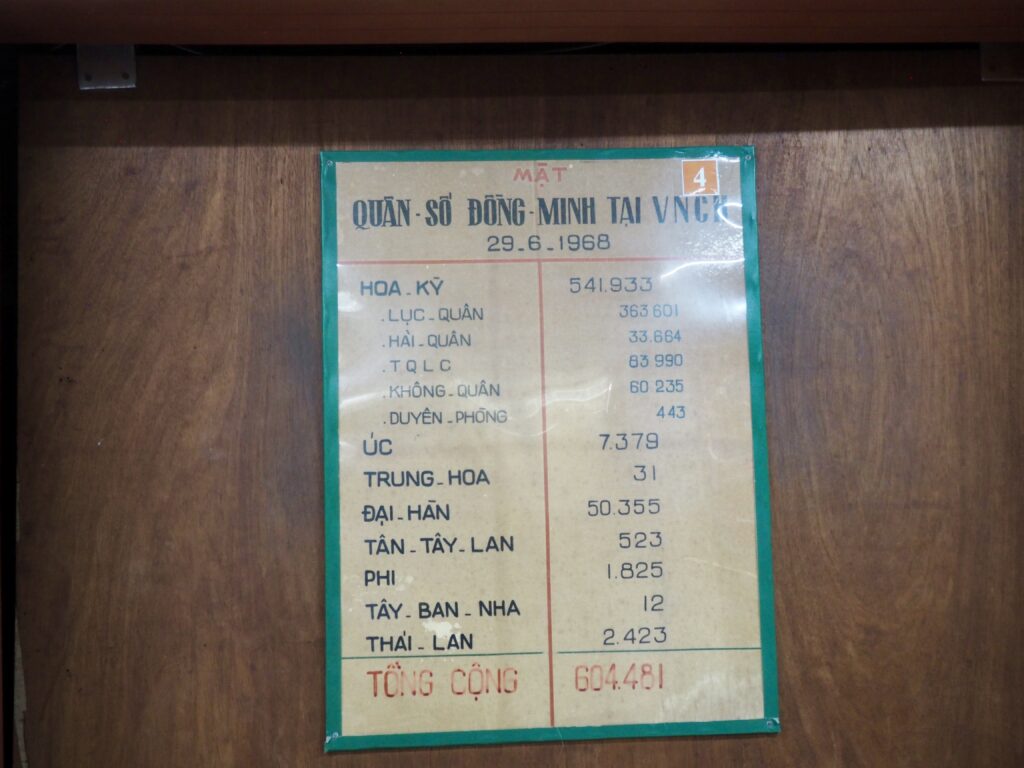
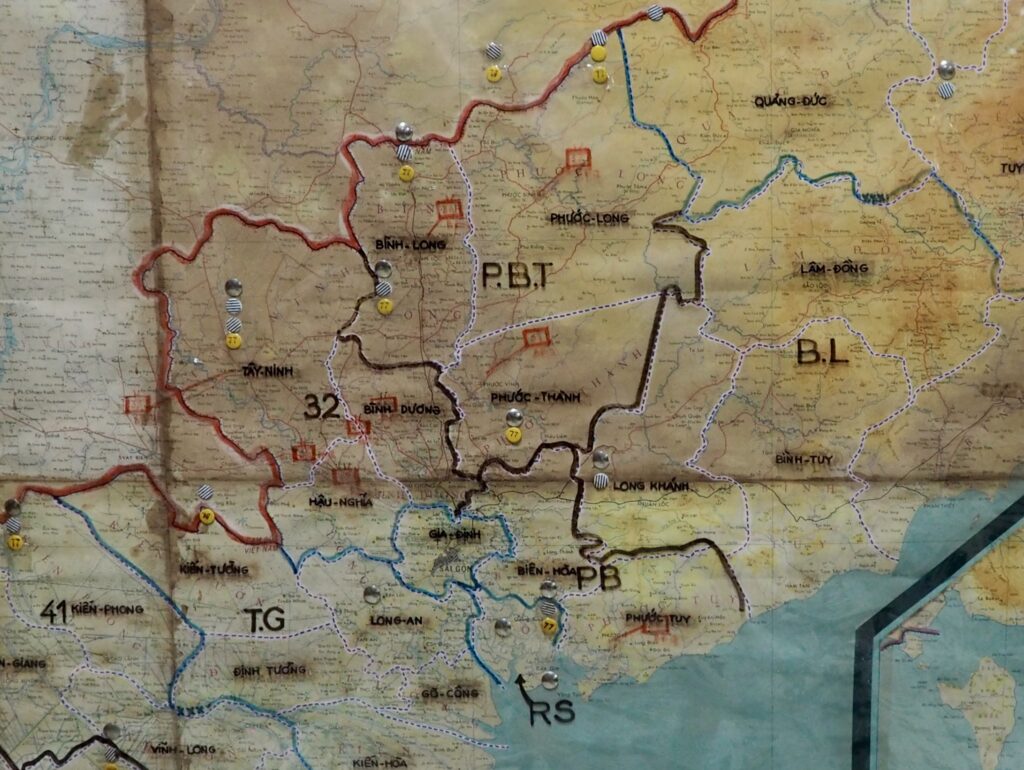
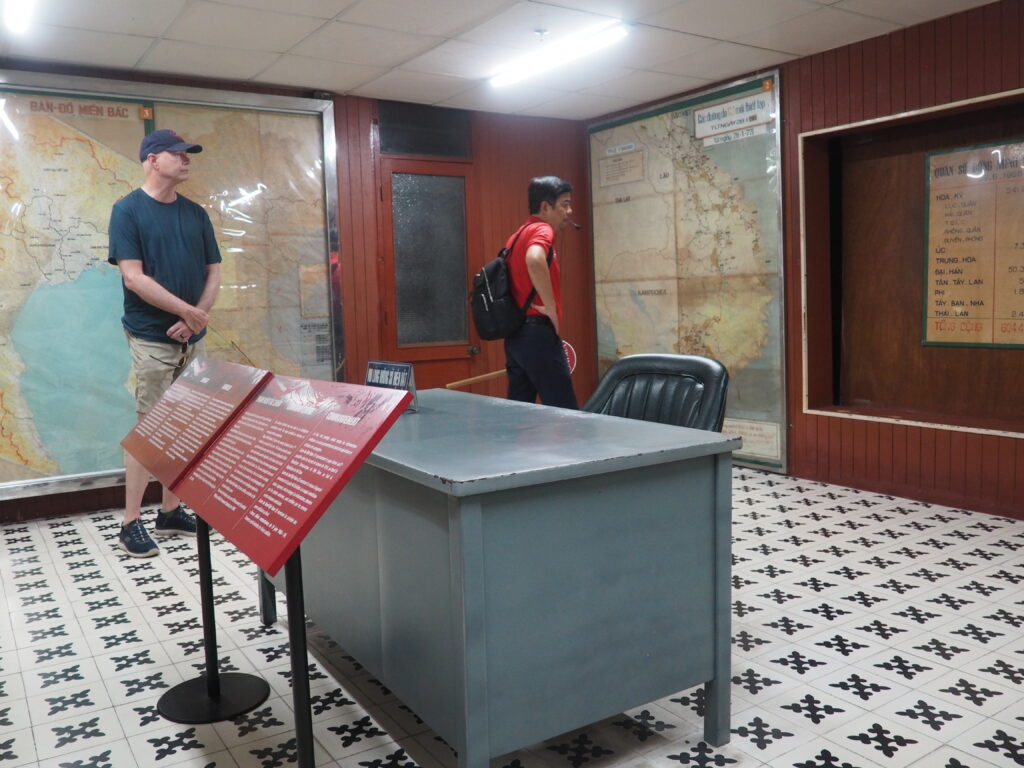
Office of the President But, the President’s War Roomwas in the Basementalong with the Situation Room Communications Room (ah, the memories)Tally of Allied Foreign Troops (Hoa Ky is, of course, the USA)and all the restof the Military Headquarters
With the government and military headquarters housed together, when that tank crashed through the Palace gate, it really was the end.
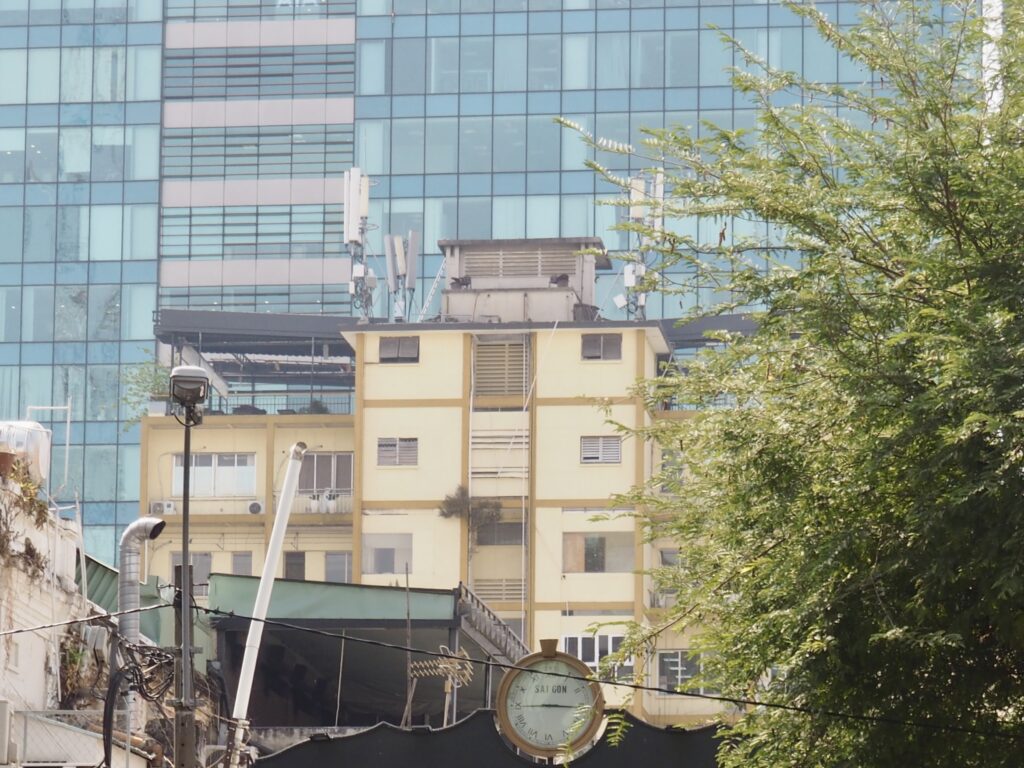
We’re told that this building, the former CIA HQ, was the setting for the iconic photo of desperate people hanging from the ladder of a helicopter taking off as Saigon fell, rather than the US Embassy, as initially reported.
Post Office!
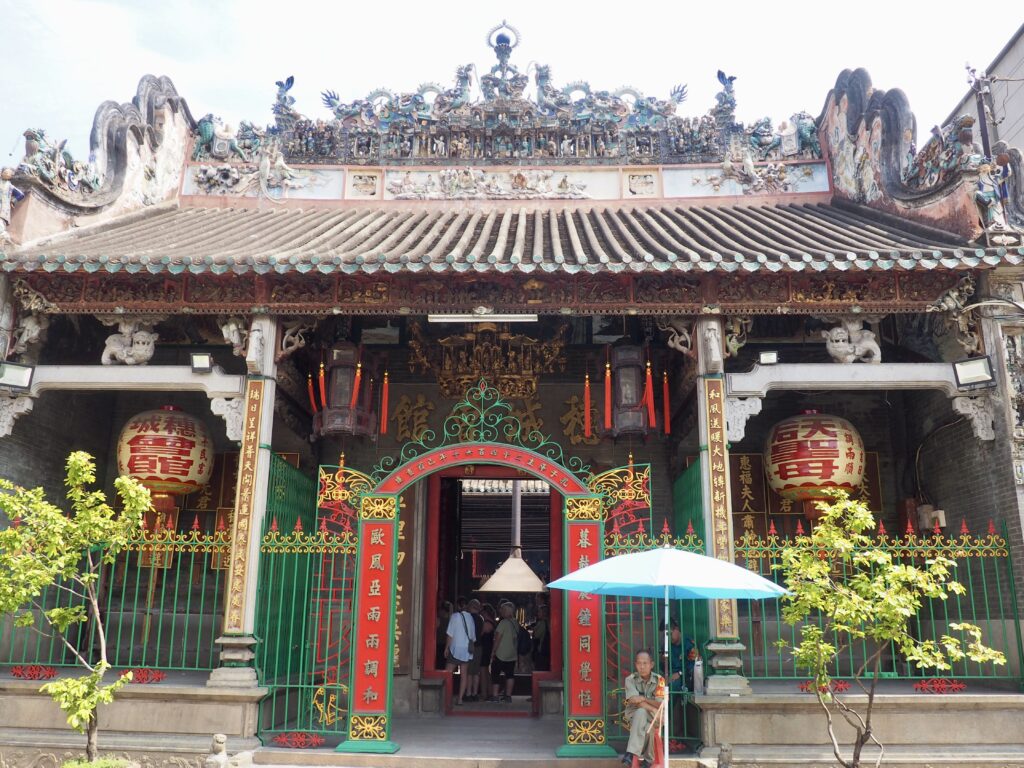
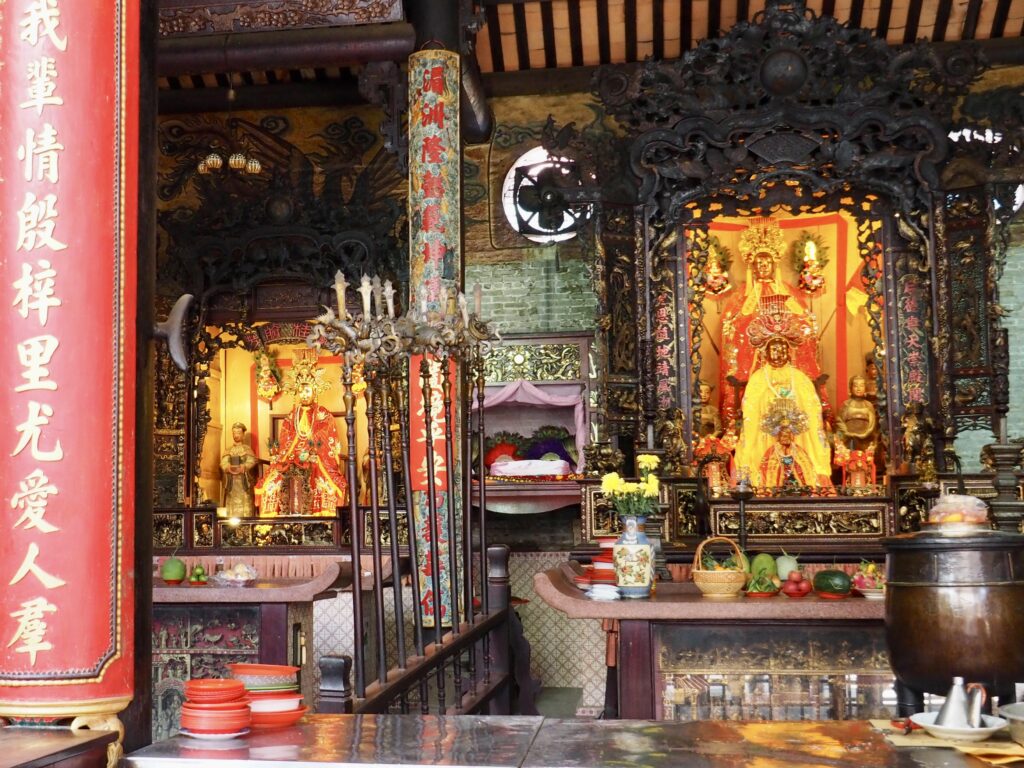
Thien Hau Temple (Mazu, Goddess of the Sea)
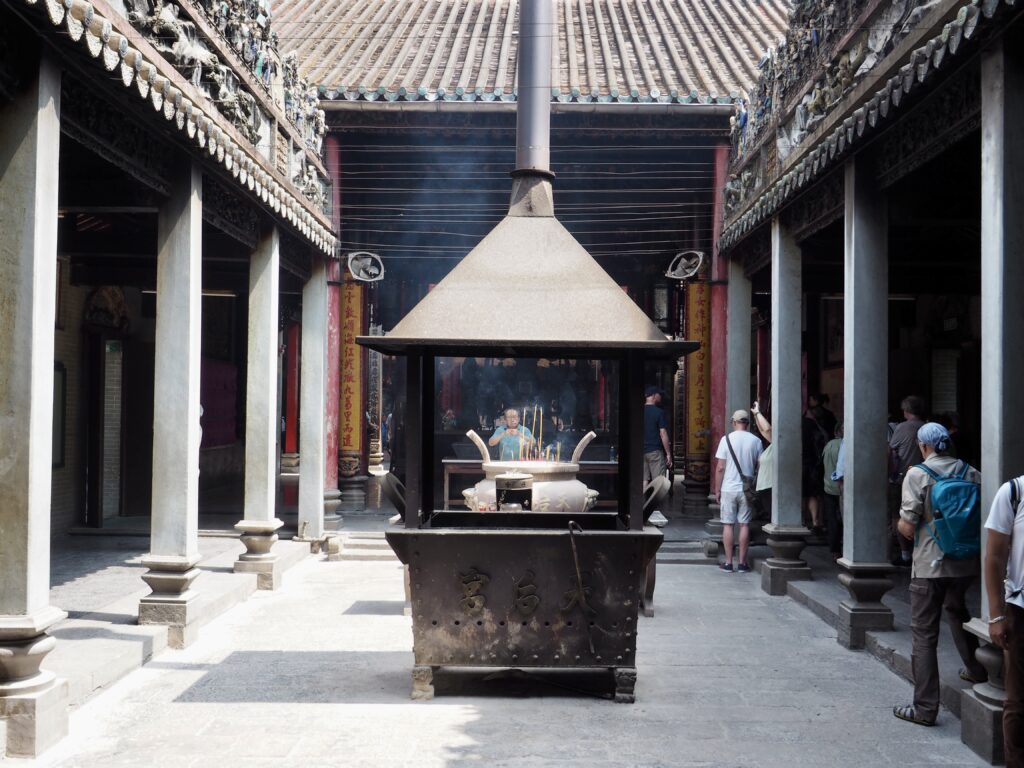
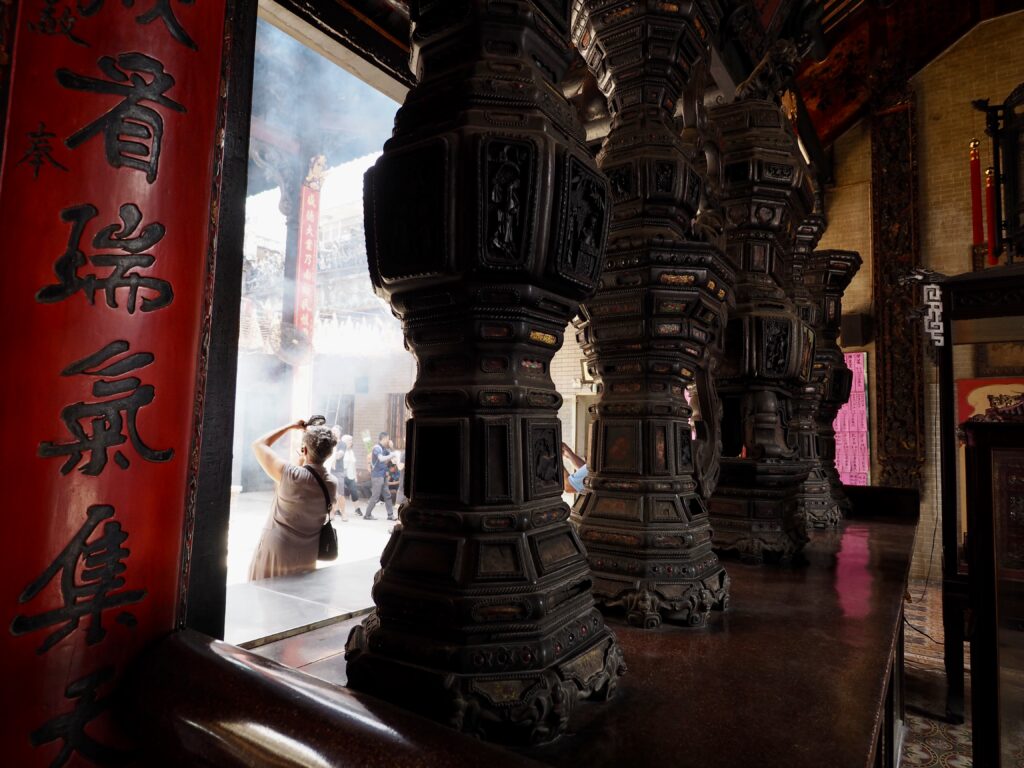
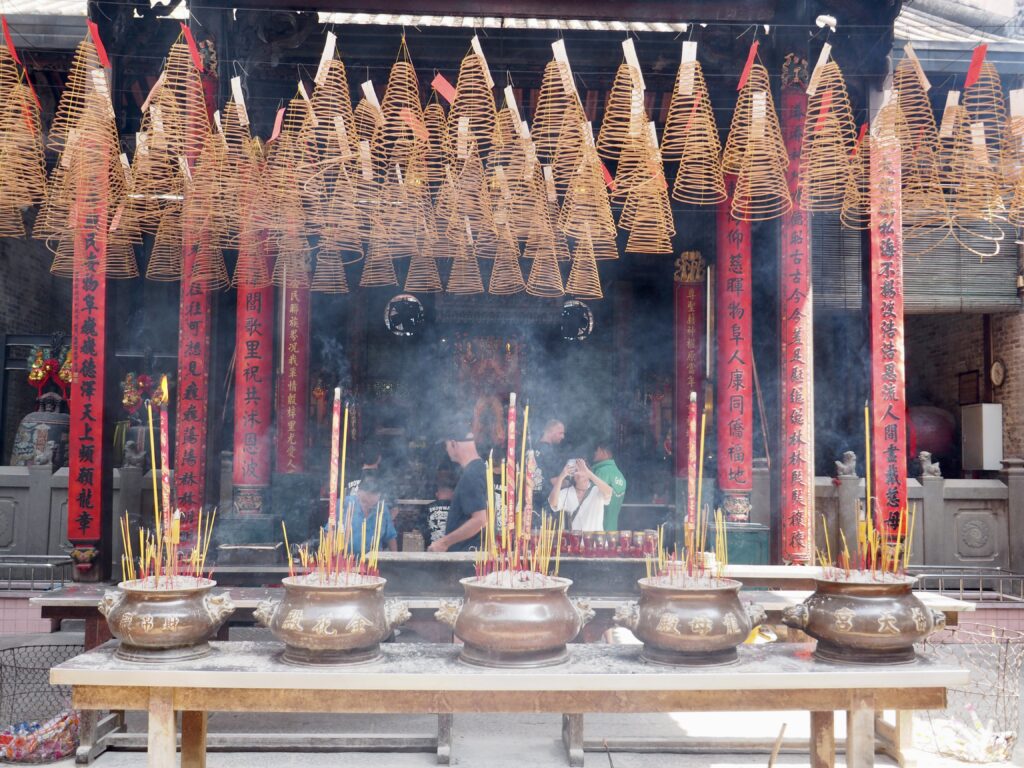
Thien Hau Temple, Cholon (Chinatown), Ho Chi Minh City
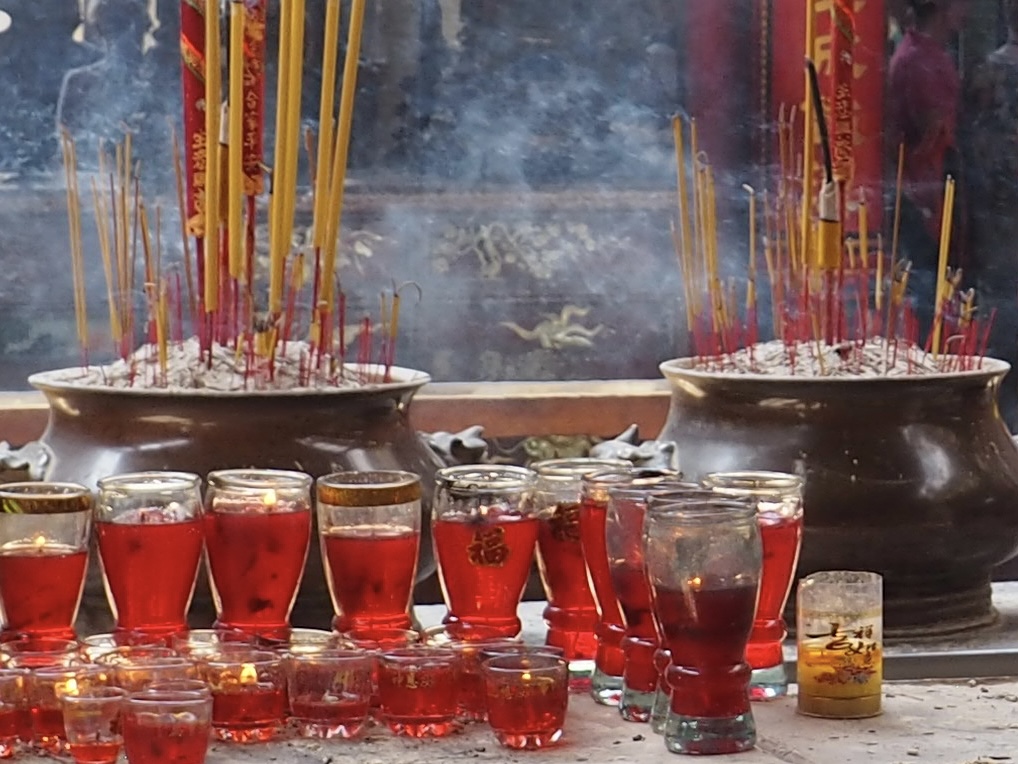
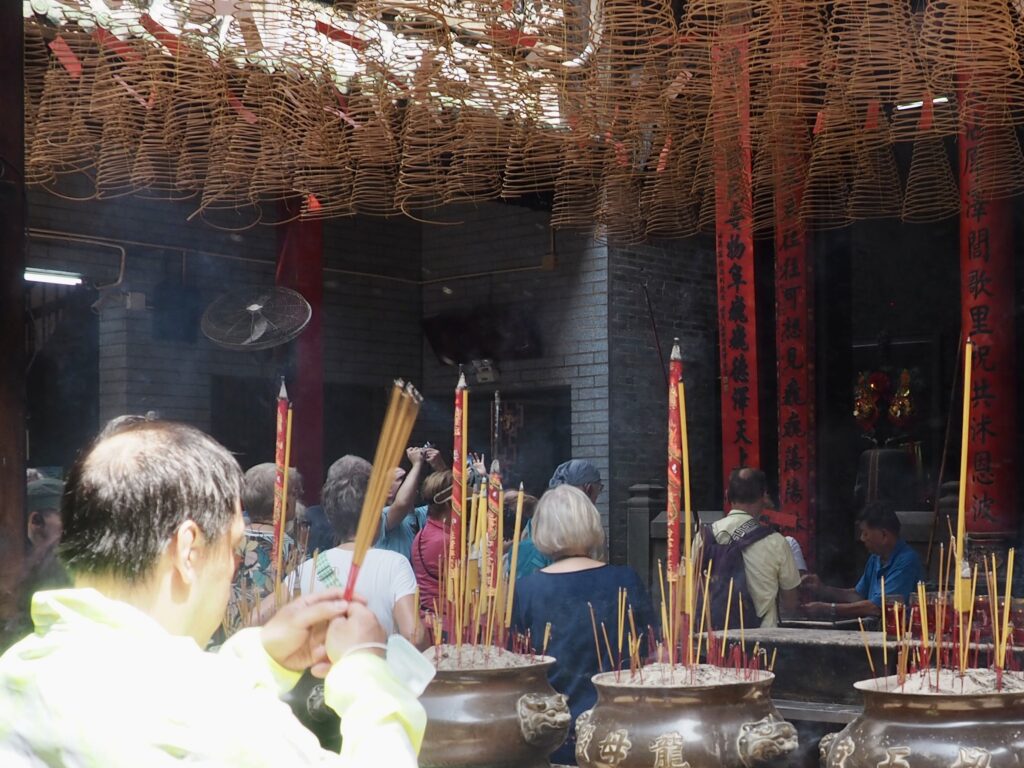
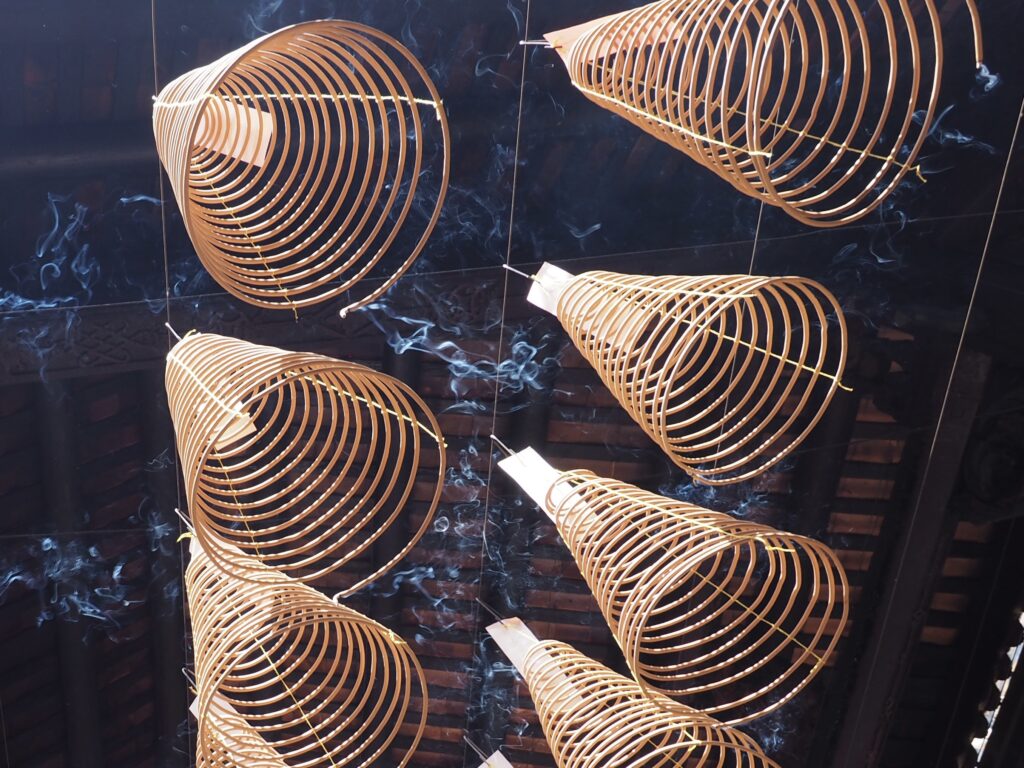
On a busy street in Chinatown is a temple first erected in 1760 to the Sea Goddess of the southern Chinese (Cantonese) by the Chinese community, long established as traders in Vietnam. The Sea Goddess is neither Buddhist nor Taoist, but has been absorbed into both by this community. The Sea Goddess (Mazu) is a deification of a young woman who saved her family by spiritual means in medieval Fujian and her worship thrives among the Chinese diaspora with roots in the sea. It was quite beautiful, despite being mobbed with western tourists.
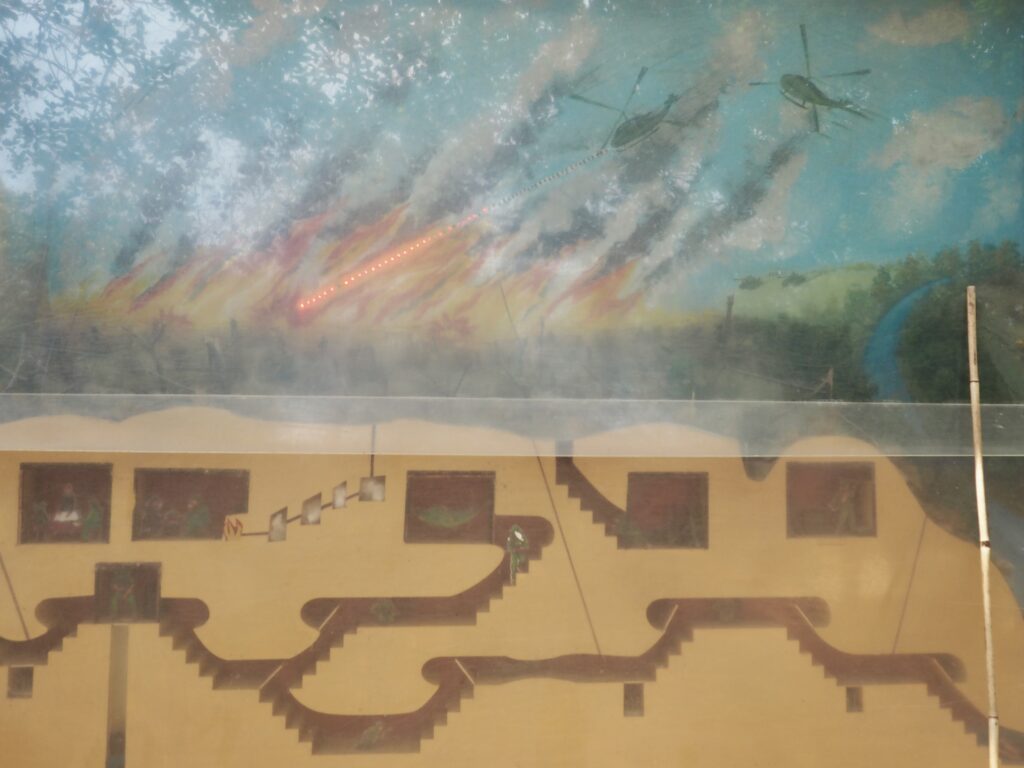
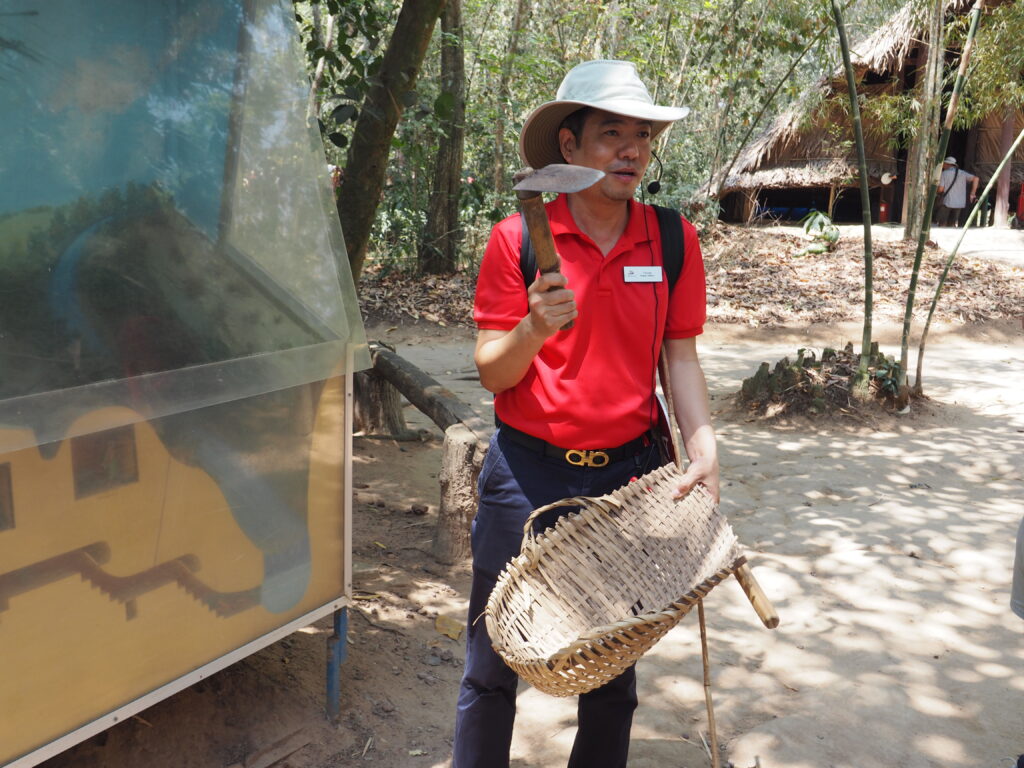
Large Outdoor Plexiglass-Covered Display, Grounds of the Cu Chi Tunnels(Hey! Isn’t that a Vinfast EV, that taxi?)
Having made port in My Tho, rather than heading straight into the heart of Ho Chi Minh City (we’re told it’s still “Saigon” to many of the local residents), we went through the western edge of the city and about two hours north . . .
. . . through a prosperous rural area where people seem to be fond of ceramic dogs in front of their homes . . .
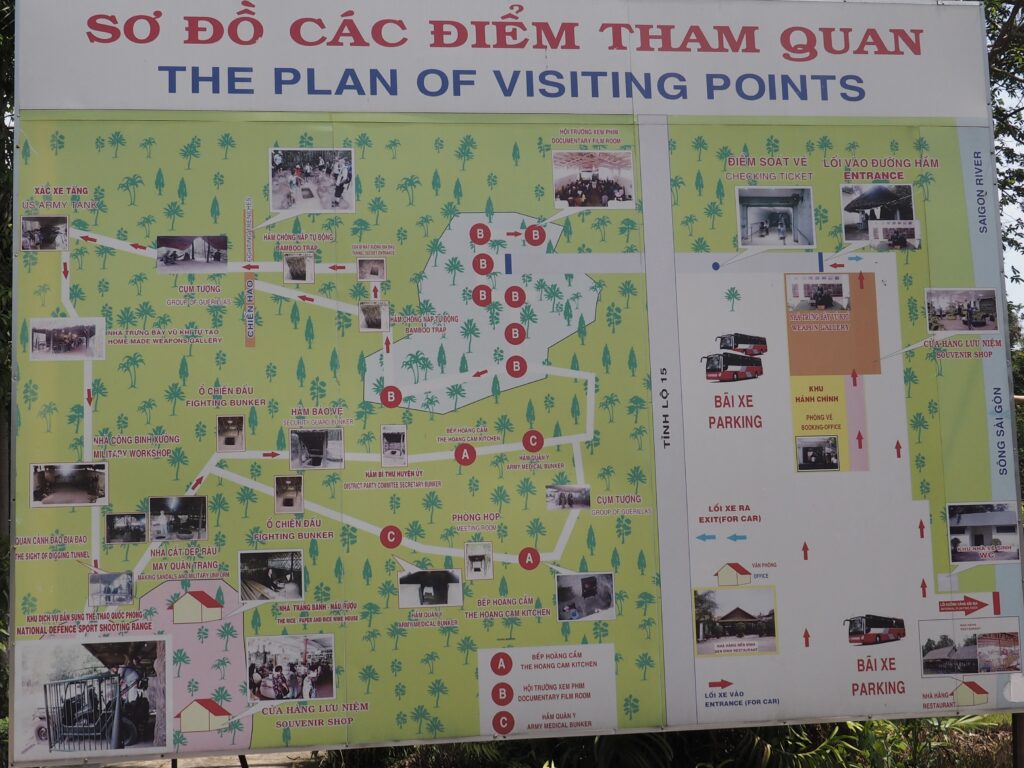
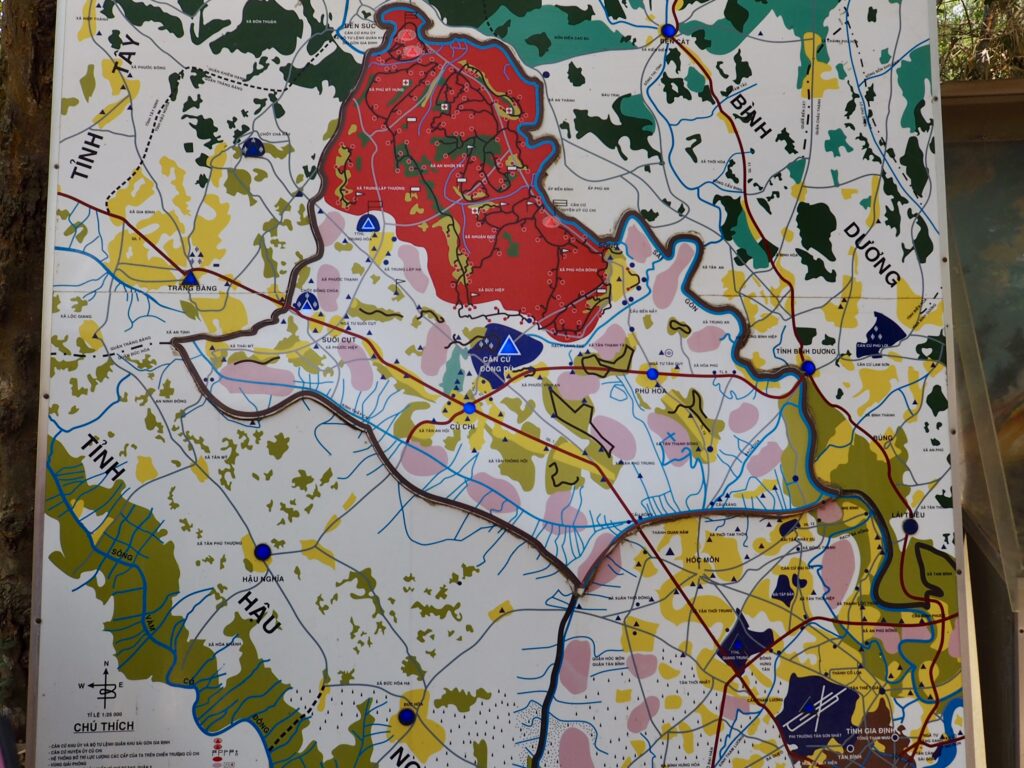
Layout of the Historical Park, Cu Chi TunnelsMap Showing Disposition of Forces, Cu Chi Tunnels
. . . to an area (in red on the map) filled with deep tunnels that was the southern terminus of the Ho Chi Minh Trail along which the Viet Cong, primarily, and North Vietnamese Army brought fighters and supplies into the heart of the South, not far from the Saigon airport and the deployments of US and South Vietnamese forces in between.
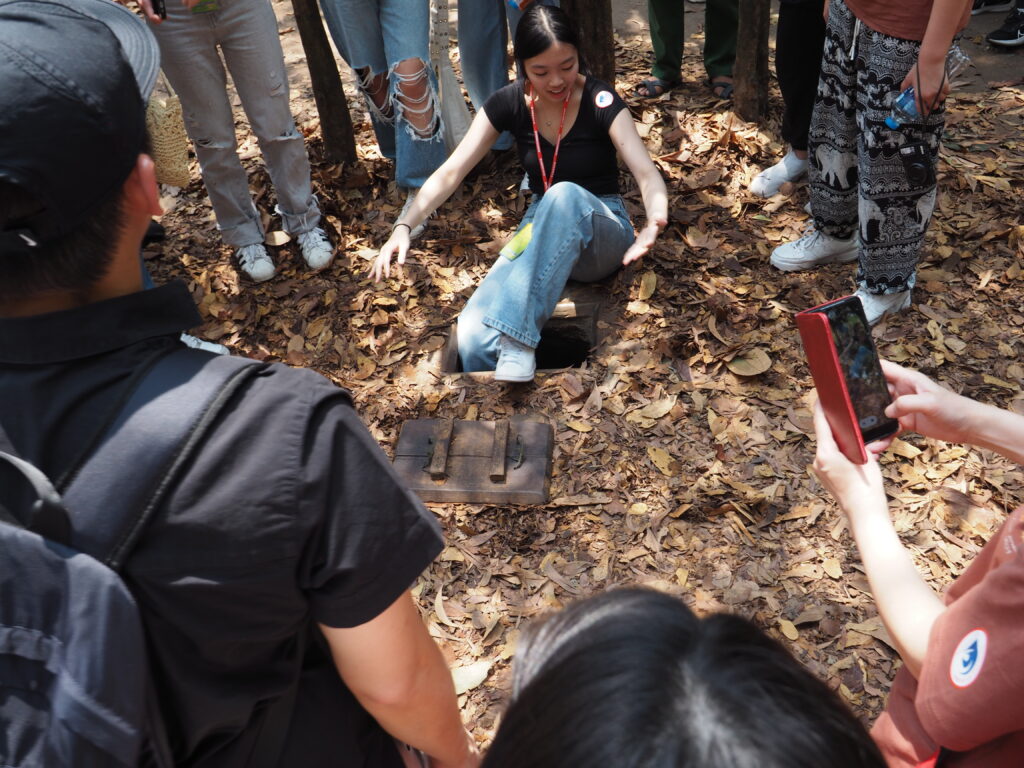
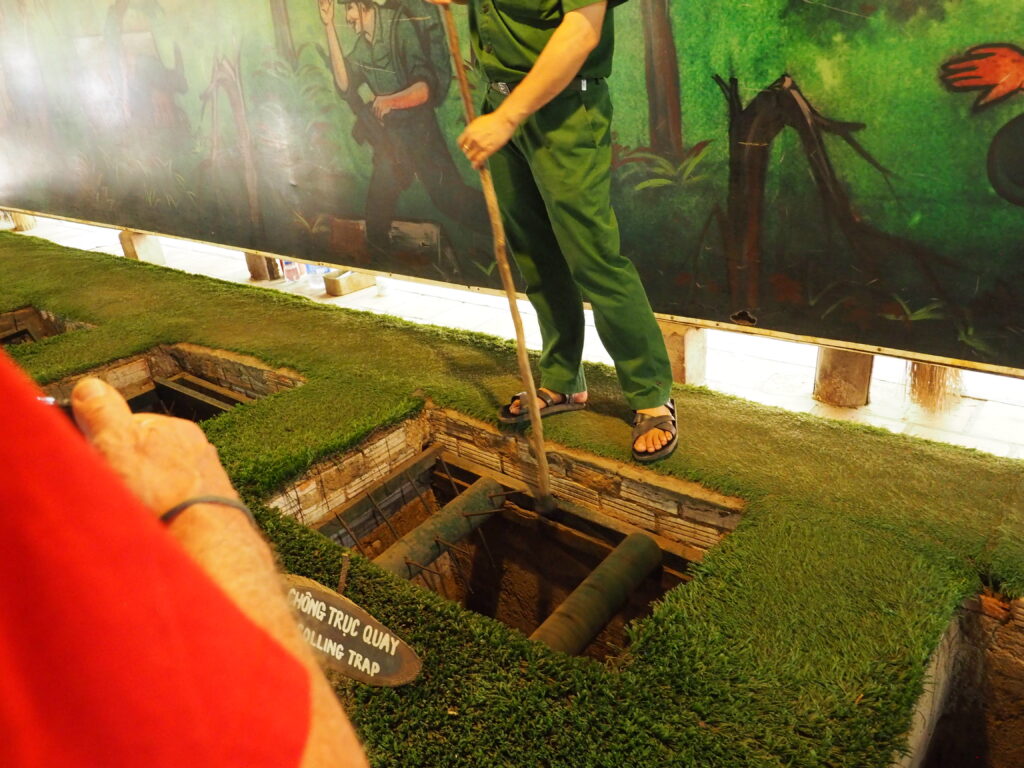
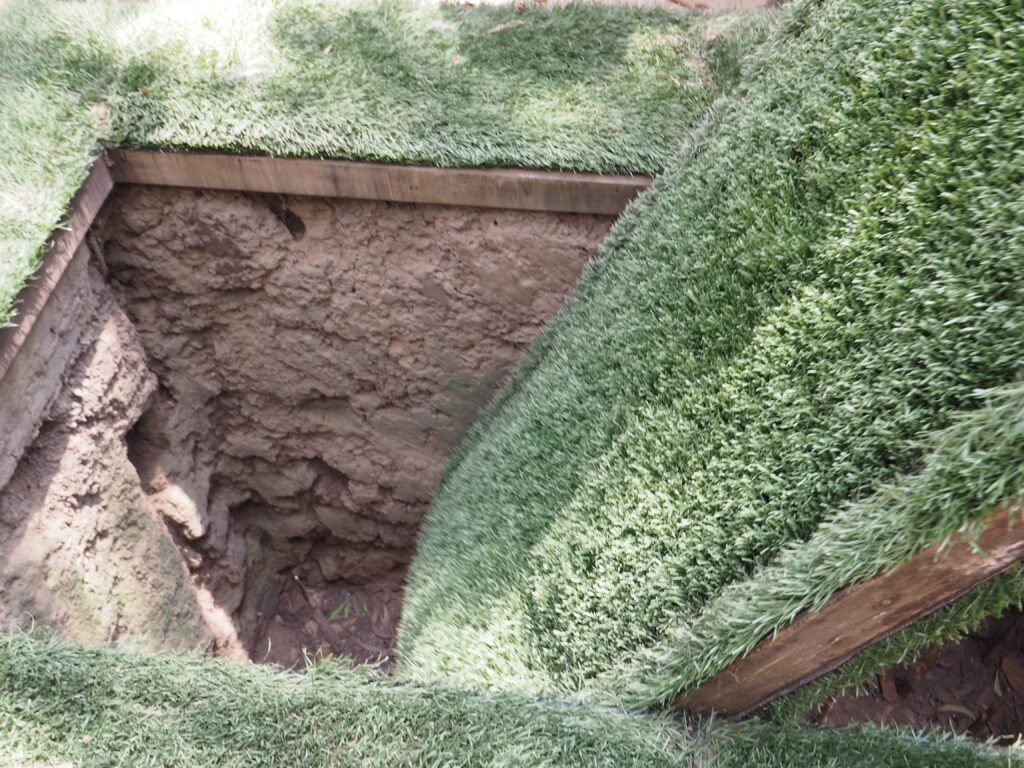
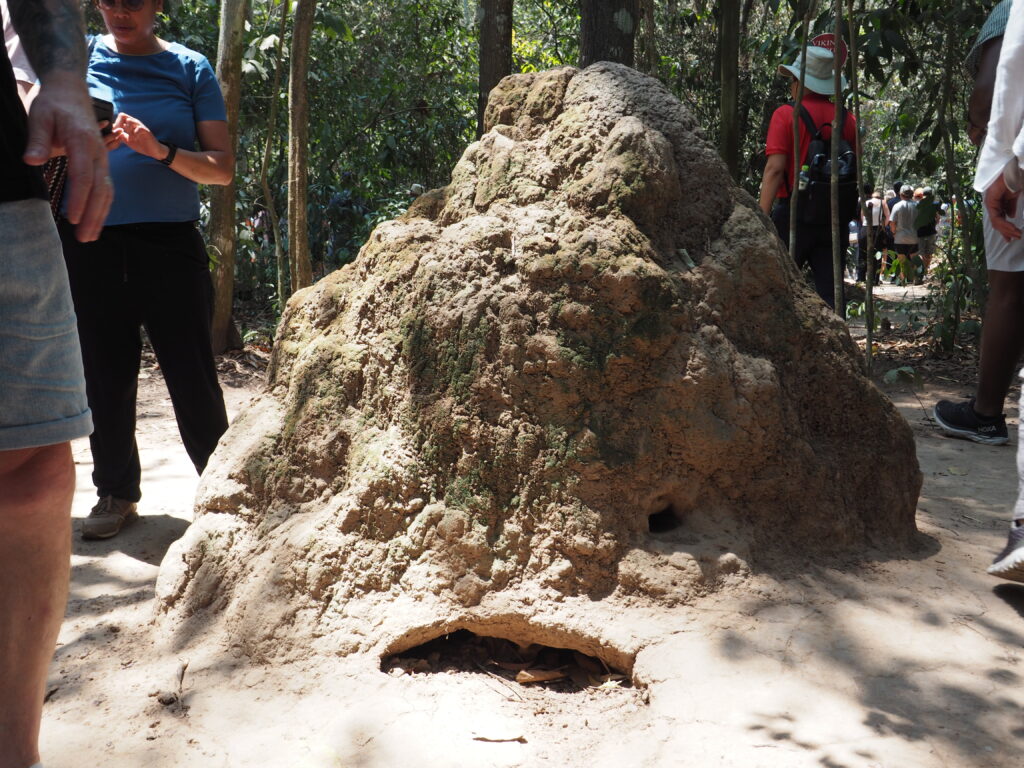
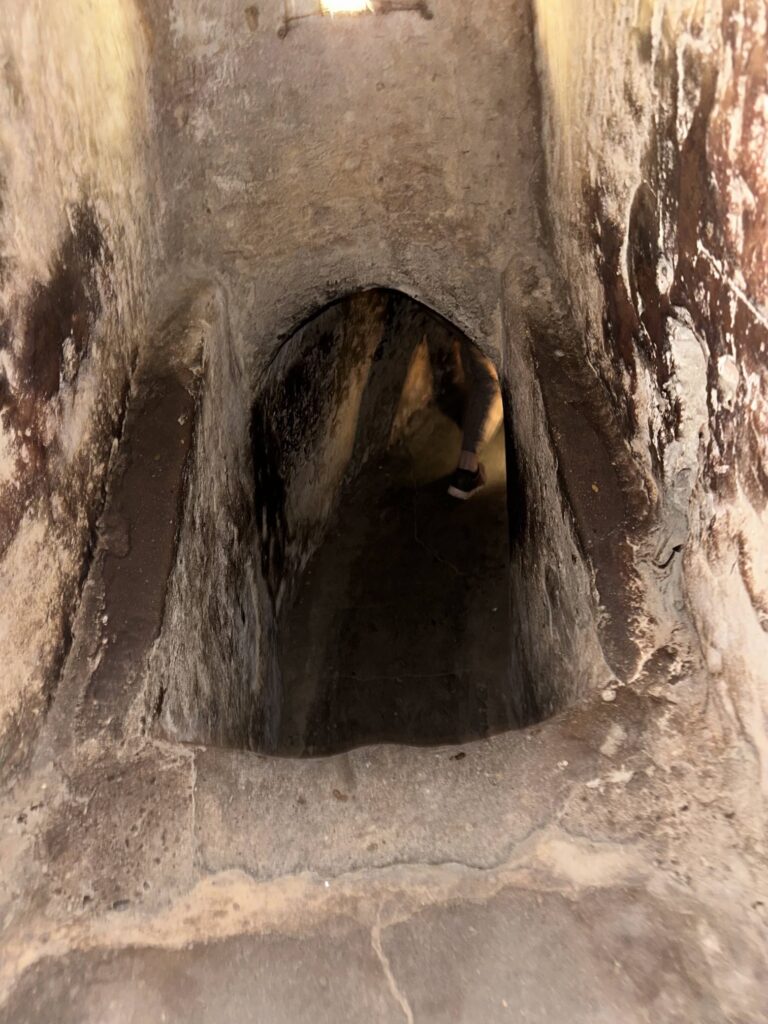
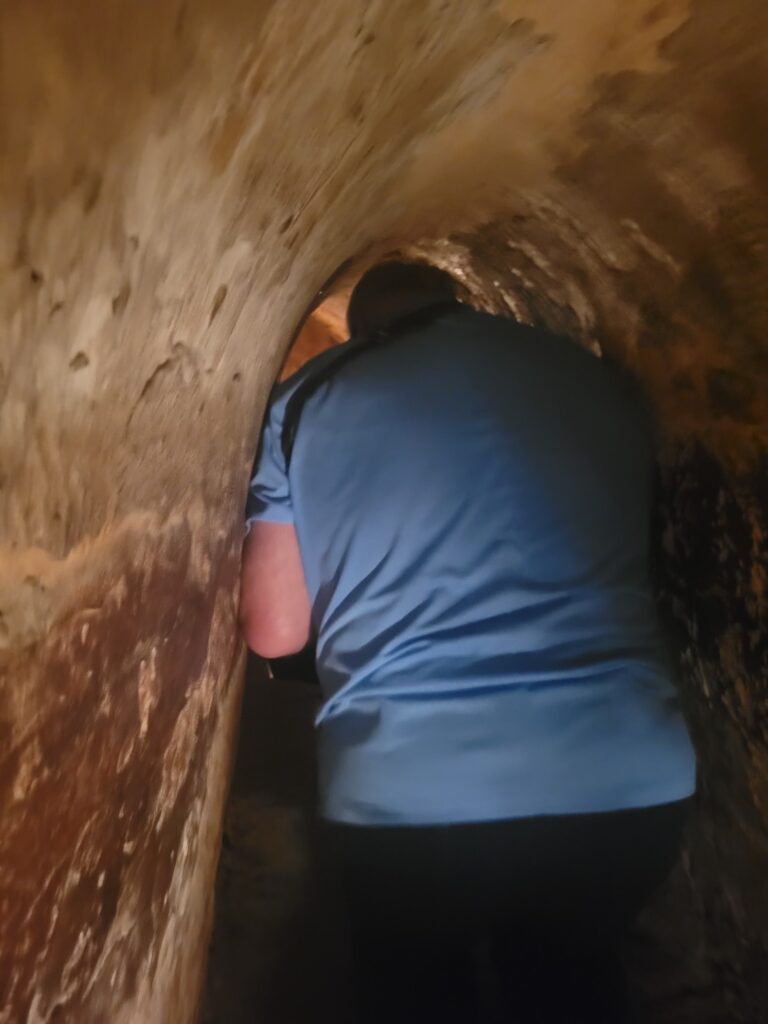
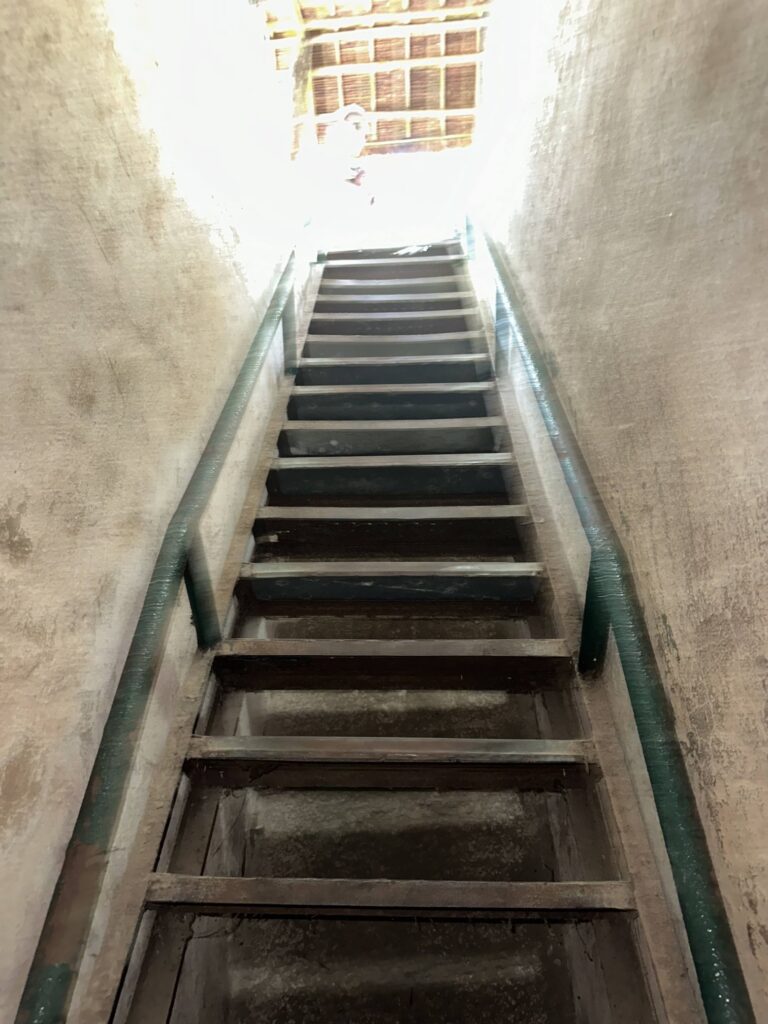
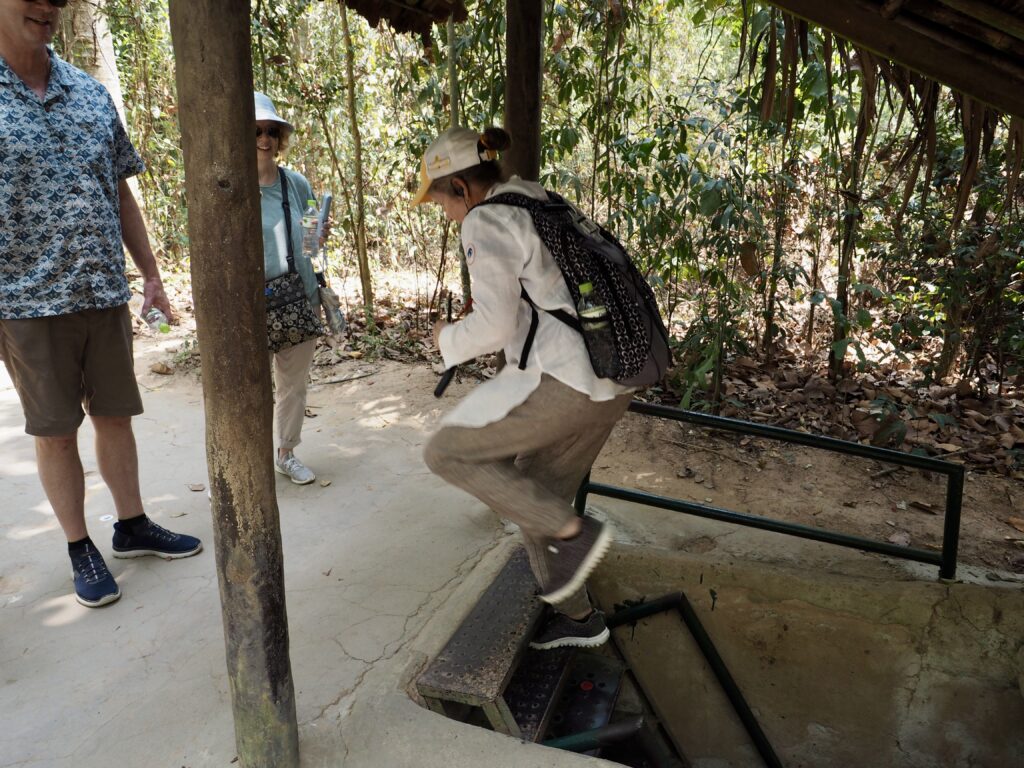
Entrances Were Concealed & Really Tightto a Maze of Tunnels Dug by HandBooby Traps of Many DesignsRiddled the GroundsAnd Fake Termite Mounds Served as Defensive Gun EmplacementsPhoto: Wendy PerklPhoto: Michael HowePhoto: Wendy Perkl
But, it was the labyrinth of deep tunnels with rooms for sleeping and cooking (with elaborate systems to contain and control smoke) that shielded the VietCong from both discovery and bombing.
This deep dive into all-too-lived-history makes us eager to see more of the Saigon we glimpsed earlier in the day, one firmly planted in the 21st century, as unsettling as that sometimes is.
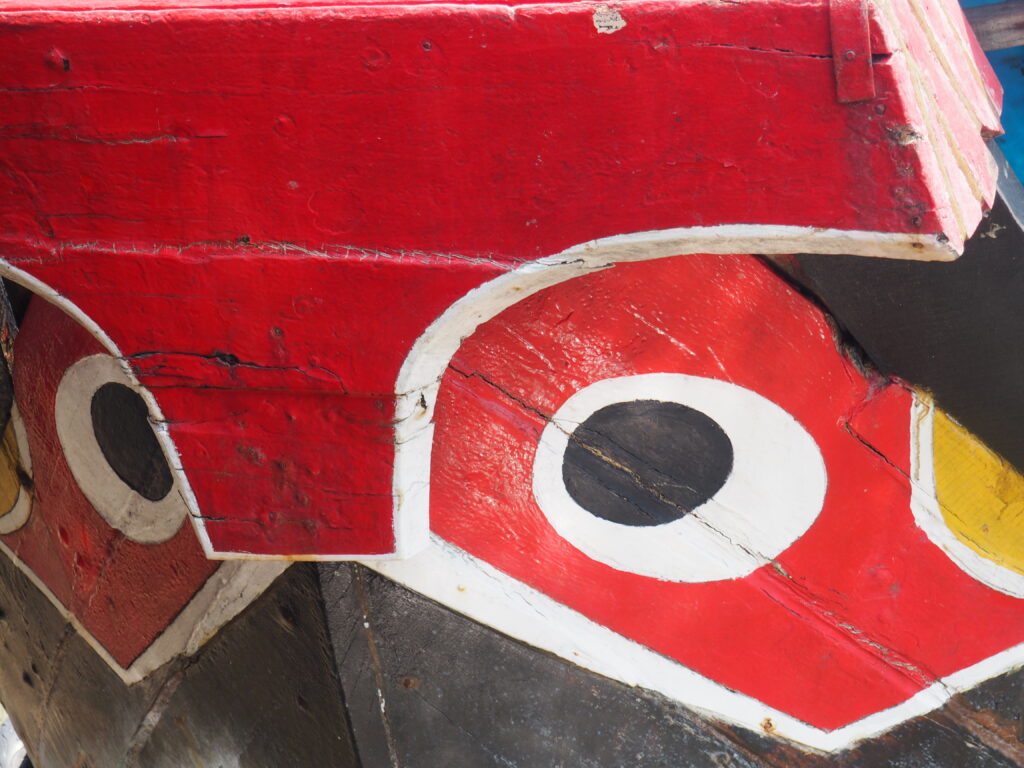
Almost every boat features this intimidating design on the prow.
Heading into the Colonial River Port of Sa Déc
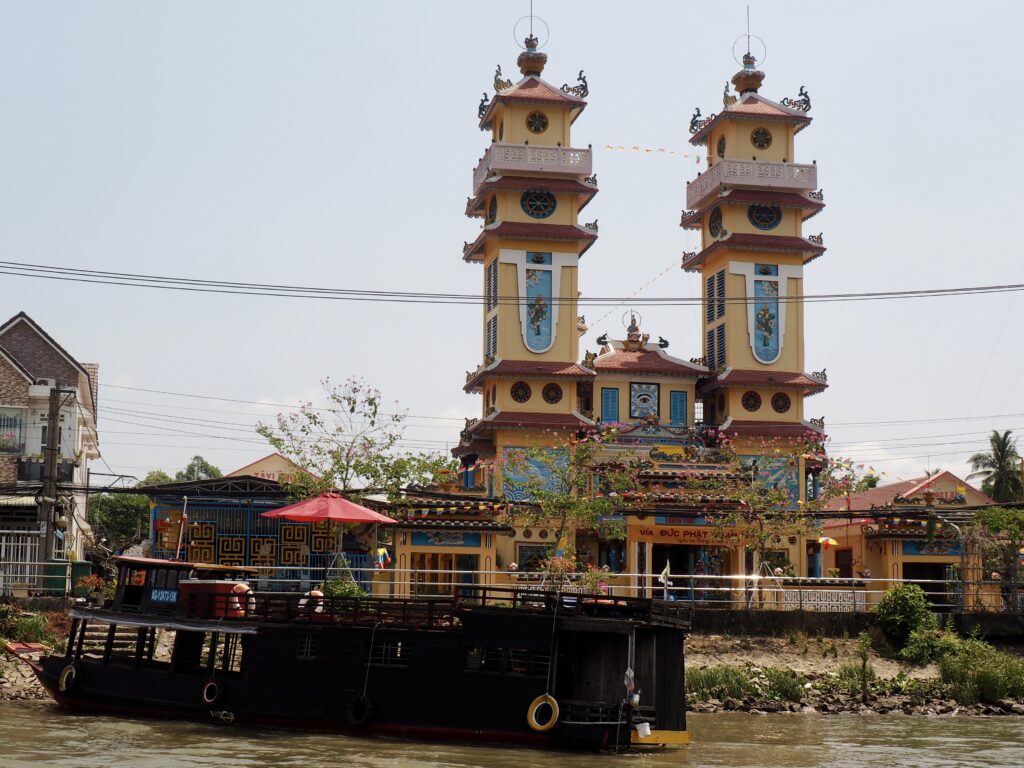
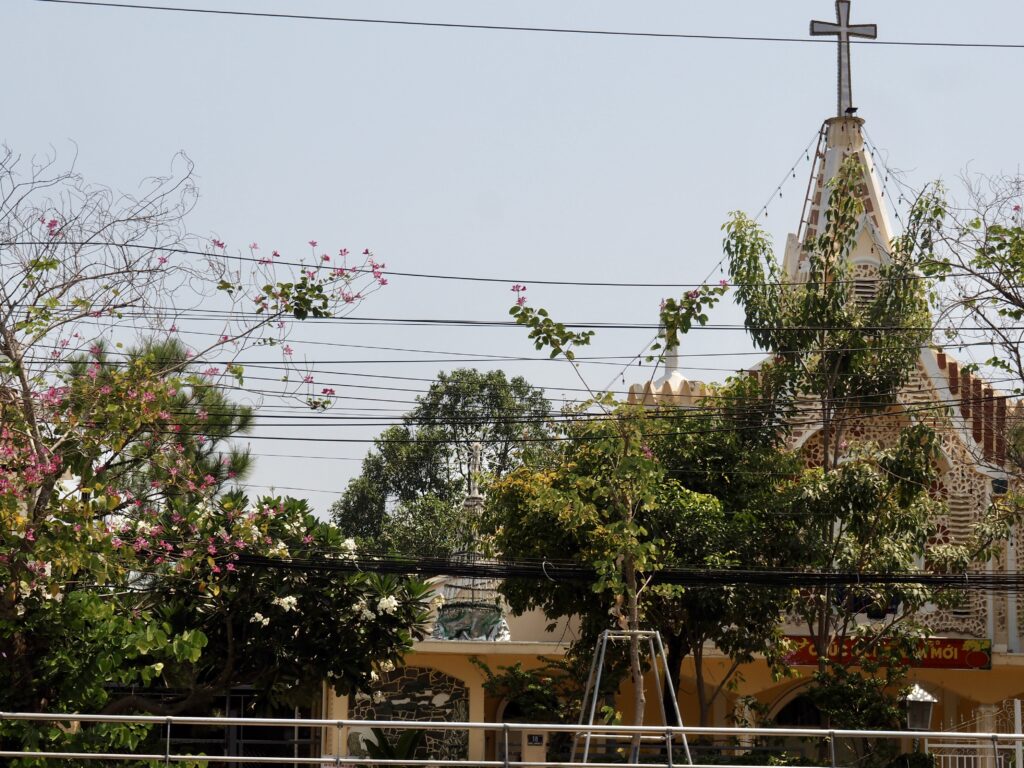
Cao Dai TempleChristian Church
Sa Déc had been one of the largest cities in the delta prior to the 19th century, but has become a rather low key river town with a nonetheless thriving business as an agricultural center and canals extending its reach further inland.
Setting of The Lover
You’ll be forgiven for not being familiar with Sa Déc’s international claim to fame as the town where the real life story behind French novelist Marguerite Duras’ autobiographical novel The Lover played out. Above is the family home of the young Chinese man, son of a wealthy businessman, with whom she had an affair as a half-orphaned, impoverished, French teenager born and raised in Vietnam. His father did not approve. Ah, the scandal, but an interesting house. The Chinese found success in Vietnam as traders and businesspeople, but have been subject to a lot of resentment for their success and suspicion as people from a very powerful neighbor.
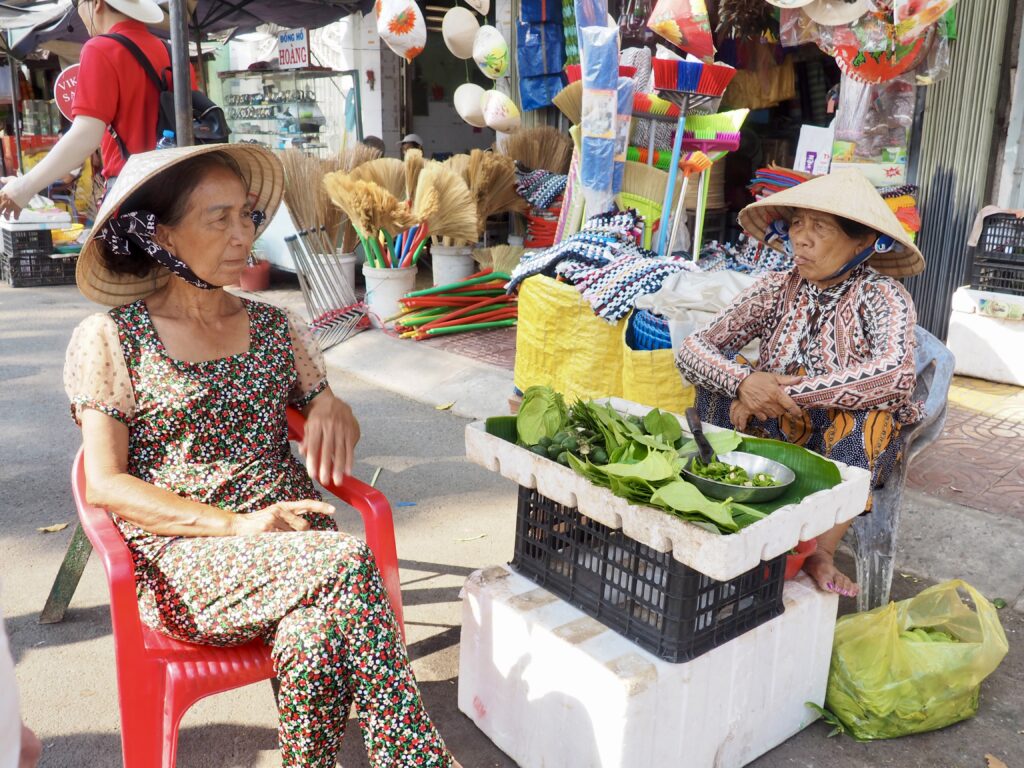
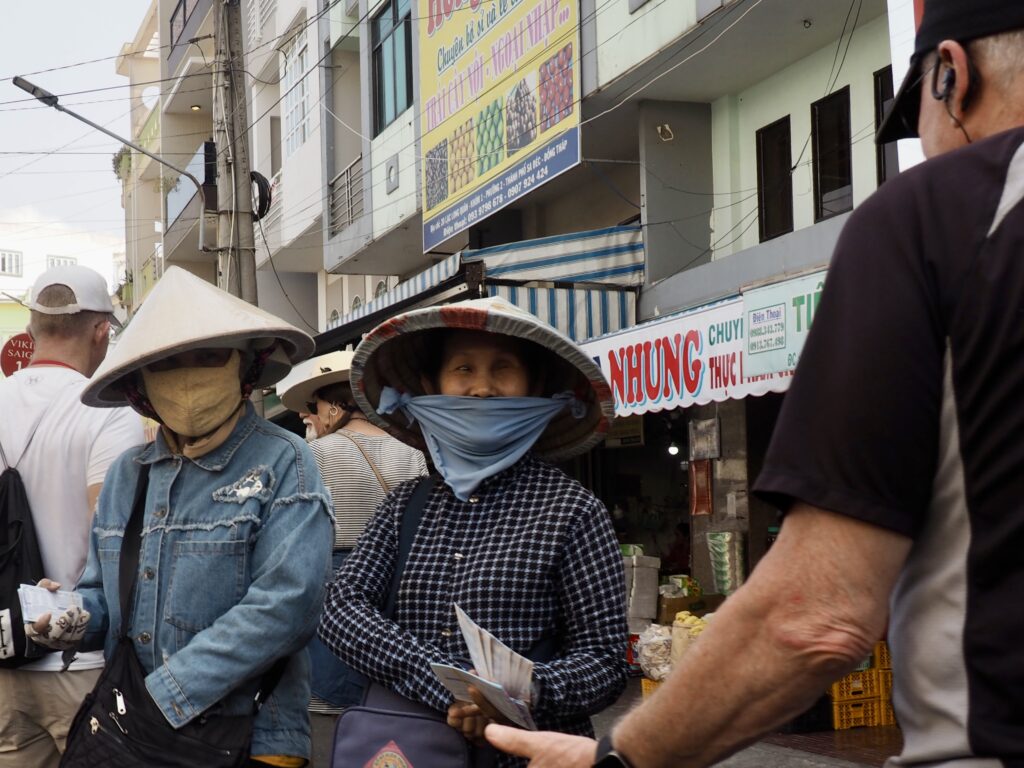
Wandering through the Market in Sa Déc
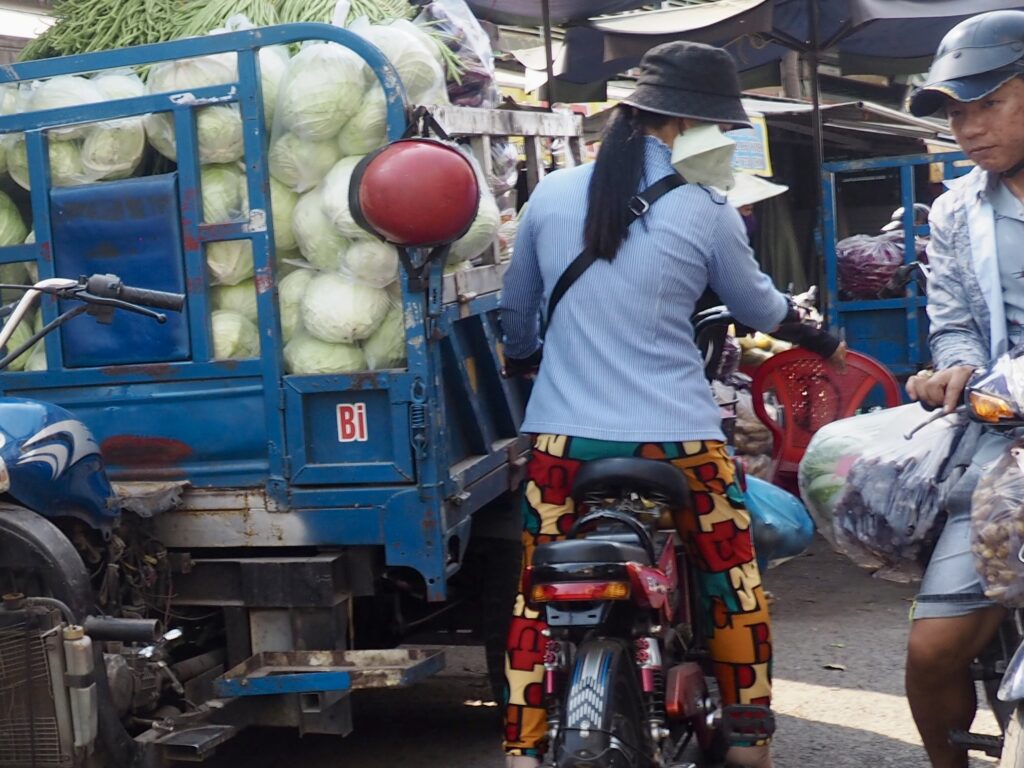
The Street Is a Bit Congested
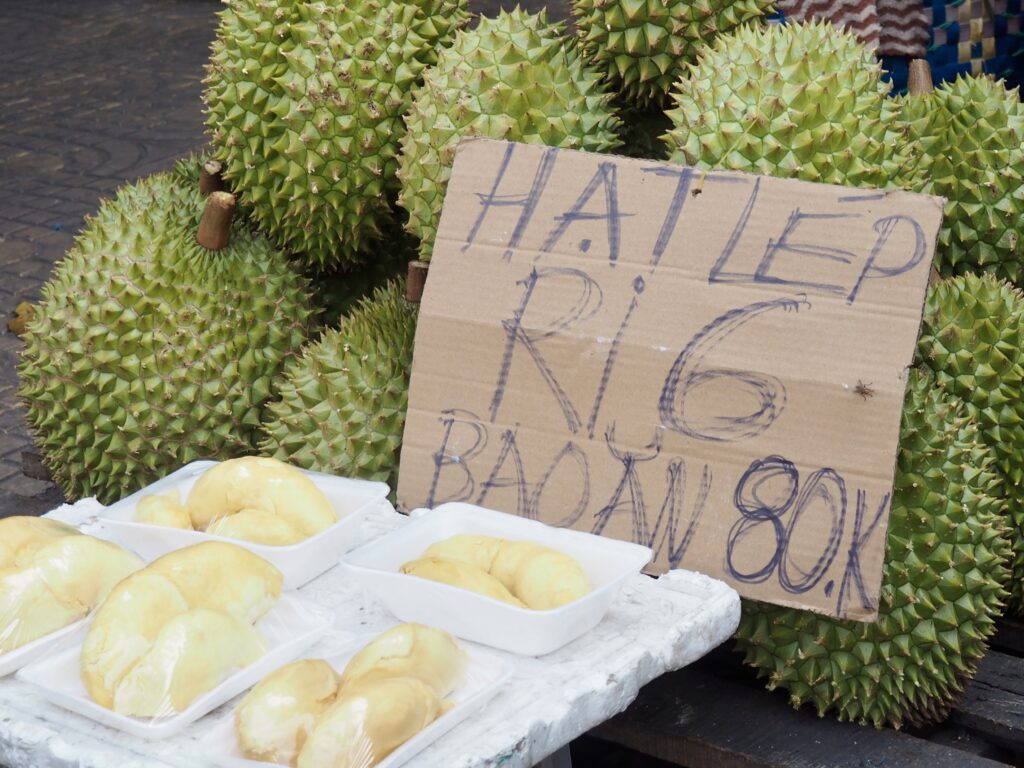
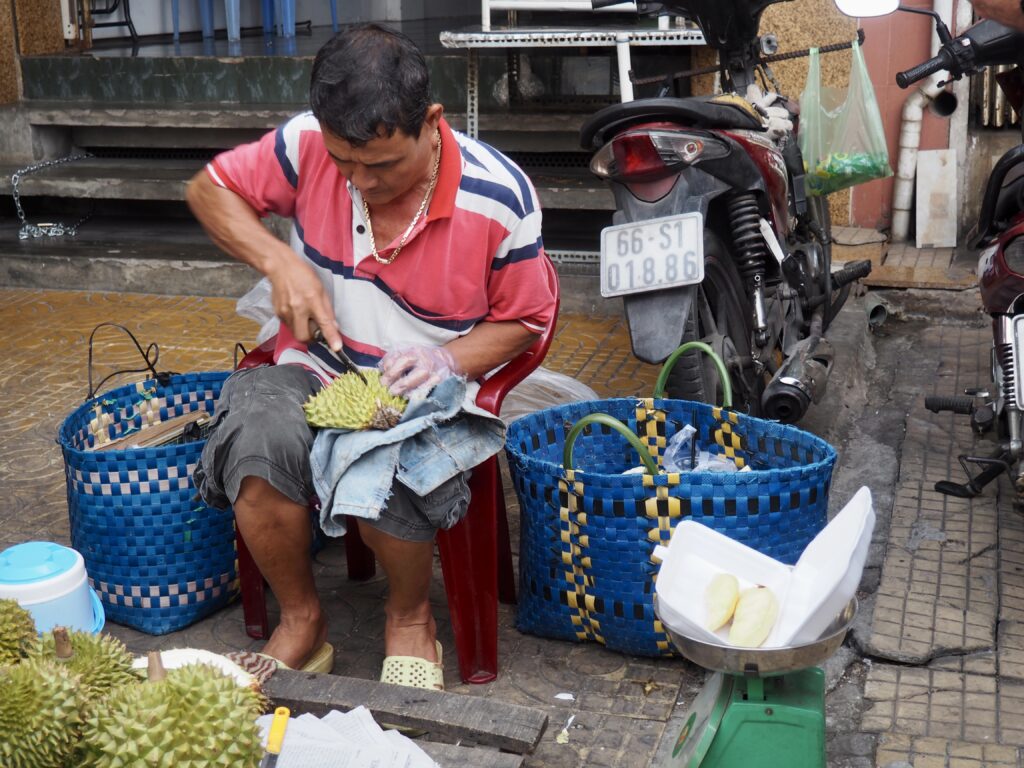
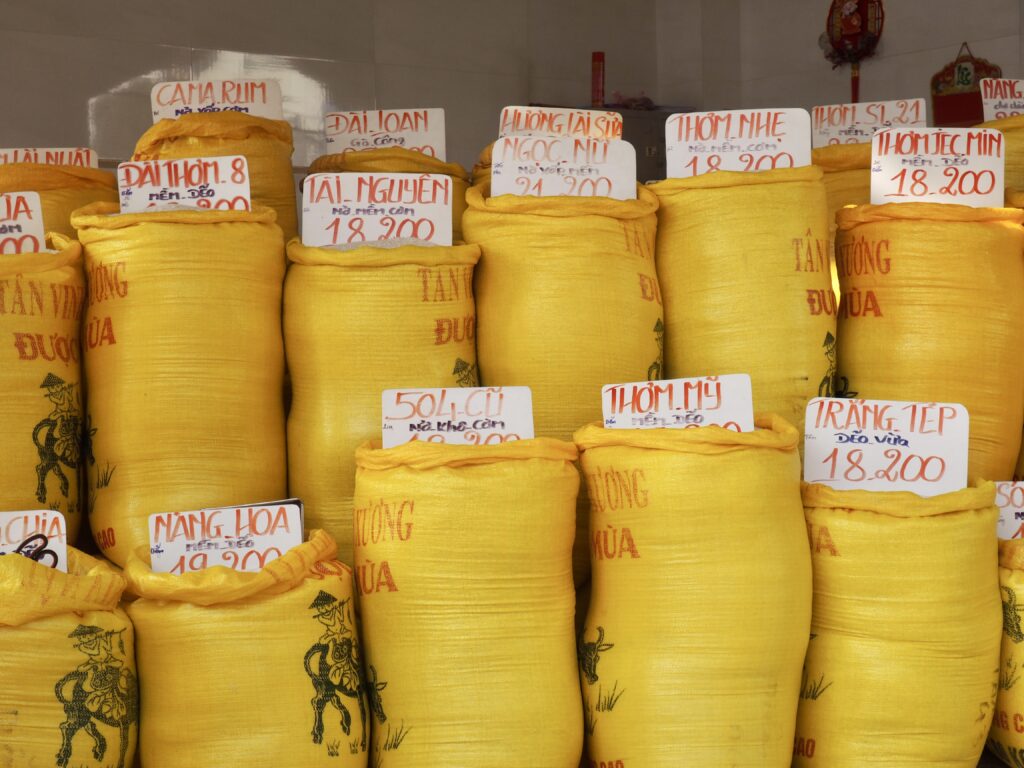
Selling (and enjoying) Betel LeavesFresh Durian Anyone?Preparing Durian for a Customer Selling Lottery TicketsAnd, Which Rice Would You Like?
Stopping by Cái Bè, a Village with Interesting Offerings
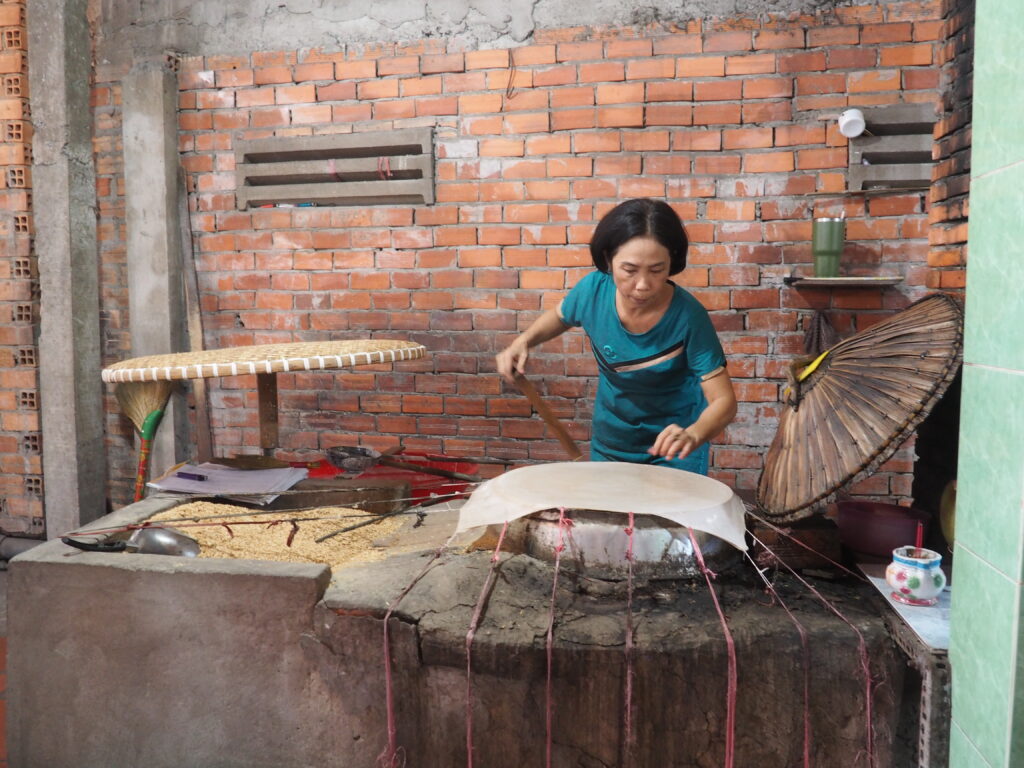
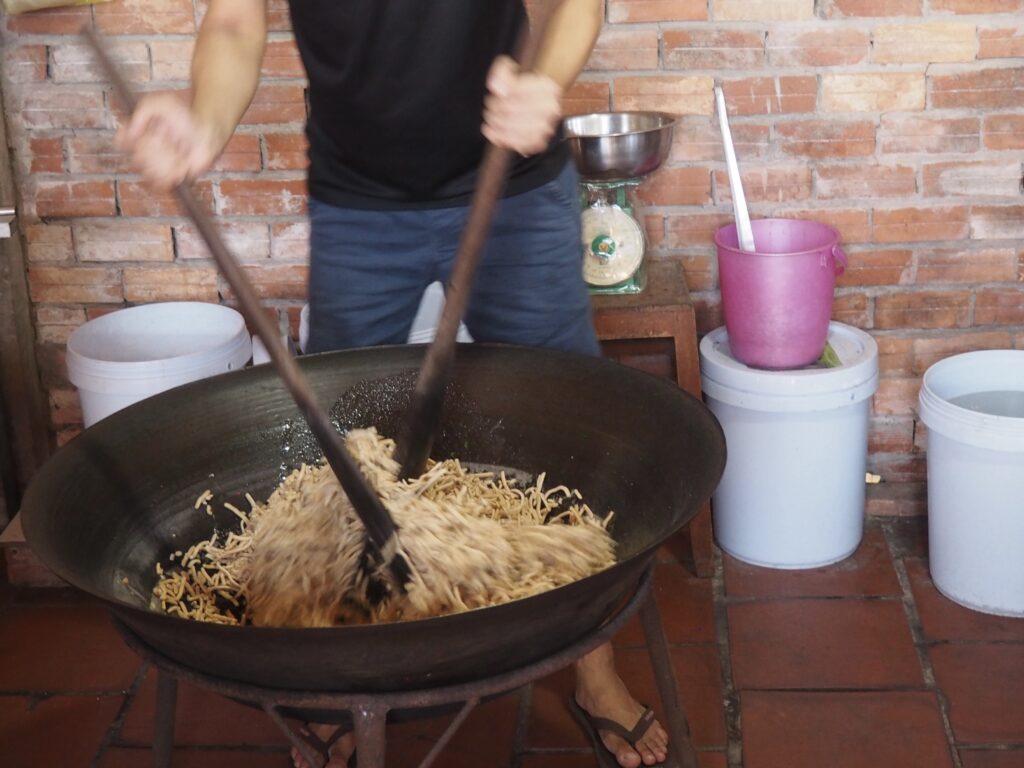
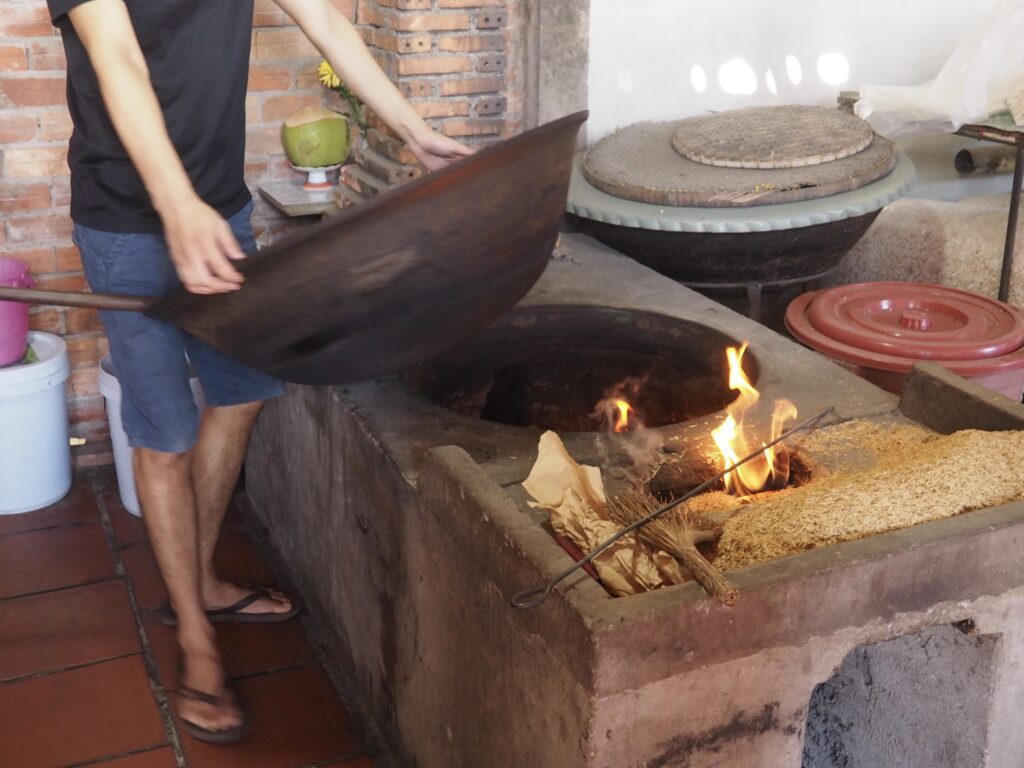
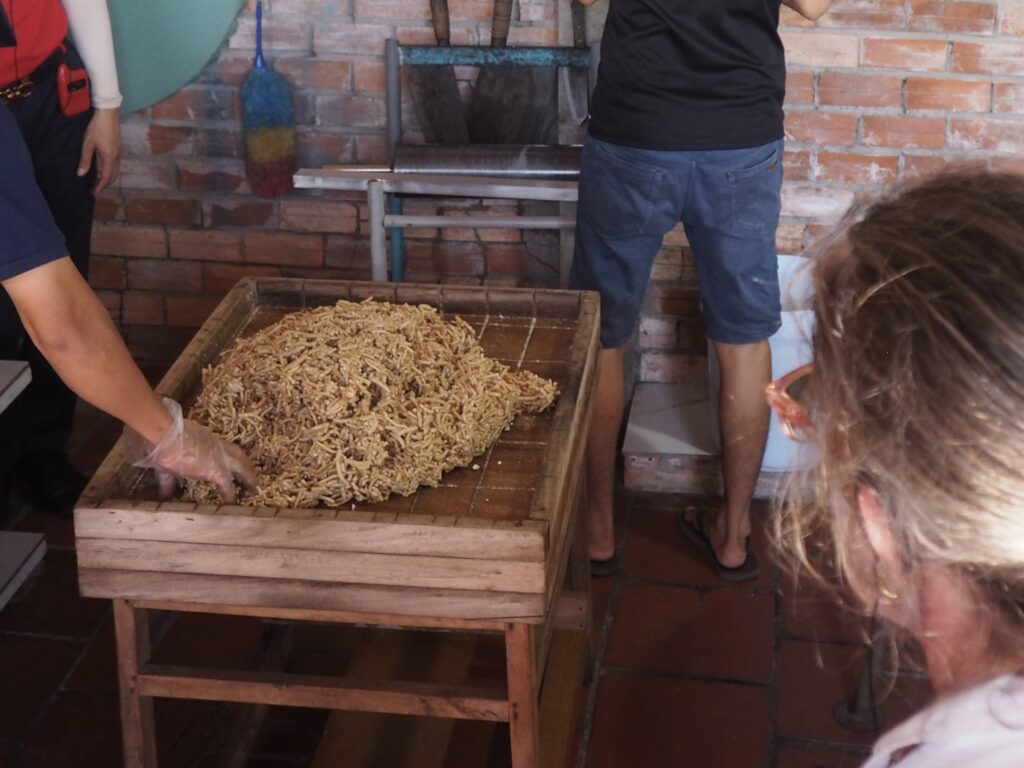
The Cracker Maker
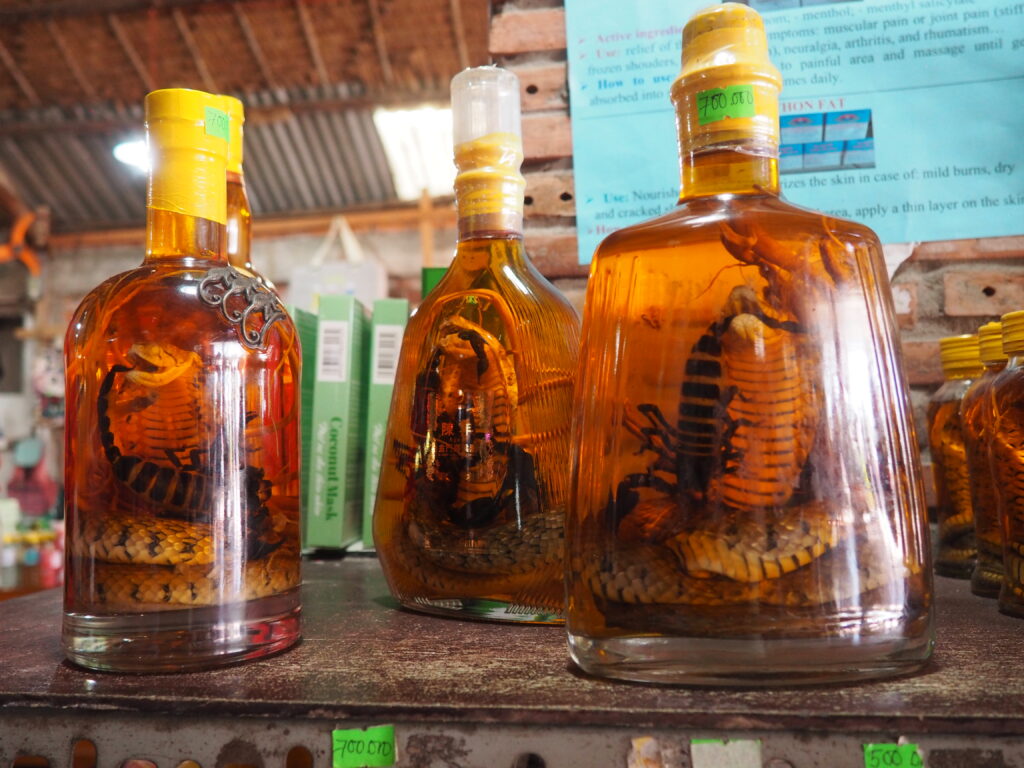
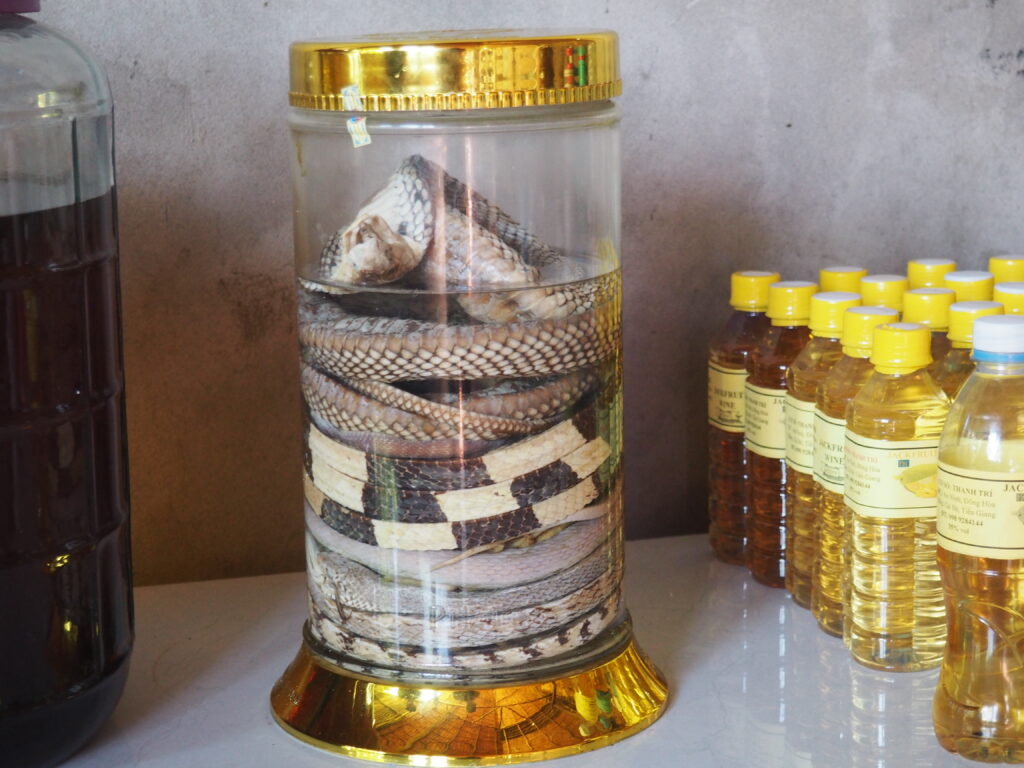
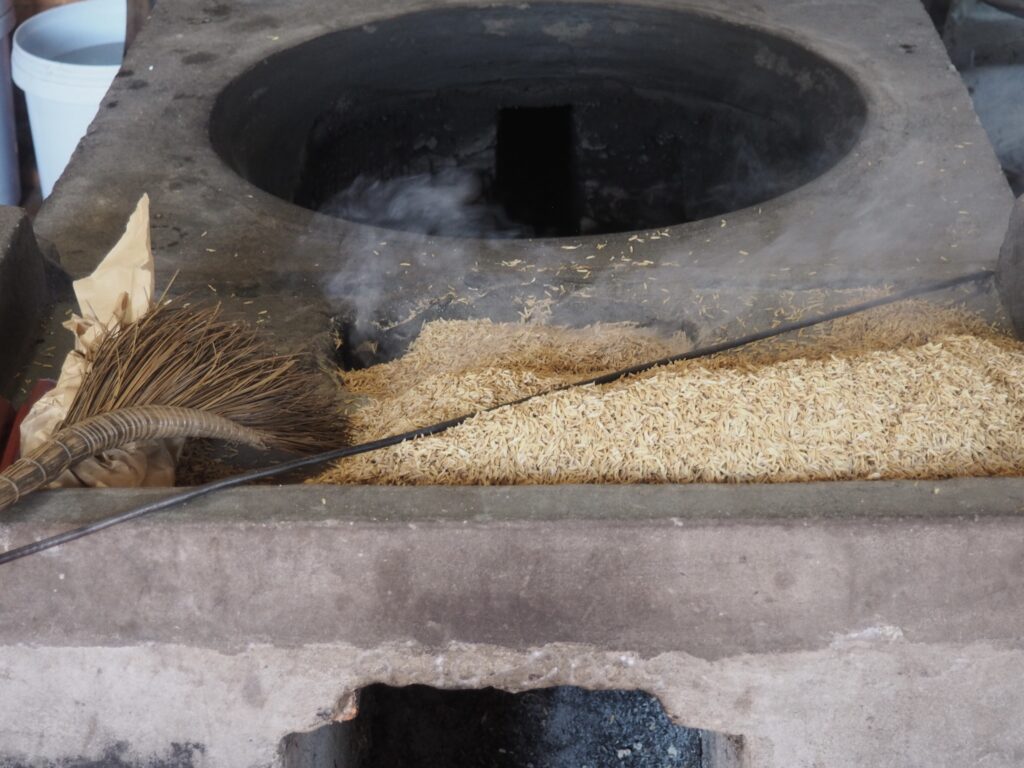
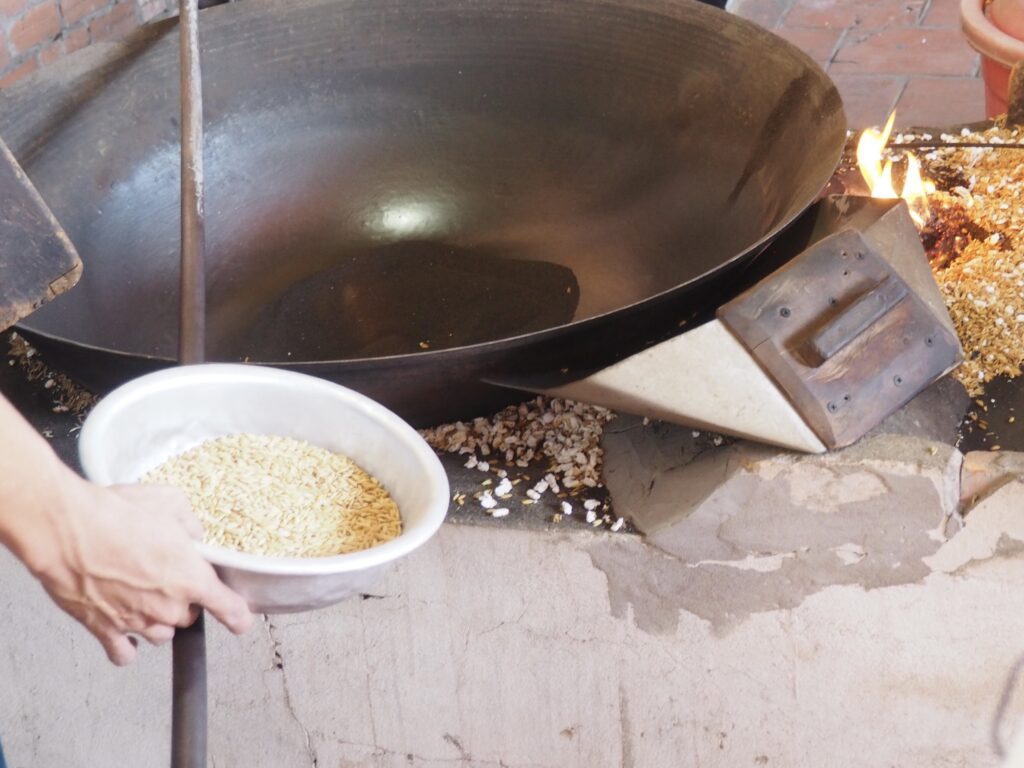
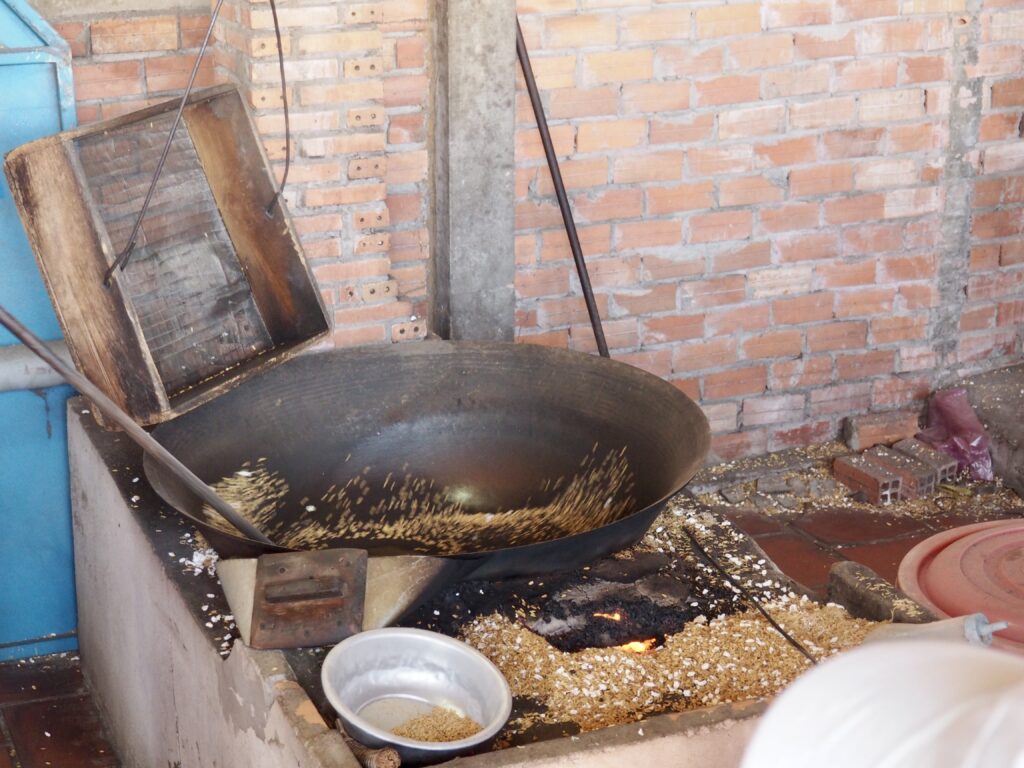
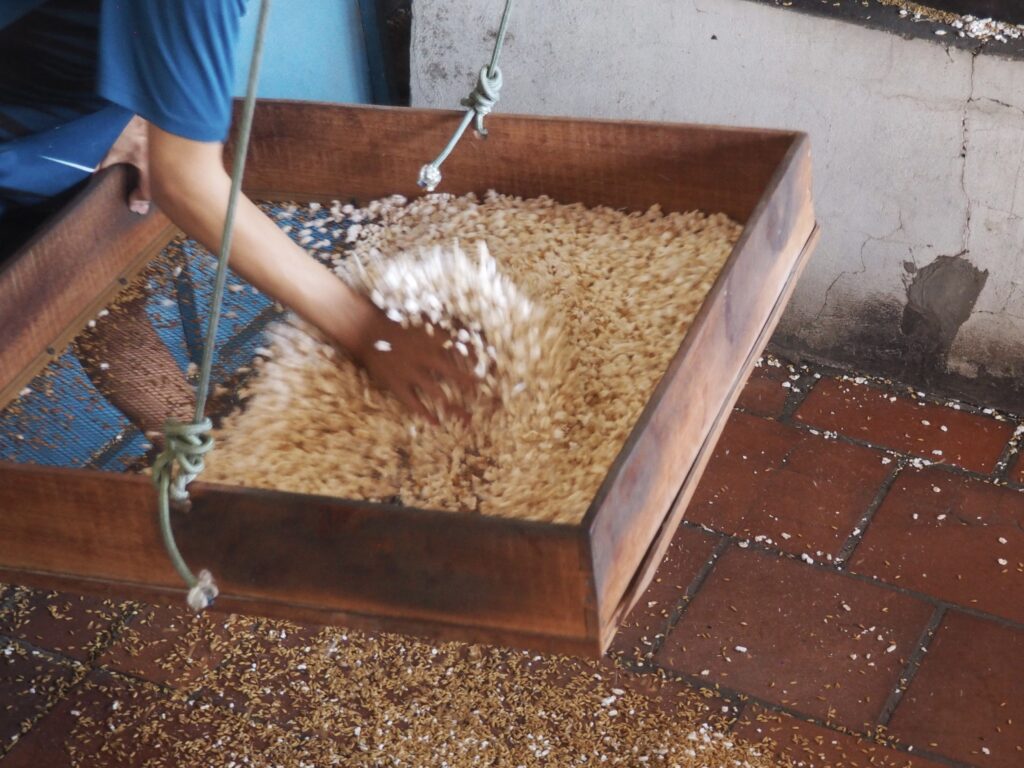
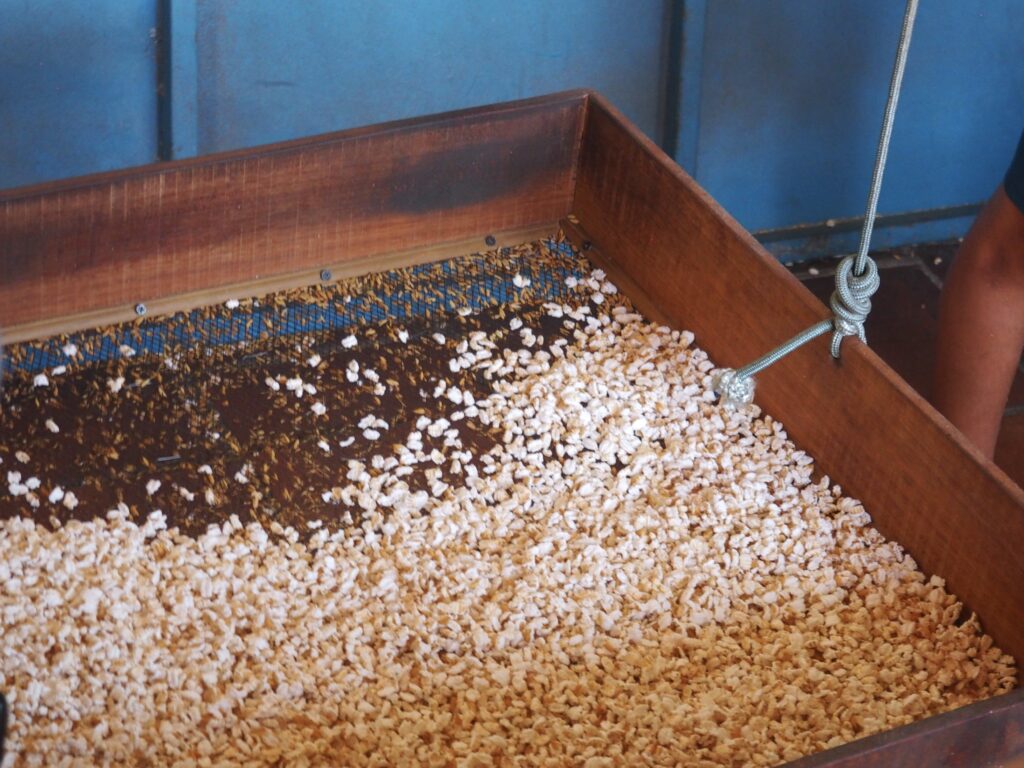
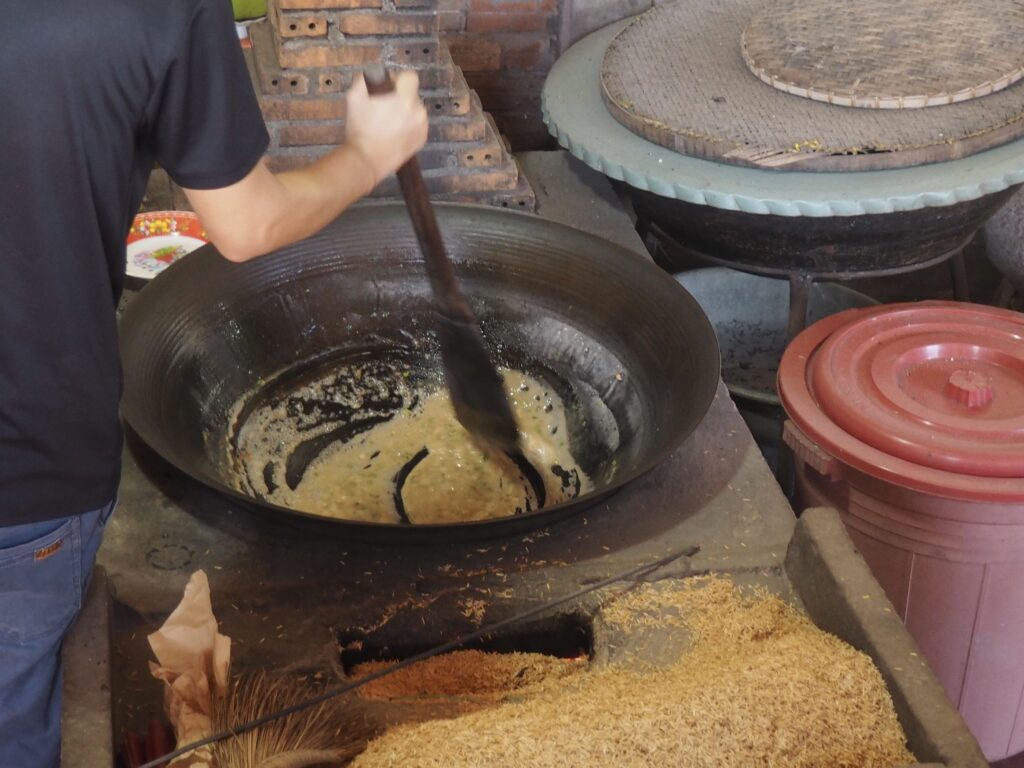
Hootch with a BiteInsufficiently Aged, We’re ToldThe Hard Way to Make Rice Krispie TreatsGet the Pan Quite Hot with a Bit of Oil Add Rice and Briskly AgitateCarefully SieveTo Remove Unpopped GrainsPrepare the Syrup Add Puffed Rice & Mix WellRemove from HeatSpread into Molds, Let Cool, Pack or Serve
Curiously, no one accepted the very kind and multiple offers to try one’s hand at these tasks, perhaps on account of the somewhat elevated temperature in the open air workshop, something around more or less 100°F.
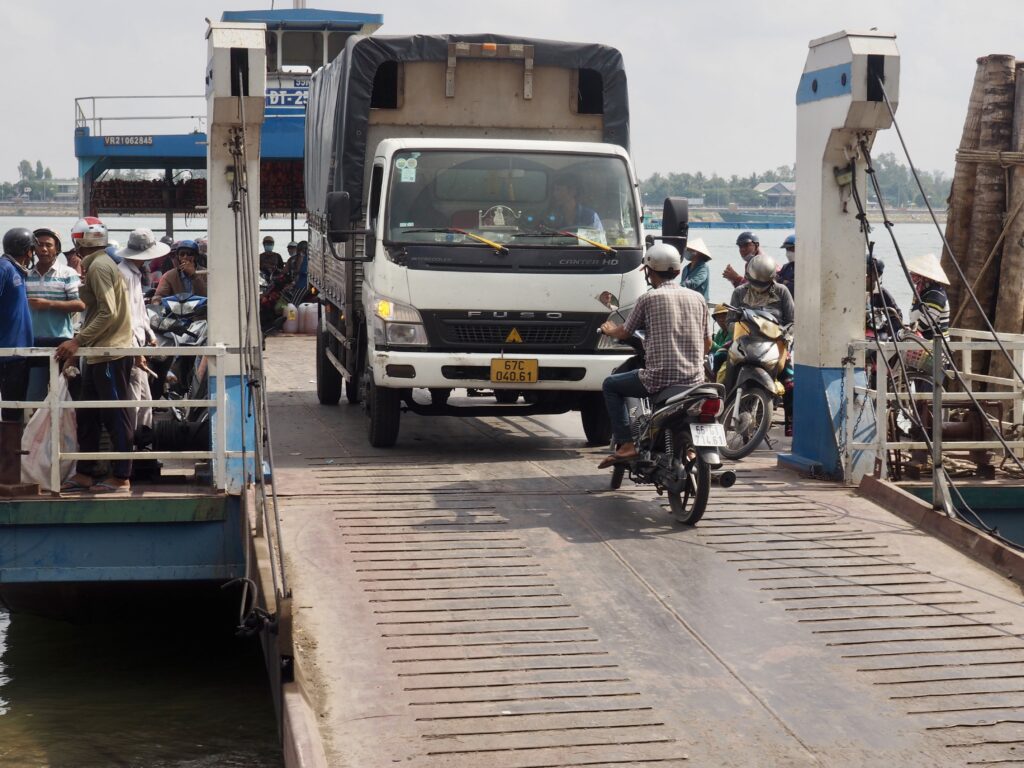
After crossing the border from Cambodia into Vietnam, we take a sampan from the ship and dock near the ferry in the border town of Tân Châu on the Mekong (or Nine Dragons) River.
Photo: Chung Nguyen
“Are you sure this is a good idea?”
Another wild ride takes us through the streets, making our contribution to the local economy.
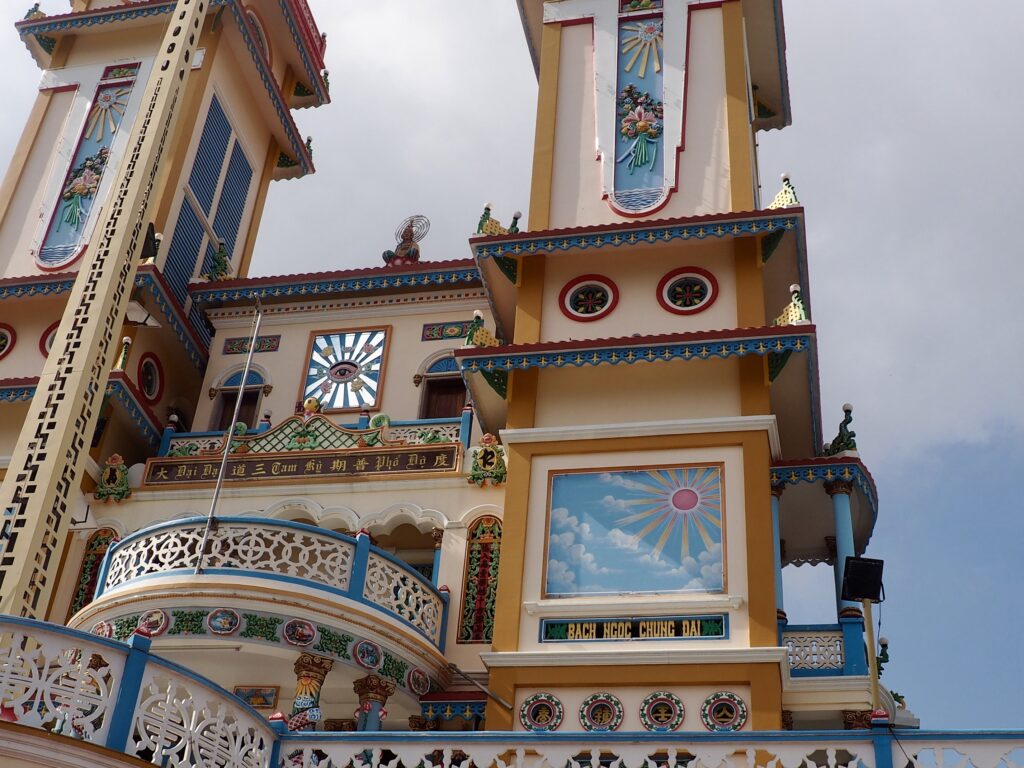
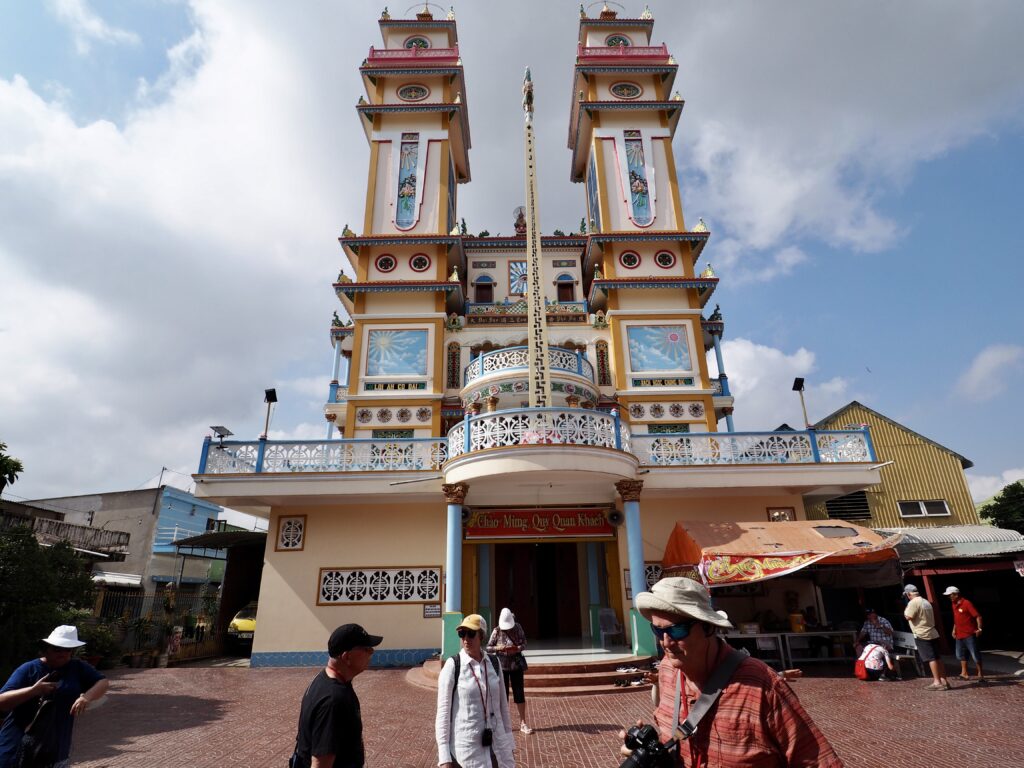
There was a Cao Dai temple along the main street fronting the river. Founded in Vietnam in 1926, the religion is fascinating, a sort of mashup of world religions that includes Victor Hugo and Confucius among its saints and has an organization like that of the Roman Catholic Church. Here’s a short explanation: https://www.britannica.com/topic/Cao-Dai
There was lots to see on the water . . .
. . . including a visit to a floating fish farm that takes advantage of the tremendous volume of water coursing down the river.
We also motored to Vinh Hoa island for a visit to some small scale farms,
and a small village (where ramps allow you to wheel in motorbikes when the floods come)
where we were invited inside (upstairs, above the space for hammocks, as well as the pen for the cattle)
and then headed back down to our sampan waiting in the canal behind the house to take us back to our ship.
A View Leaving Phnom PenhSand, dredged from the river bottom, is a significant export.
We leave Cambodia with the popular mask dance about the monkey king from the Ramayana, apparently originating in the time of the Khmer Empire which has engendered some controversy between Cambodia and Thailand, both claiming it as a unique part of their intangible cultural heritage (per UNESCO status), the Cambodians pointing out that it came to Thailand only after their sack of Angkor. Ahh, politics.
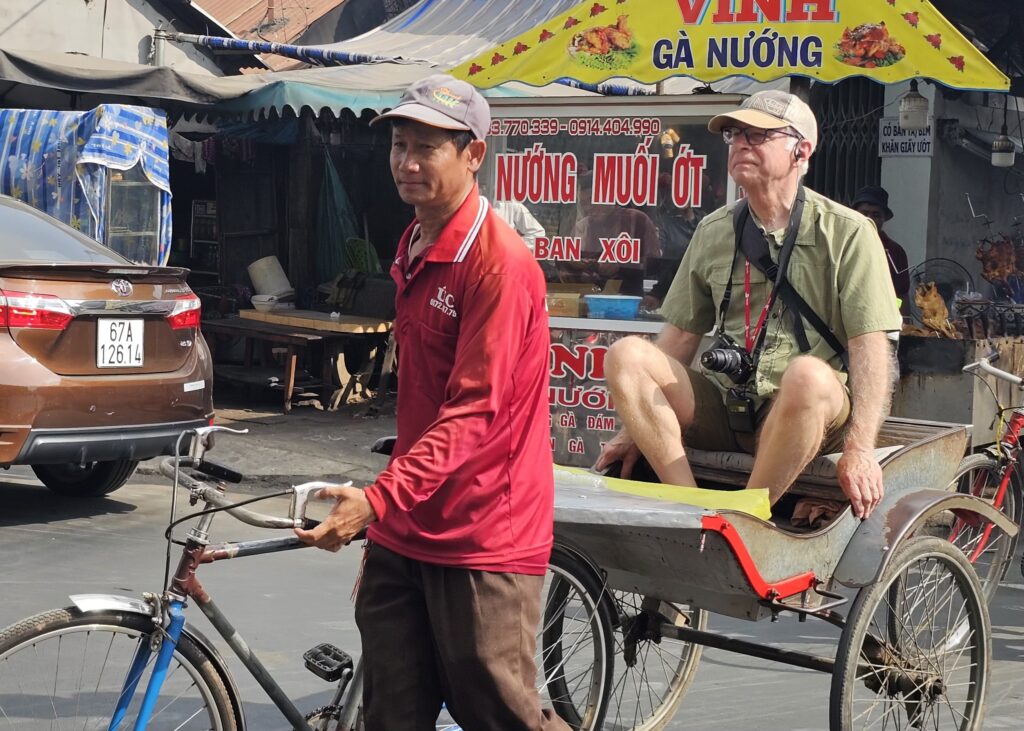
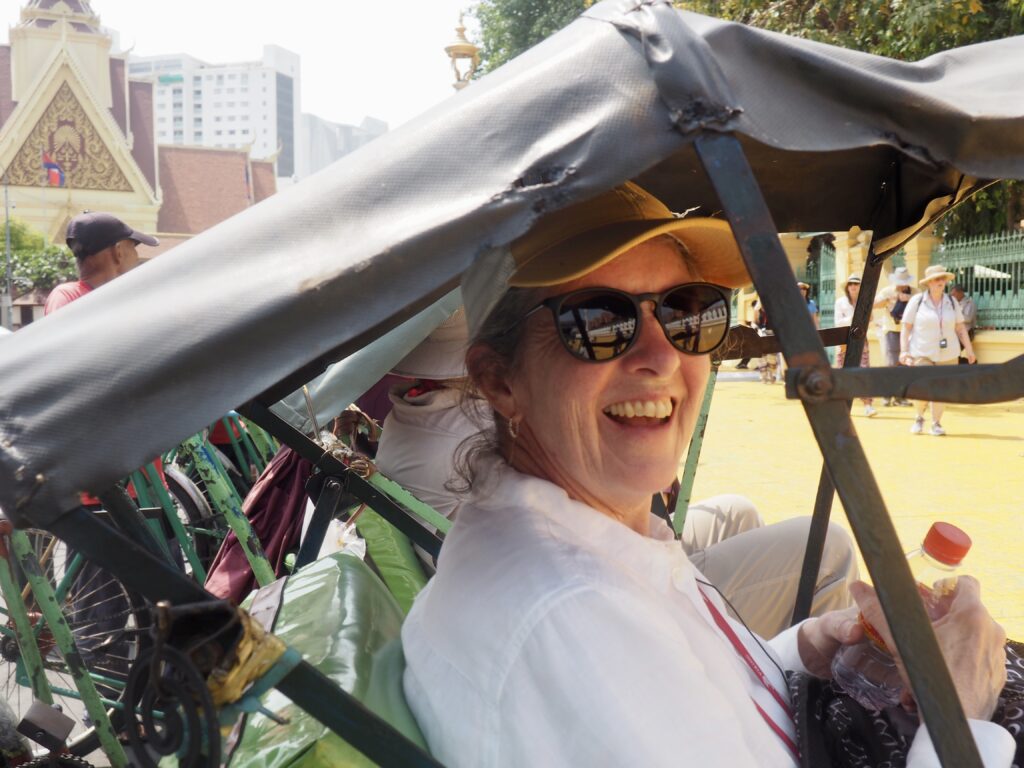
It’s quite a sight, 75 pedicabs swarming through a major city, but everyone takes it in stride. And, it’s a great vantage point for the passenger.
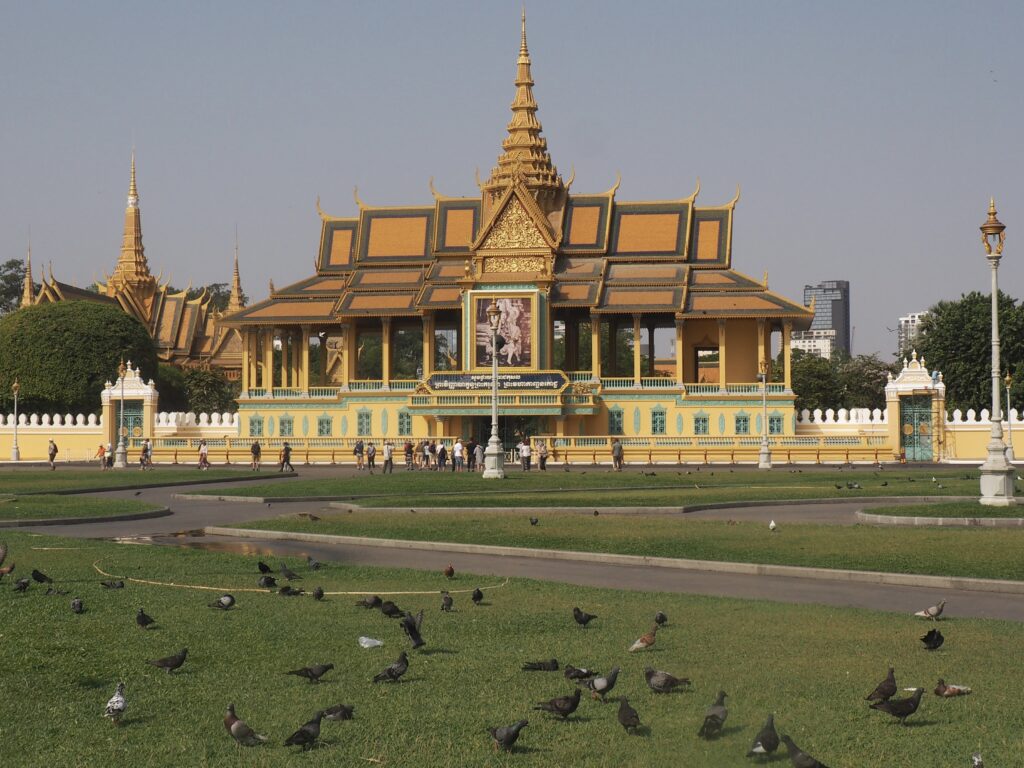
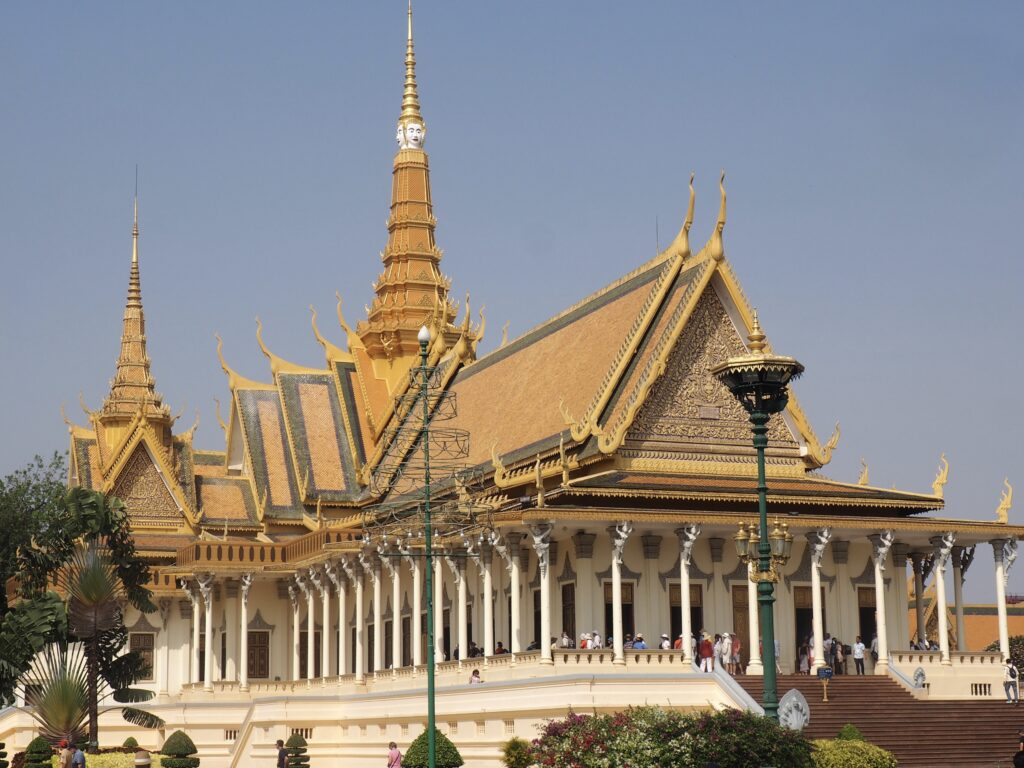
First stop, the Royal Palace. Although not a center of power, the Royal Family remains a source of identity, pride, and loyalty in this one-party state.
Every day of the week has its own color, if you didn’t know.
Shrine to Norodom Sihanouk
The most revered figure in political Cambodia is, of course, Norodom Sihanouk (known to history as Prince Sihanouk), the King who single-handedly achieved independence for his country in 1953 (having been underestimated by the French), nearly a year before Ho Chi Minh achieved the same for Vietnam, maintaining a strong monarchy in the face of historic trends. He dropped what he called his “atomic bomb” in 1955 by abdicating the throne in favor of his father and then forming a political movement (rather than party) to continue to dominate politics. That his rule and closeness to the Chinese then led to the rise of Pol Pot is his political tragedy.
We found Wat Phnom on a walk into the city on a hilltop in a lovely park (not far from Starbucks). It’s a temple pagoda apparently from the 14th century, although repeatedly rebuilt, named after a Lady Penh who pulled a tree from the river with five statues in a hollow, four of Buddha and one of Vishnu and convinced the townspeople to create a hill and the temple. It’s absolutely gorgeous and comes with a great view.
Spirit house at Wat Phnom. Spirit houses are outside most homes, businesses and temples to attract spirits away from where people want to be left in peace.
We found Phnom Penh to be a surprisingly rewarding place to walk around and our ship was docked (obviously) right there on the river. (Yes, that’s a huge clock and the rabbit – for the year recently ended – is made of bamboo.)
We rejoined the group for a trip out to Udon Monastery.
Udon or Udong, some 40 kilometers northwest of Phnom Penh was a royal residence and capital from the 17th through much of the 19th century and now houses a beautiful Buddhist monastery where a monk offered a blessing to travelers.
It is also a place where older people, both men and women, may go to live out the remainder of their lives in monastic retreat to achieve their spiritual objectives. There were quite a number of people visiting the monastery to visit with their parents or other family members. Our local guide, who had spent 8 years earlier in life as a monk (as do a large percentage of men), shared that he would also like to return to a monastery towards the end of his life. (The women in the photos were pleased to speak through a translator and didn’t mind having their photos taken, although it felt awkward for the photographer. Their quarters are small, but neatly kept.)
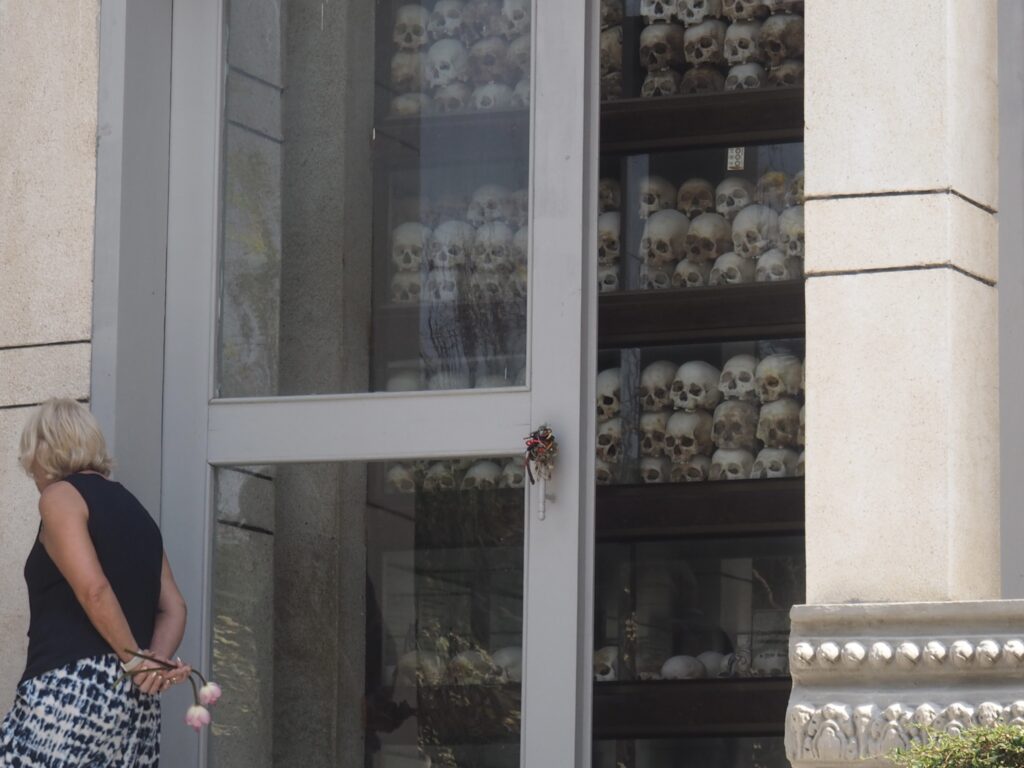
Buddhist Stupa with More Than 5,000 Skulls Exhumed from the Killing Field of Choeung Ek
The unlikely victors of a civil war against an American backed regime, the Khmer Rouge under Chinese protege Pol Pot seized power in 1975 and proceeded to carry out a plan to transform the country into an egalitarian nation of only farmers, eradicating the educated classes (in other words, an even more ruthless version of the Cultural Revolution, which ended only with Mao’s death in 1976). One quarter of Cambodia’s population died or roughly two million people, of which estimates range from half a million to more than a million by execution. Phnom Penh was evacuated and the people turned into farmers, by force.
Choeung Ek is the best known of the 300 Killing Fields, more or less, and 8,895 bodies have been recovered there. Human bones and tatters of clothing can still be seen on the ground.
As many as 20,000 people were tortured and executed at the Tuol Sleng detention center (one of up to 200 such centers), including both Cambodians and foreigners accused of being CIA. One of only a handful of survivors (and a witness at the genocide trial) is there to speak about his experience.
Our local guide spent much of his childhood at a refugee camp across the border in Thailand where they relied on airdrops of food and supplies for survival. His family fled when they grew concerned that his father’s lies about his occupation would no longer hold up, as more and more people in the village could point a finger and expose him as a teacher. Any education, soft hands, or ability to speak a foreign language, for instance, could be fatal. He took on the identity of a barber.
In 1979 the Vietnamese, with backing from the Soviet Union, invaded and removed Pol Pot from power. A handful of officials were put on trial and convicted of genocide. However, many officials complicit in the genocide remain in power.
The population of Cambodia is now roughly 17 million, although the country continues to suffer from the tremendous loss of an educated class which either fled the country or died there. Our guide was able to obtain an education, including with advanced degrees, and founded a substantial school to teach English and computers in his home village, supplementing the local school. Not much has changed politically as the same people who were Khmer Rouge remain in power and this remains a one party state, though with the apparent rewards of a capitalist economy. So, as our guide advised, the one most important freedom is the freedom of silence and he himself can just as easily be a mechanic, as he was during the pandemic, as a highly educated guide for foreigners.
Almost every house is elevated on pilings to protect from flooding, provide a shaded space below and better air circulation in the quarters above, and to provide a sheltered outdoor living space during the monsoon season.
Selling Sticky Rice and Mung Bean Baked in BambooThe Bamboo Makes a Convenient PackageIt Has a Slightly Smoky Flavor
To supplement their income in the dry season, farmers prepare a roadside treat by baking sticky rice and mung beans in bamboo. Actually, it tastes quite good.
We Arrive at the Mekong
This bamboo bridge (of which you’re seeing only a short segment) is rebuilt every year. One of Many Fishermen’s Homes
Our tour through Cambodia and Vietnam includes making our way down the Mekong River (known by the Vietnamese as the Nine Dragons River) from north of Phnom Penh until we disembark in the delta on our way to Ho Chi Minh City. The height of the river varies markedly by season and, traveling towards the end of the dry season, our ship docked well below street level, providing an odd perspective. Jim wasn’t crazy about the catwalk.
Phnom Srey & Phnom Pros
Woman with Trowel (in her right hand)
Not far from Kampong Cham, Cambodia, are two hills topped with temples facing each other from half a kilometer away. In between lies a garden of Buddhas. Legend has it that in times past the women and the men of Cambodia had a contest to determine who must ask for the other’s hand in marriage. The men would build one hill and the women another and whoever could build the tallest hill by the time the sirius star should appear in the night sky would have the honor of being asked by the other to join in marriage. It was the women who played a trick by hanging a lantern so high the men mistook it for the star and laid down their tools so that the women’s hill would stand taller.
It was the garden of Buddhas that enchanted us. We later learned online that the temples were destroyed in the terror of the Khmer Rouge and rebuilt and that this had been one of the many “killing fields” of that not-so-distant time.
The bodhisattva Lord of Compassion (see Angkor post)?
Silk Island
An Island Village Dedicated to SilkFrom EggsTo WormsWhich Form Their CocoonsFrom Which Come the Silken ThreadsCarefully Wound into SkeinsAnd Woven Into Cloth
On an island in the Mekong River just north of Phnom Penh there’s a village which has for generations devoted its energies to cultivating the silk worm and weaving that silk into luxurious fabrics. The fabrics are, in fact, quite beautiful and come in various grades, including those woven also with cotton.
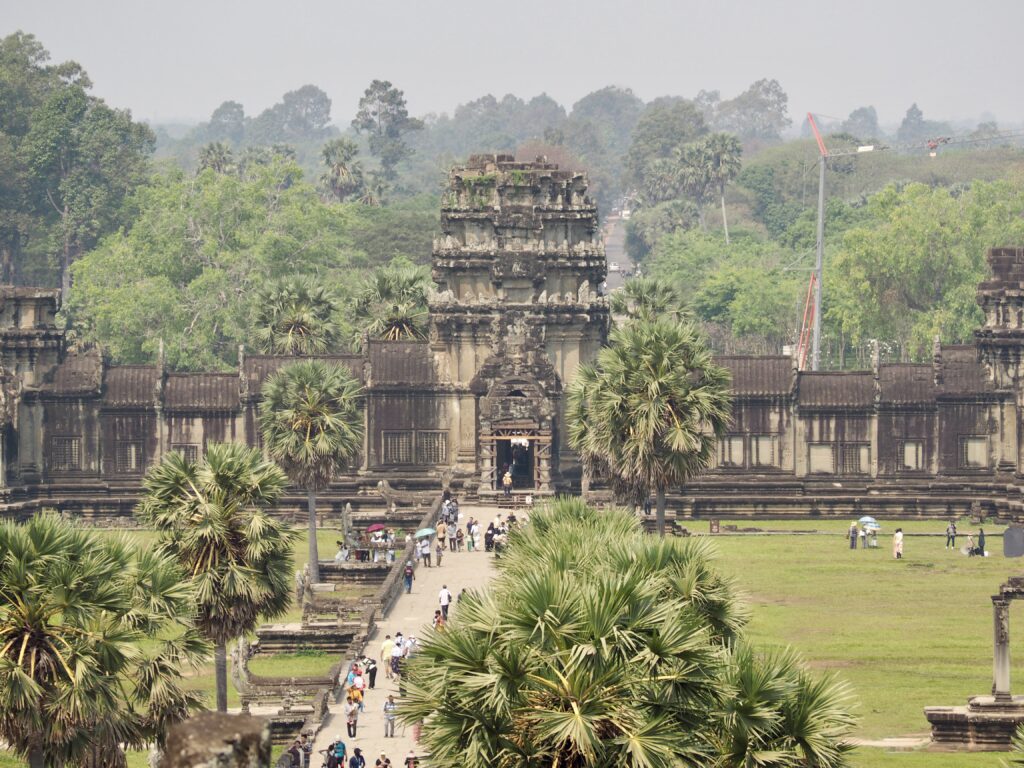
Deep inside Cambodia up the Tonlé Sap river that flows in two directions depending on the season and just north of the huge and bountiful freshwater lake of the same name with its floating villages is Angkor, an agglomeration of temple cities serving as the capitals of the Khmer Empire that dominated Southeast Asia for hundreds of years and occupied a landscape larger than present day Paris with as many as a million people living there amidst imperial grandeur from the early ninth century until its sack by Ayutthaya (a Siamese [Thai] empire) in 1431. This largest pre-industrial city in the world (by territory) had extensive infrastructure to support its population, including a sophisticated water management system to stabilize, store and disperse water to compensate for the unpredictability of the monsoon season. Its more than 1,000 temples lie scattered across the present forested landscape in various states of preservation and repair (constructed with far more stone than used in all of ancient Egypt), the most famous and iconic being the temple city of Angkor Wat, the only building depicted on a national flag.
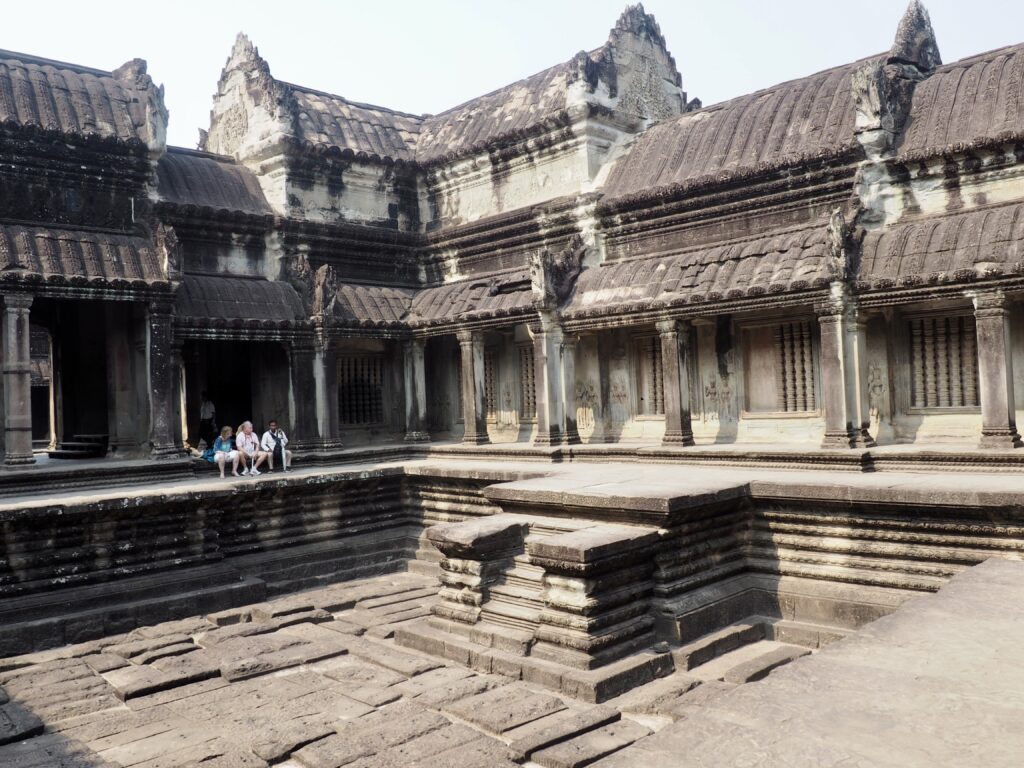
Angkor Wat
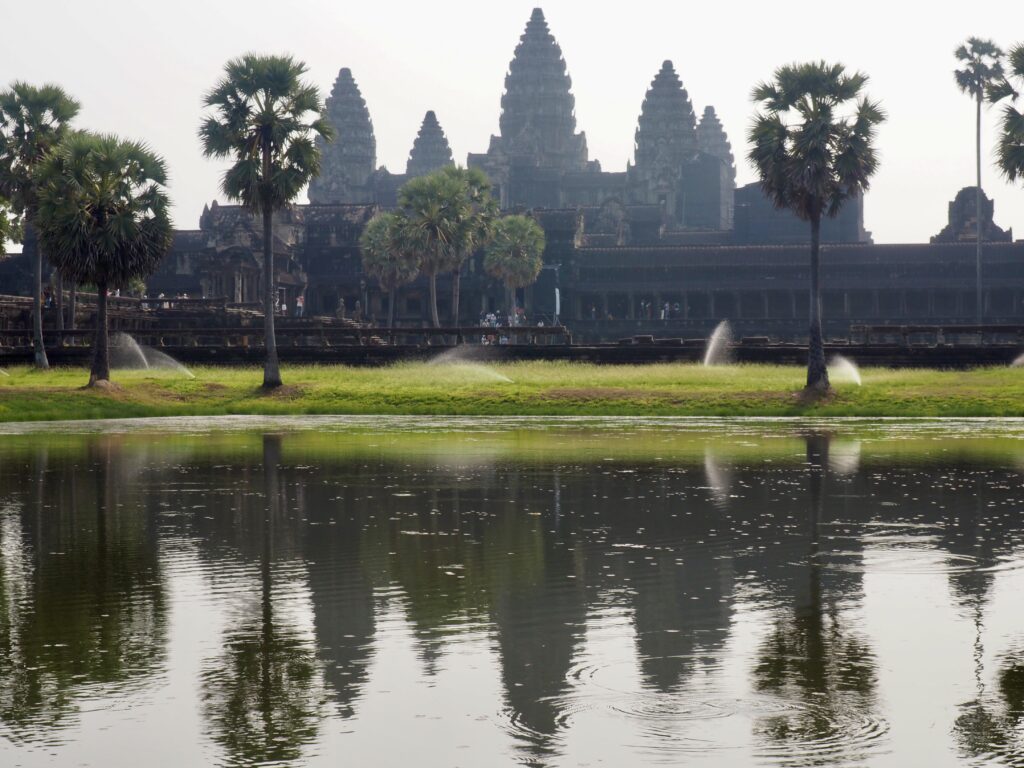
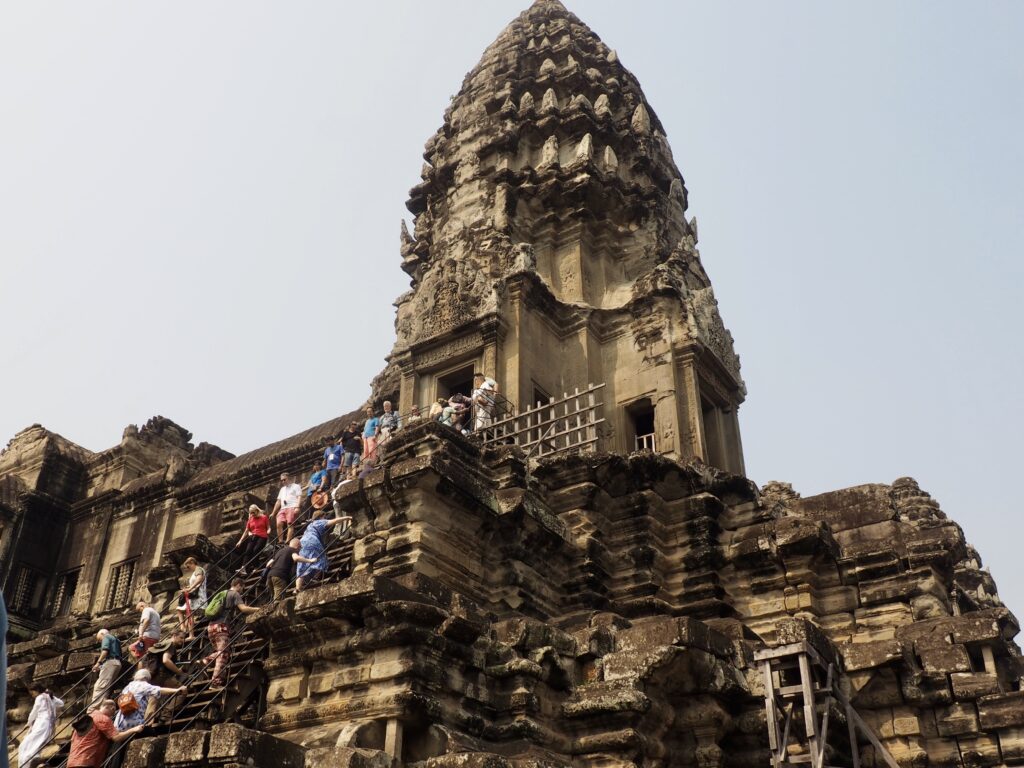
The Classic View of Angkor Wat with the Five Peaks of Mount Meru
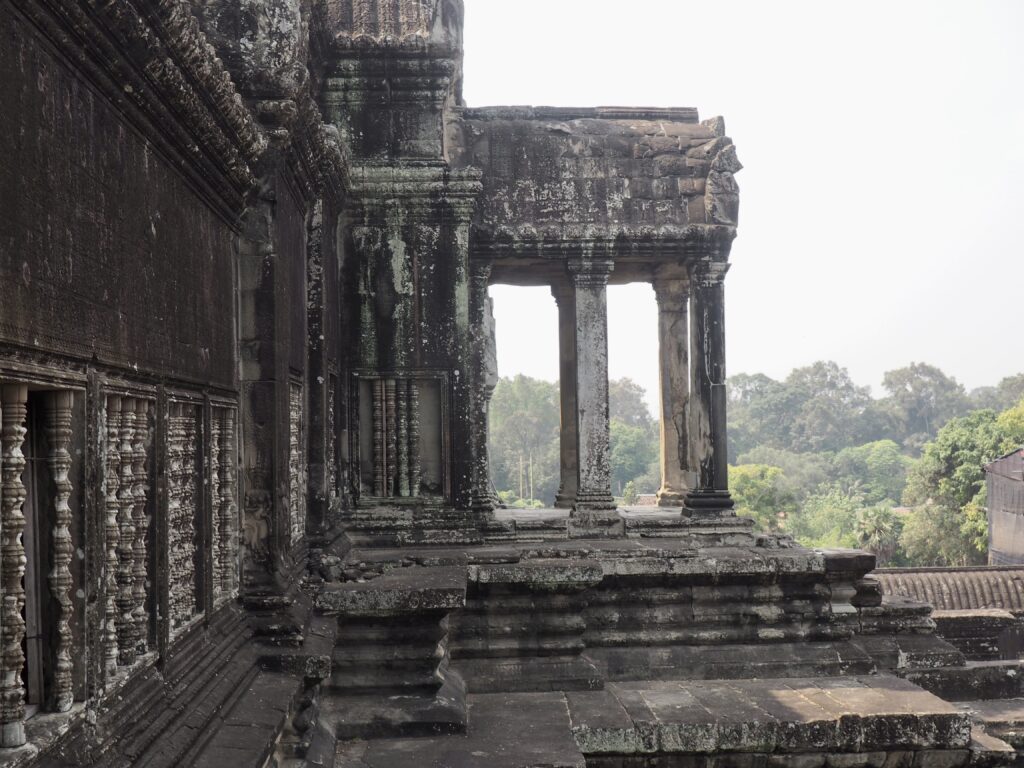
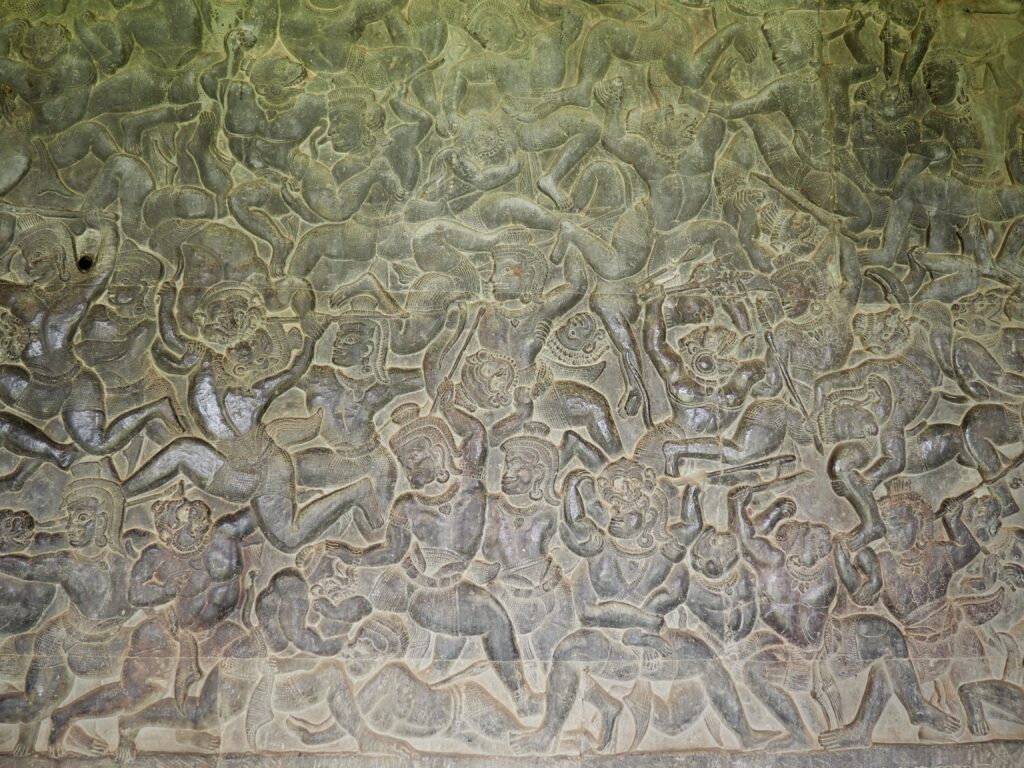
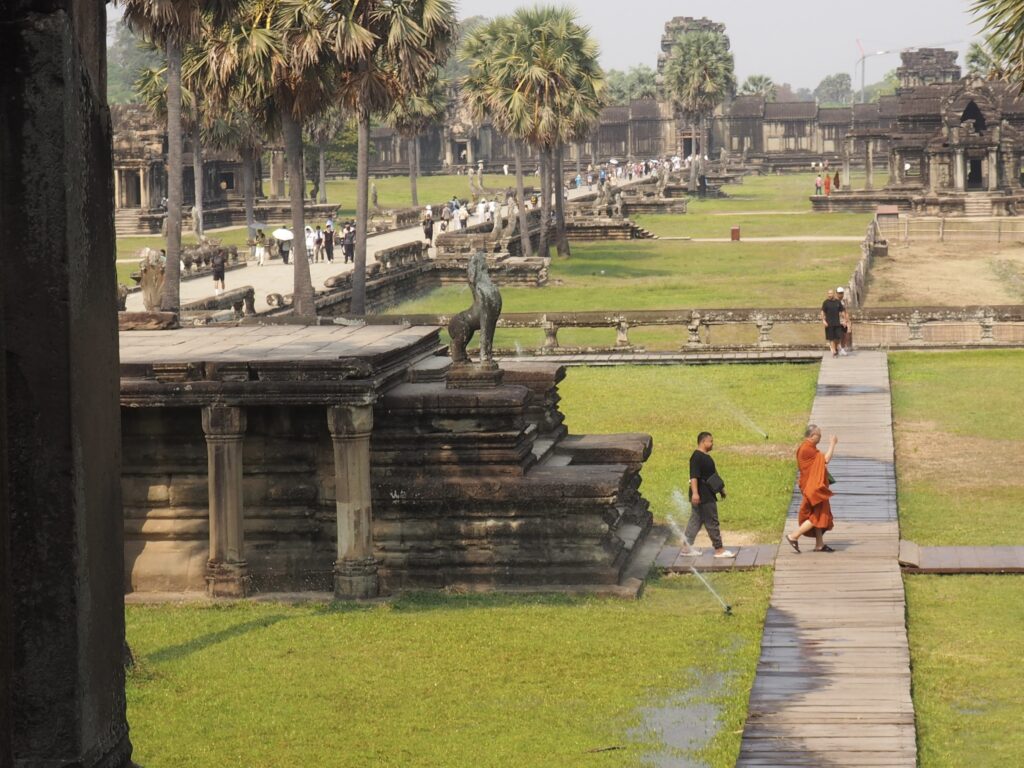
This largest religious structure in the world was built in the early 12th century as a Hindu temple dedicated to Vishnu and then adapted to serve as a Buddhist temple towards the end of the same century, so it retains both identities. The architectural layout is based on the Hindu and Buddhist idea of Mount Meru, the five-peaked mountain at the center of the universe. It is surrounded by an enormous moat that’s more than 3 miles long and which may represent, again, the universe surrounded by water. There are also very long galleries of bas reliefs depicting, for example, scenes from the Ramayana. But, we’ll allow the photos to speak, as all that remains are manipulations of landscape, human compositions in stone, a few travelers’ tales, and the continuous habitation of a handful of monks.
(STEPS DOWN INTO A WATER-FILLED POOL)
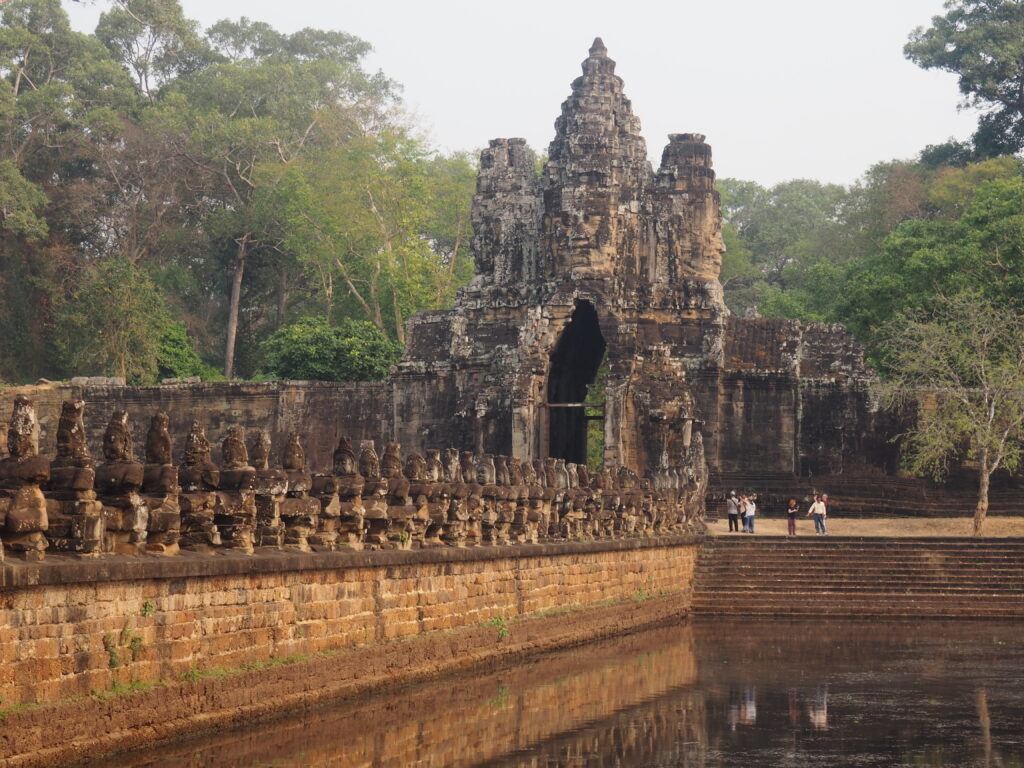
Angkor Thom
Bridge into Angkor Thom
Established in the late 12th century, Angkor Thom was also a moated temple city serving as the last capital complex of the Khmer kings at Angkor, with magnificent gods and demons lining the bridge across the moat to the South Gate.
A naga or seven headed snake (left and below) seems to be everywhere. It’s a sacred and revered Hindu deity in the form of a cobra (often partly human) that protects from evil and is typically seen on the ends of railings or, in Buddhist tradition, as a protective hood over the head of the Buddha.
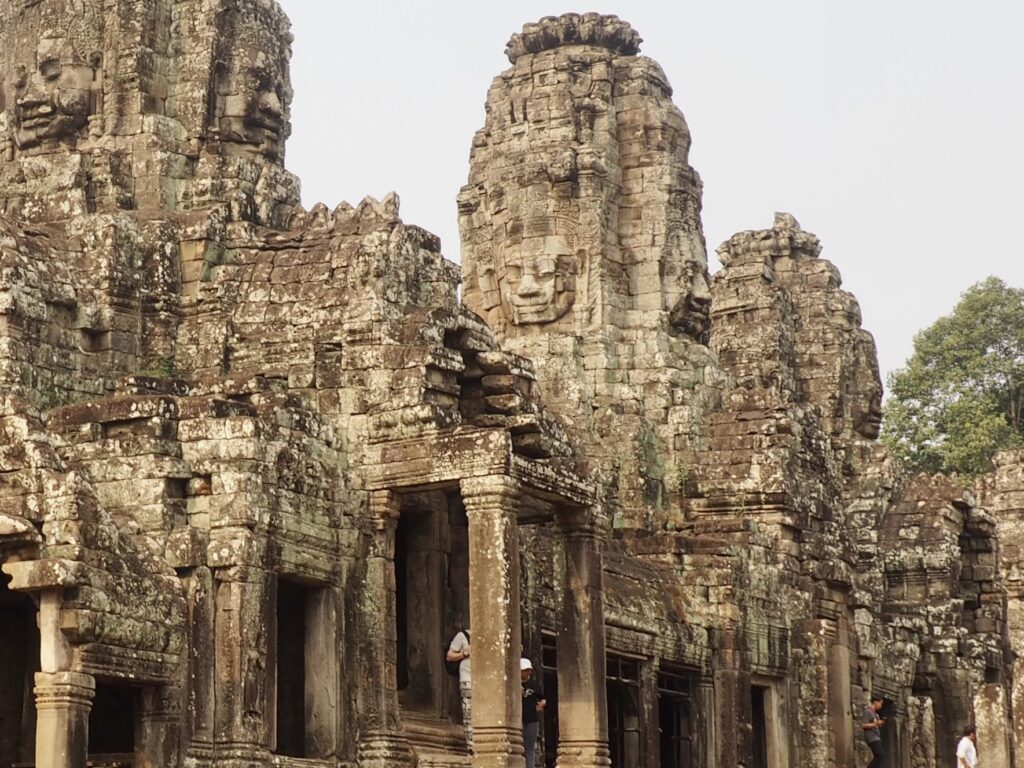
Heads facing in four directions are incorporated into the gate and, as you’ll see, are a common design element. The meaning or significance are unknown, although they may represent the king (look long and hard enough and, honestly, you’ll see them).
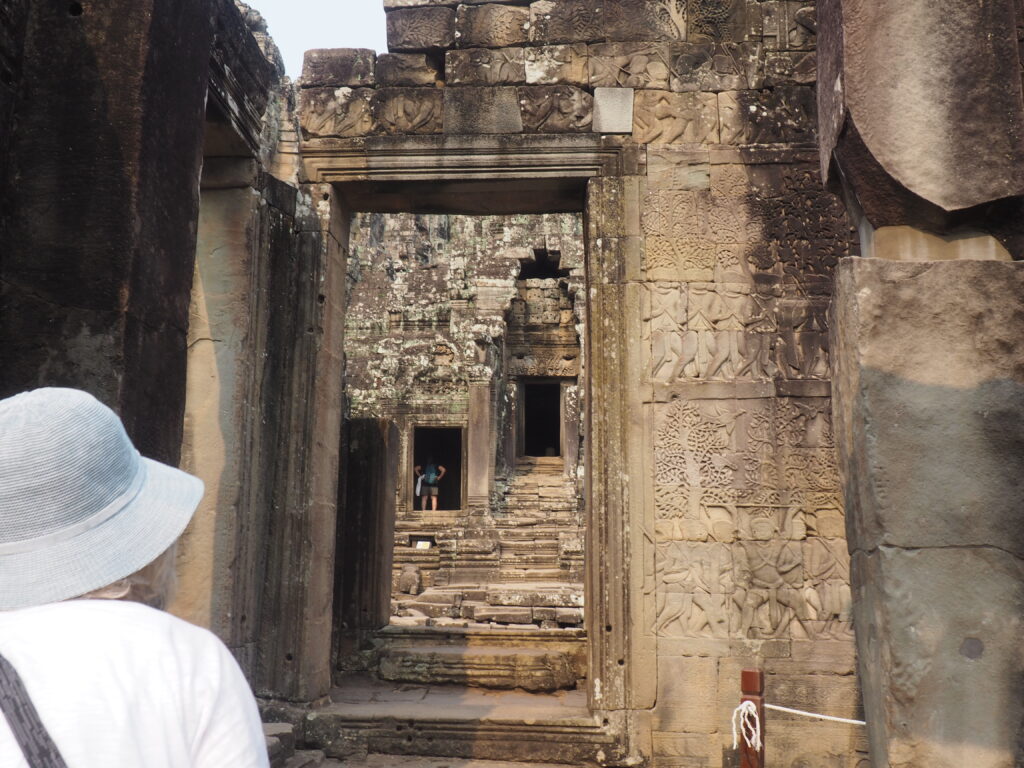
Bayon
“Here’s looking at you!”
Built in the late 12th or early 13th century, Bayon occupies the center of Angkor Thom, is the last temple constructed in Angkor, and has an architectural style distinct from Angkor Wat, especially with all those contented faces looming over you in all four directions. There’s a debate as to whether the faces represent the Buddhist bodhisattva of compassion (Avalokitesvara, “the lord who looks down”) or the then-reigning king or Lord Brahma. Although the king was a Buddhist, there was a bit of back and forth over the years as Hinduism and Buddhism vied for influence and there are strong arguments (favored by the locals) that it’s Brahma.
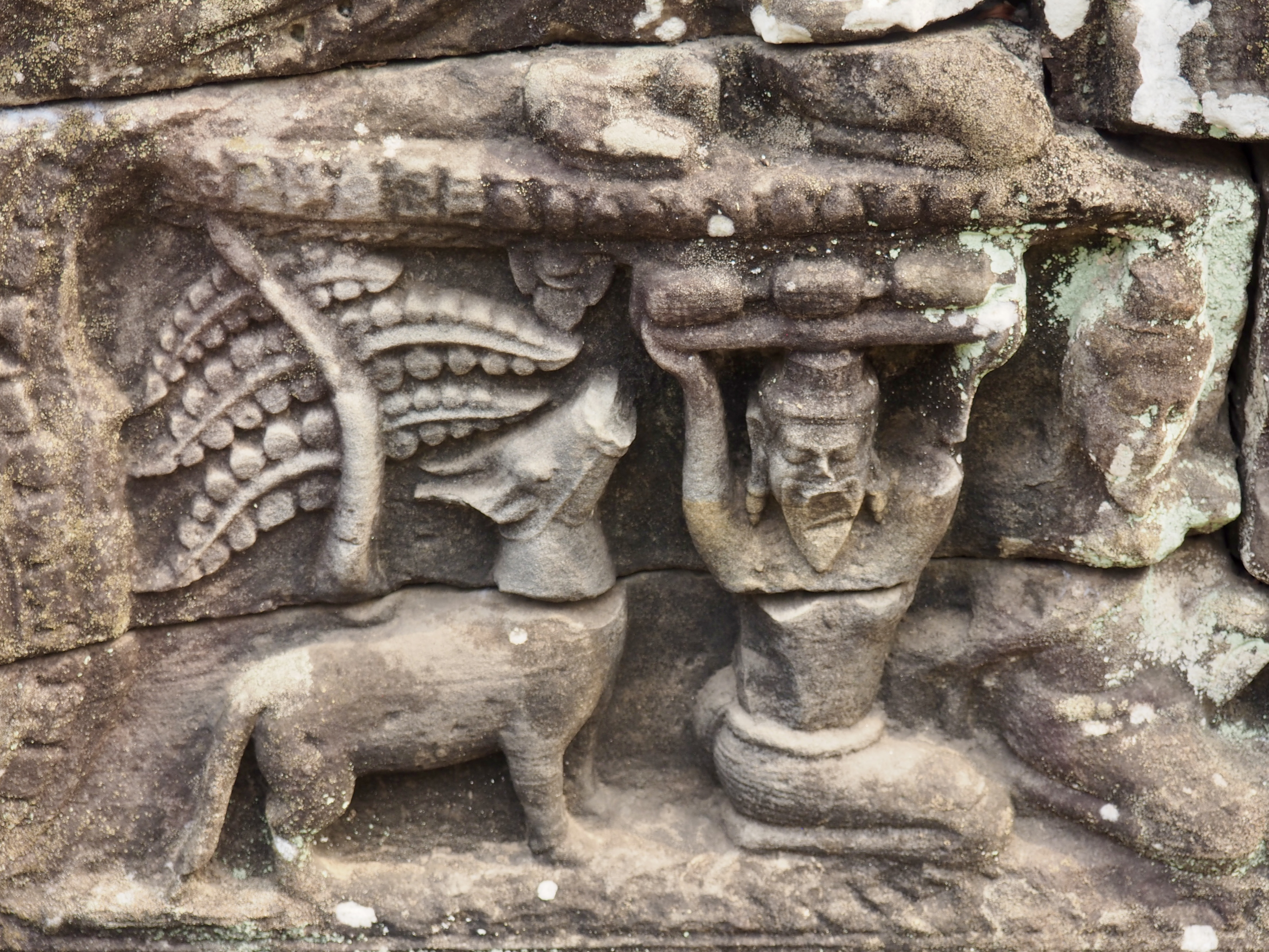
The bas reliefs at Bayon depict both ordinary life of the time and historic events and are nicely preserved.
Terrace of the Leper King
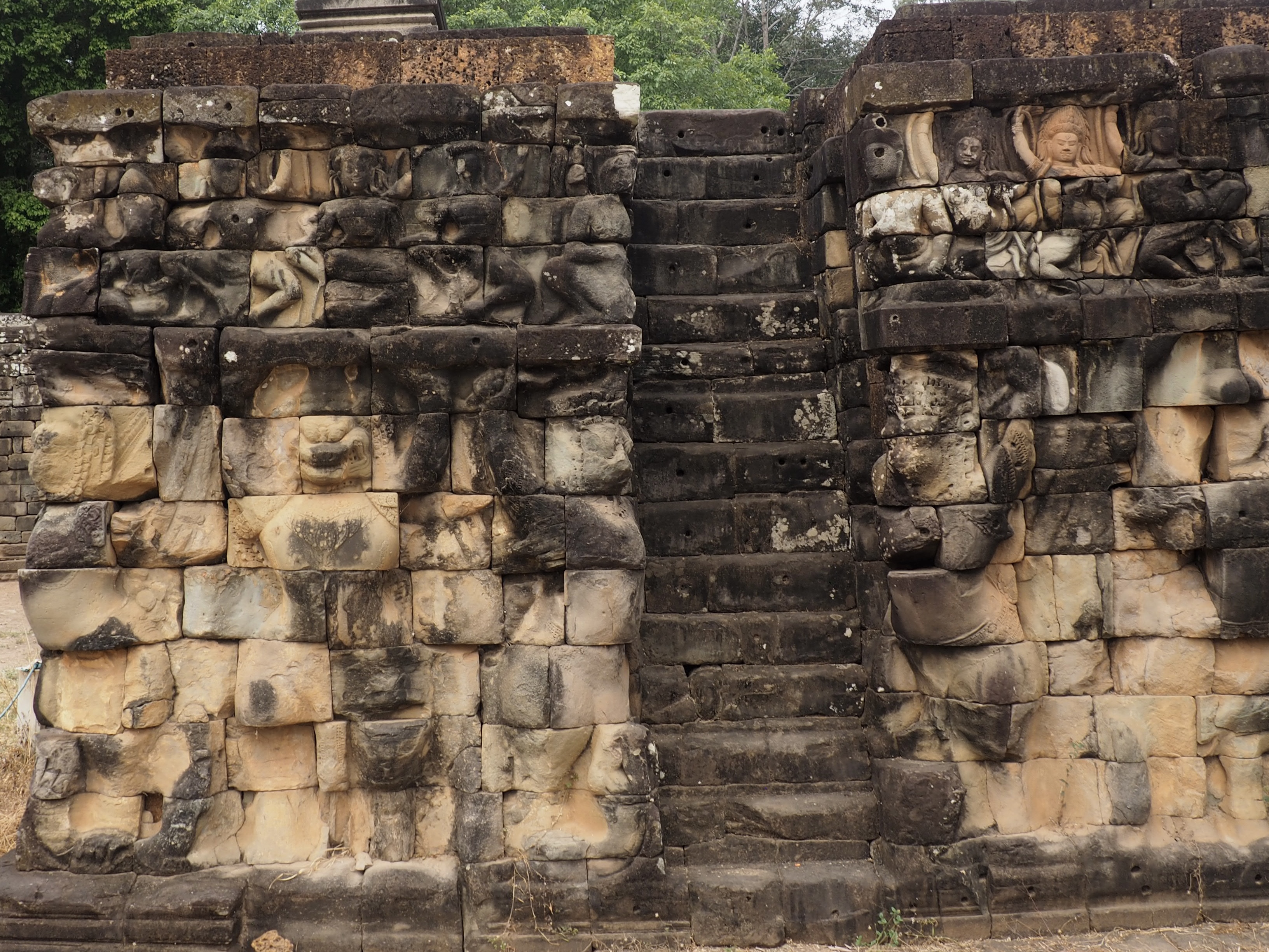
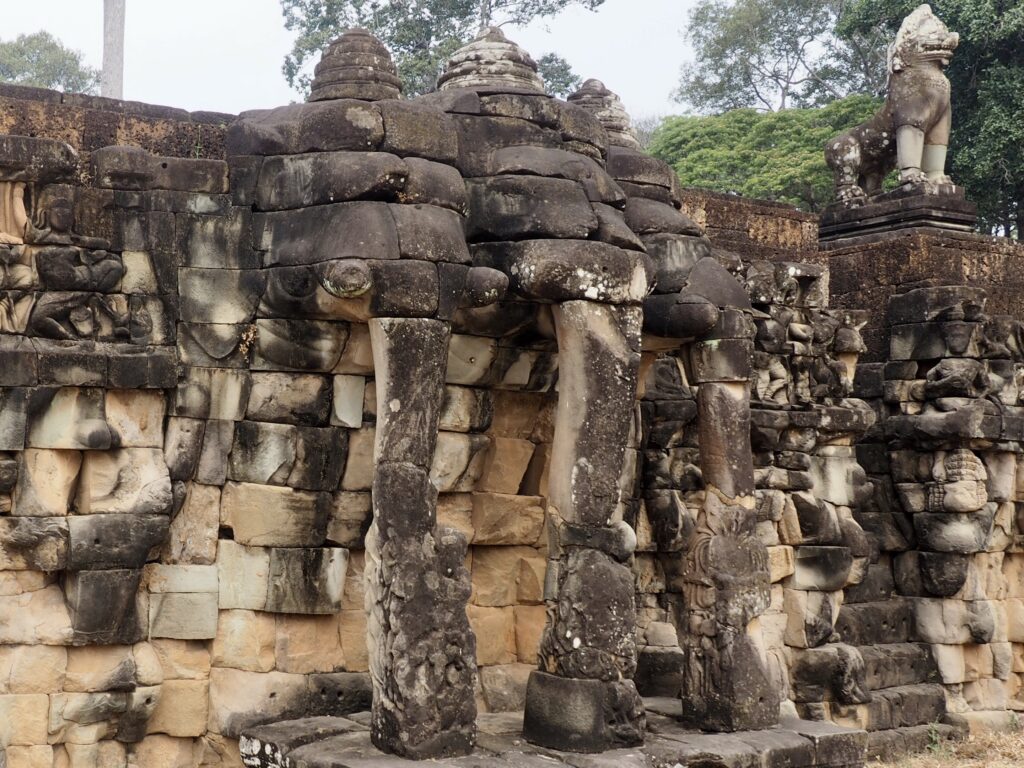
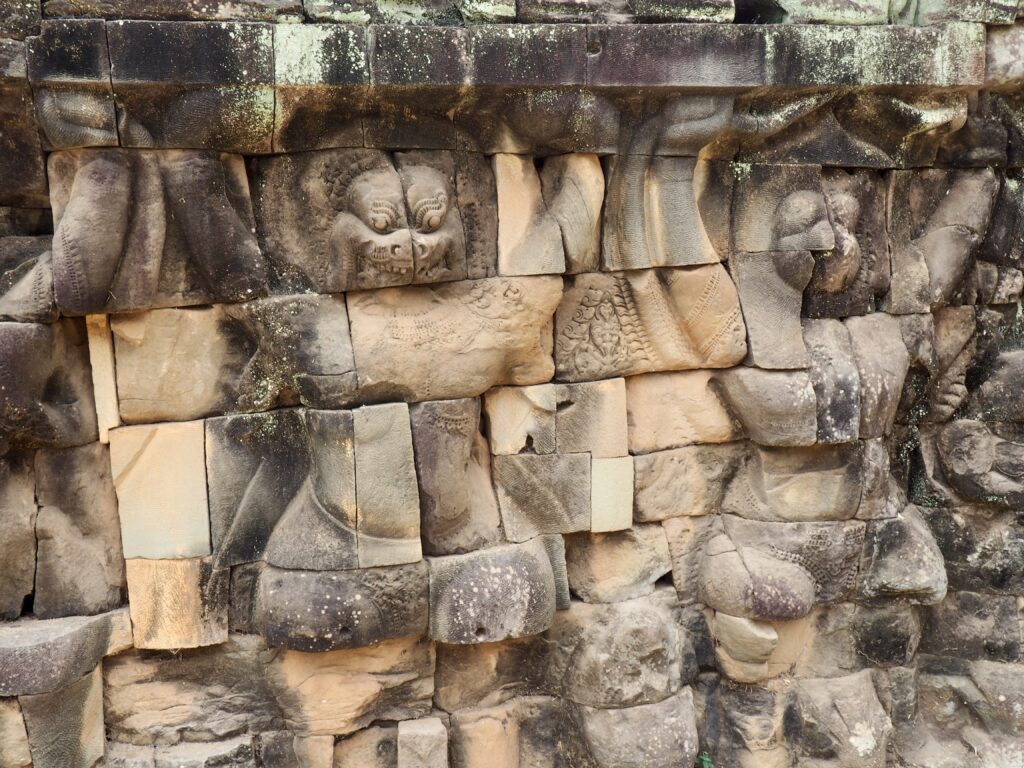
Also inside Angkor Thom is an area named after a “leper king” because of a discolored and moss encrusted statue found there and since replaced by a replica. Really. Although there is a legend about an early Angkor king who had leprosy, he has not be linked to this location. Anyway, the reliefs of animals are quite interesting and on a larger scale than we’ve seen.
Ta Prohm
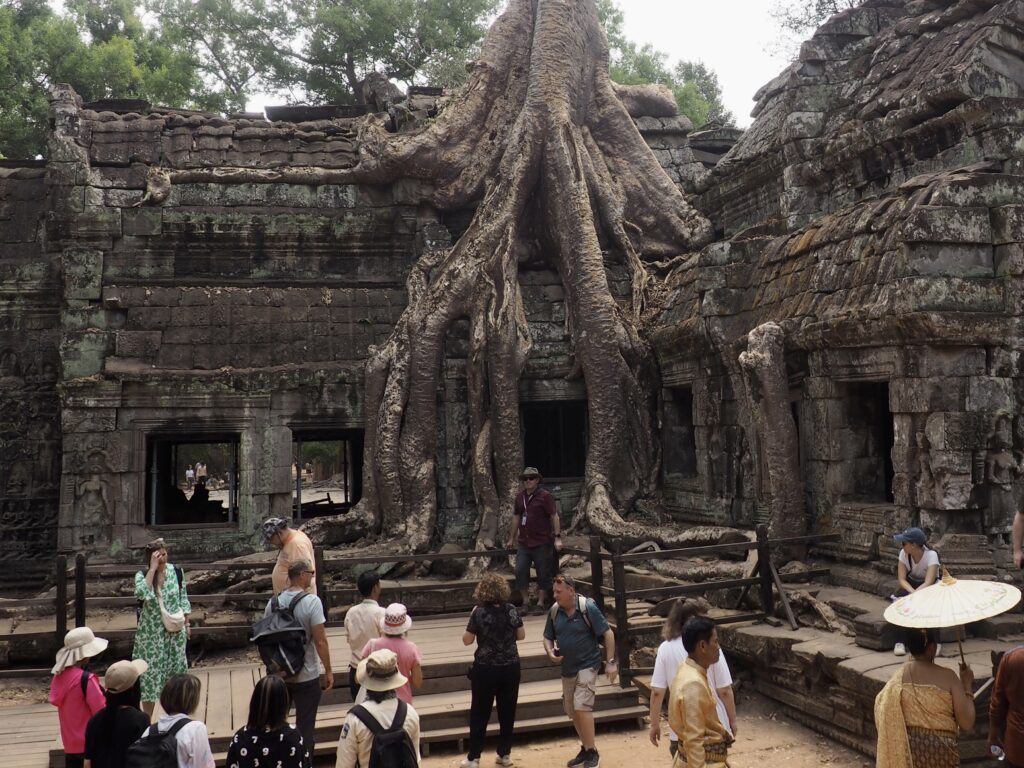
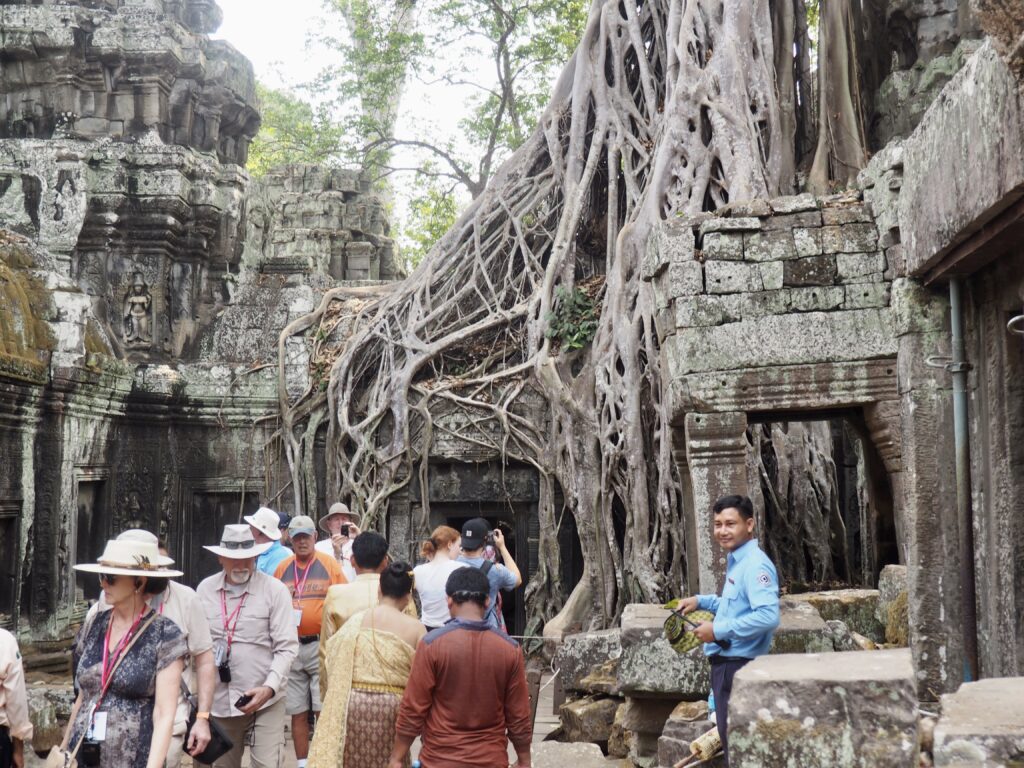
The massive popularity of Ta Prohm hinges on its gothic appeal of the revenge of nature and its cameo appearance in Lara Croft: Tomb Raider from 2001. Guides proudly tout their “wow” photo ops and take turns setting up group photos at the choicest spots. After Ayutthaya laid waste to Angkor and pushed the Khmer south to Phnom Penh, Ta Prohm was totally abandoned and the forest had its way. Favoring the conservation of the “picturesque,” decisions were made when conservation and restoration began early in the 21st century to leave Ta Prohm in its wild state, although efforts have now been made to stabilize and gradually restore the area.
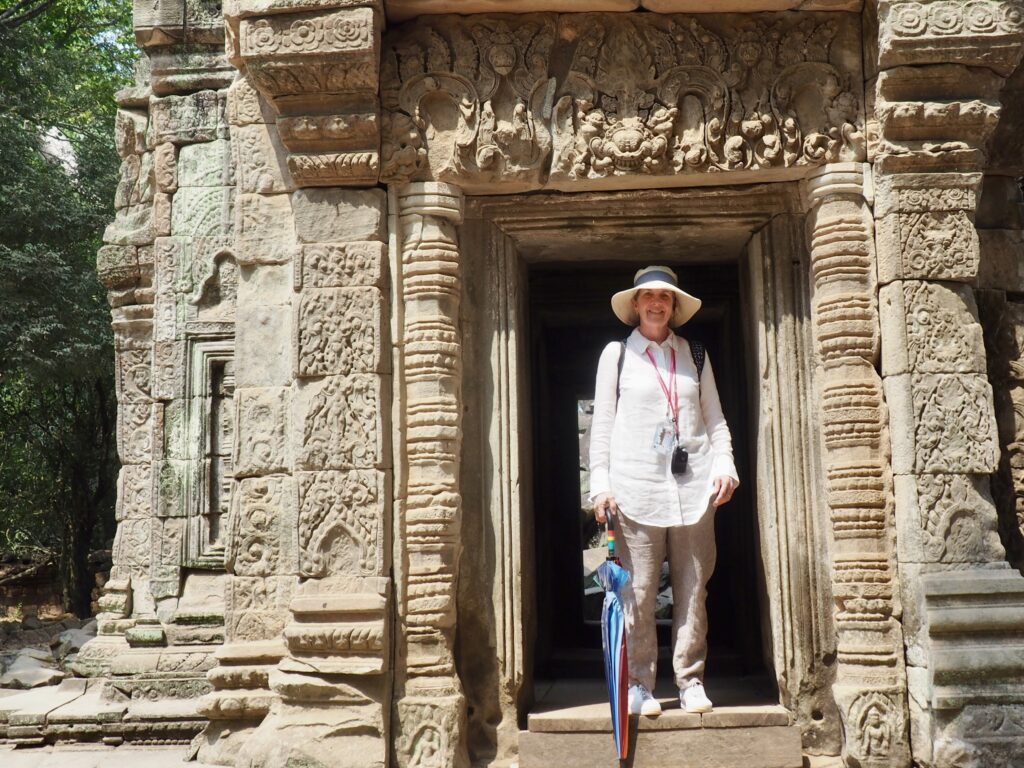
But, enough about us. Ta Prohm was founded in 1186 as a monastery and center of learning dedicated to the king’s mother, according to a surviving stele. It’s not far from Angkor Thom.
According to that surviving stele, about 12,500 people lived in the monastery, including 18 high priests and 615 dancers, with a population of 80,000 people living nearby to support the monastery with food and services.
Let’s Not Forget the Size of the Task
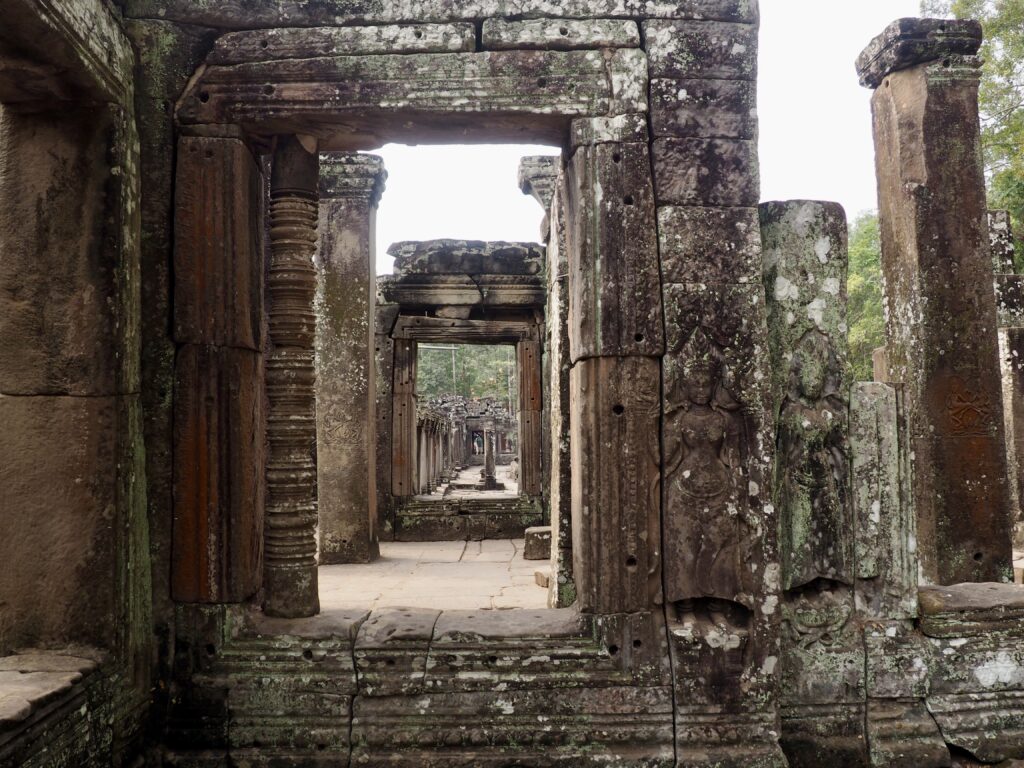
Although some small continuous presence of monks at Angkor Wat helped to maintain the integrity of its structures, the rest of Angkor was in complete ruin. The armies of Ayutthaya did what they could to eradicate the capital of their long time rival empire (as would be their fate at the hands of the Burmese) and nature then had its way with structures that were, after all, merely stacked stone, not mortared in place. Throughout Angkor you will see not only piles of rubble, but reassembled bits of wall that seem to have obviously misplaced pieces. It’s thanks to the French for initiating the reconstruction of these masterpieces when the world began to recognize their value and to the many national teams that are continuing the effort, such as those from India and Japan.
It was an odd feeling, admittedly, arriving in Ha Noi (“land inside the river”). But, a lot of time has gone by since America’s intimate involvement with the people here and that is dwarfed in the Vietnamese imagination by the nearly 100 years of French colonialism resolved by almost ten years of brutal warfare and 1,000 years of subjugation by the Chinese, despite the horrific scale of the loss of life in the war we suffered through together. Times keep changing. Although a one-party state, we’re told the government is “communist” in name only and, of course, the West is eager to invest in any counterweight to China (and Vietnam is eager to play that role).
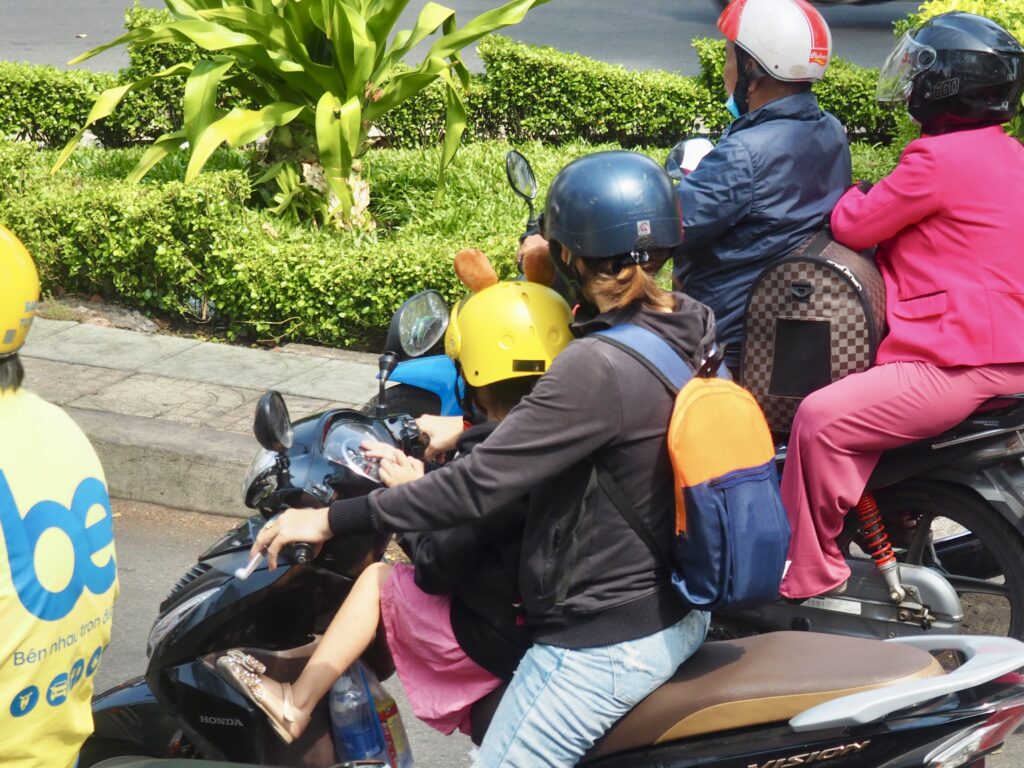
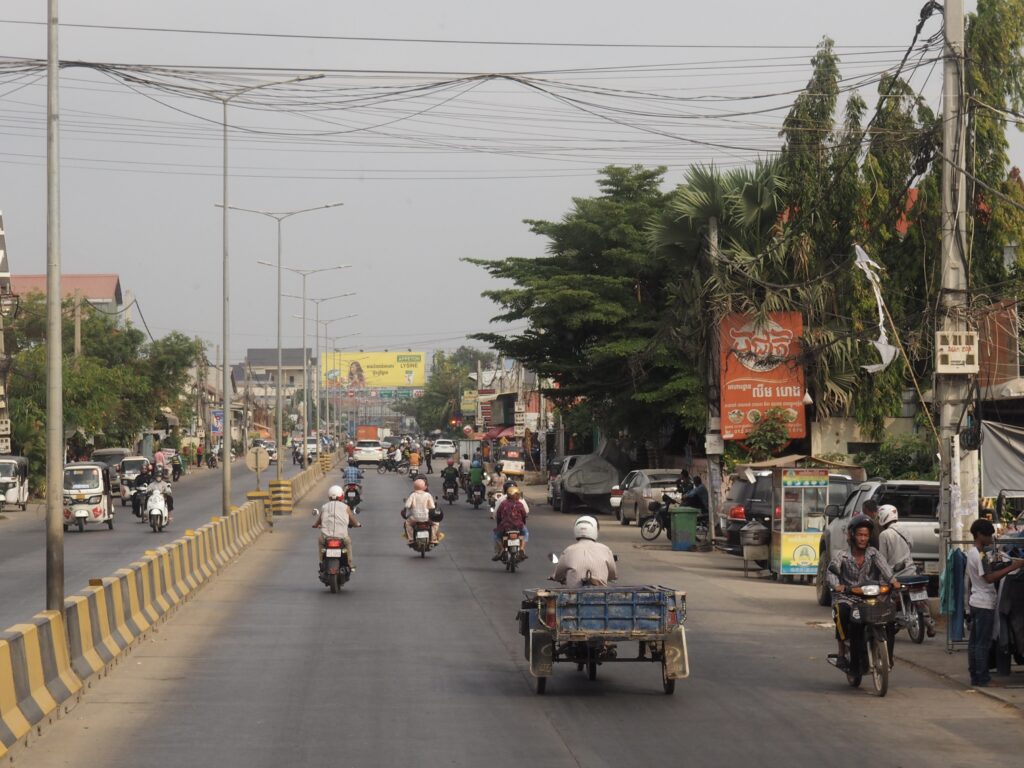
Hanoi is a dynamic city with a sense of energy and purpose and more to see and do than we had time. That’s not to say that it’s easy to get around on foot. It’s a motorbike city and pedestrians have no place to walk other than the street because the sidewalks are taken up both by commerce and as parking for all those motorbikes. Our adventure of walking to a restaurant in the neighborhood of our hotel was initially a little harrowing, but you get used to everything and we regained the skill of being cautiously intrepid.
Time Out for Banh Mi!
One of the many gifts to gastronomy from the collision of traditional Vietnamese cuisine and the French kitchen is banh mi, the cucumber, sauce and cilantro with the whatever-have-you meat on a baguette that is sheer pleasure to eat. So, we set out from our hotel to find a very local place specializing in only banh mi. Not as much of the goodies on the inside as one stateside and the seating was on those little plastic stools about half the height of a western chair, but hard to complain when two sandwiches and two Cokes run up a tab of around $4 or so. And, yes, delicious.
Tran Quoc Pagoda
As we awaited the start of our organized tour, we explored a nearby ancient Buddhist temple on a little island in the lake near where John McCain crash landed during the “American war.”
Monument to Reconciliation Commemorating John McCain’s Post-War Visit to Hanoi
Hoa Lo Prison (aka the Hanoi Hilton)
Before it acquired infamy in American minds, Hoa Lo was a notorious symbol of French cruelty and oppression in their efforts to maintain iron fisted control of not only Vietnam, but all of Indochina. The guillotine seemed especially fascinating to the many visitors.
And, of course, some artifacts from the time of the inhumane imprisonment of Senator McCain and the other captured aviators are also on display.
Ba Dinh Square
Ba Dinh Square is a vast (80 acres) public space accessible only through security where, most importantly, Ho Chi Minh read a Declaration of Independence from France on September 2, 1945, hoping for international support, including from President Truman to whom he sent an unacknowledged request for recognition and assistance.
The Mausoleum
Ho Chi Minh’s request to be cremated was ignored and he got the full Lenin and Mao treatment instead, including periodic public viewing. It’s a rather imposing site and, we couldn’t help thinking, a bit ironic.
Presidential Palace
Yellow was the Emperor’s favorite color, so the French obliged, as did he. When Ho Chi Minh finally booted the French in 1954 (after nearly a decade of savage warfare), he declined to occupy the palace and lived in the much more modest quarters out back.
Ho Chi Minh Stilt House
“A grateful nation” built a residence more to his liking in 1958 in which he lived until his death in 1969. Unfortunately, they forgot to provide toilet facilities, so he continued to run back to his previous quarters, above, for those purposes. Other than that, it’s quite a nice place. Per the custom throughout much of Southeast Asia, the area under the house is also living space. The upper right photo shows the entrance to his bomb shelter in a separate building.
One Pillar Pagoda
Nearby Ba Dinh Square is a small, but beautiful and unique, Buddhist temple.
Van Mieu (Temple of Literature)
Dedicated to Confucius and Confucian study, the Temple was established in 1070 and became the home of the Imperial Academy to educate the princes and other elites from 1076 until 1779 as the capital shifted to Hue.
Beginning in 1484, Doctors Stelae (those big slabs of stone) were erected to record the names and birthplaces of successful graduates of the triennial royal examinations. The turtle supporting each of the surviving 82 stelae is, among other things, a symbol of wisdom and one of the holy animals of Vietnam.
Vietnam Museum of Ethnology
The Museum of Ethnology focuses on the 54 officially recognized ethnic groups within Vietnam, a country created by the gradual extension of authority by the Viet civilization centered on Hanoi and the valley of the Red River on whose banks the city lies.
Exhibits are inside and out for which, sadly, we barely had time for a quick look-see; and there’s a separate museum focused on Southeast Asian peoples and cultures that we didn’t have time to see at all. It’s a very impressive effort to provide some visibility to a wide range of internal ethnicities.
With that, we boarded our flight to Siemreap, Cambodia.