Wherever we went during our early October visit to northern New Mexico, people assumed we had come for the balloons. Albuquerque’s big event really pulls them in, but not us, although we benefited from the extended days and hours across the region that come with a major influx of tourists. We came for the rest.
Los Alamos
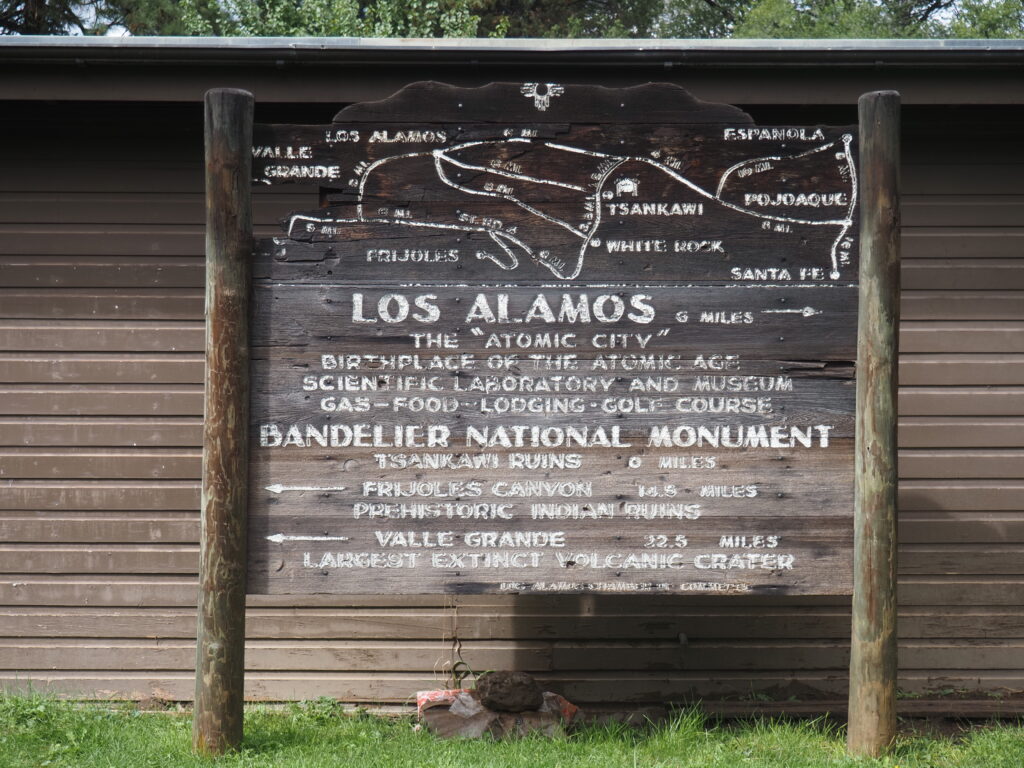
The plan for day 1 was to take the “High Road to Taos” on the backroads from Santa Fe. “Not a good idea,” our Lyft driver Joseph confirmed as he drove us back to the airport to pick up our rental. So, we rearranged our expectations and drove out to Los Alamos in the pouring rain, only to have it brighten for us and deliver more than tolerable weather.
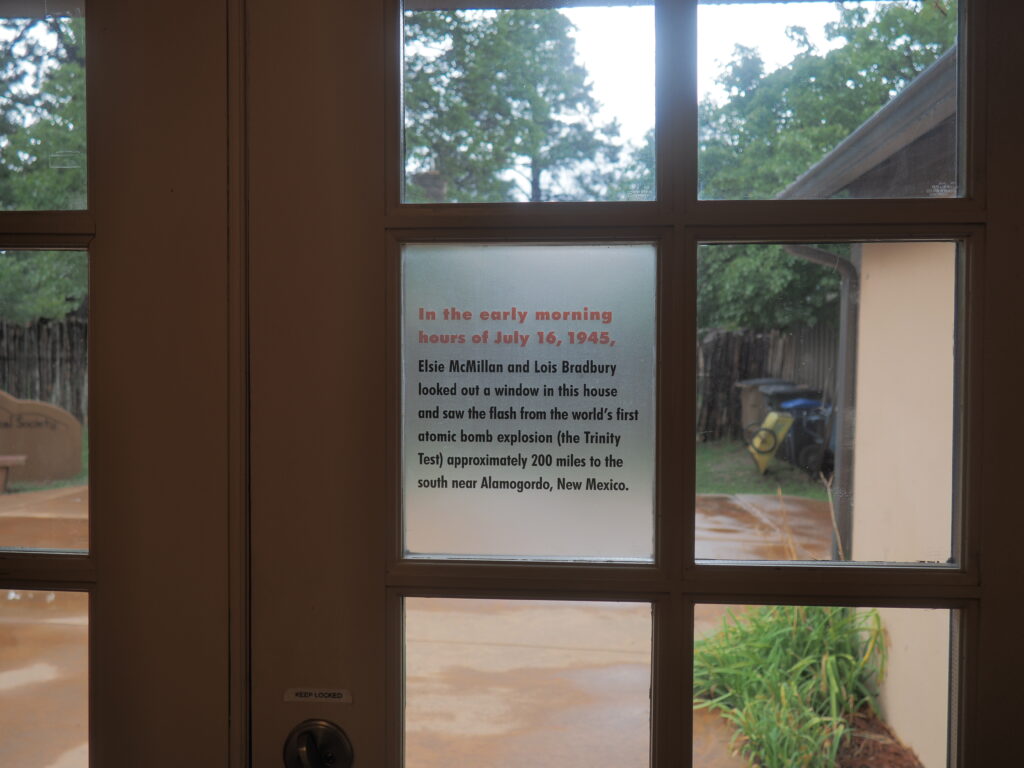
Los Alamos turns out to be a very pleasant and prosperous small town with good food and lots of scientists, although it’s certainly out of the way and, as pointed out by the person manning the little historical museum, imprudently situated by a dormant volcano.


It seems Oppenheimer loved northern New Mexico and that’s why Los Alamos was chosen for such a top secret project. The town was the home of an elite boarding school, which meant there were buildings that could be taken by eminent domain to house the Manhattan Project. They never got them back and the town remains an important nuclear research center (which maintains a nice science museum with actually worthwhile video introductions to both the Manhattan Project and the continuing work they’re doing there). It all brought home once again the enormity of the potential for any future use of nuclear weapons. (Heaven protect us.)
In and Around Taos
Millicent rogers museum
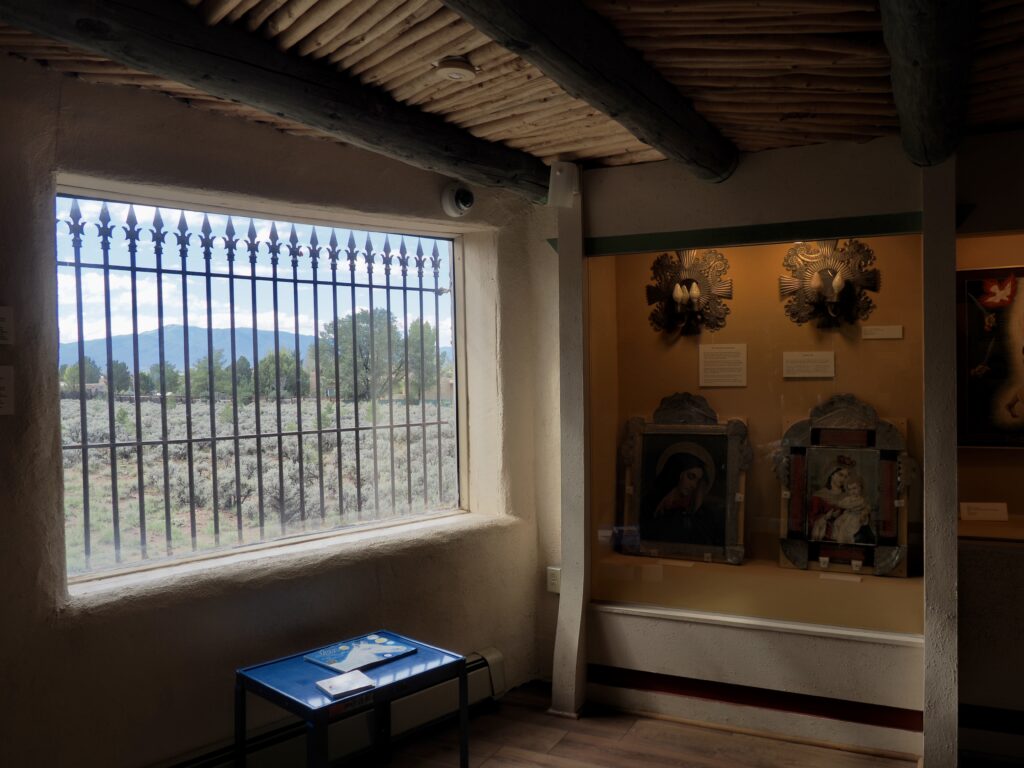
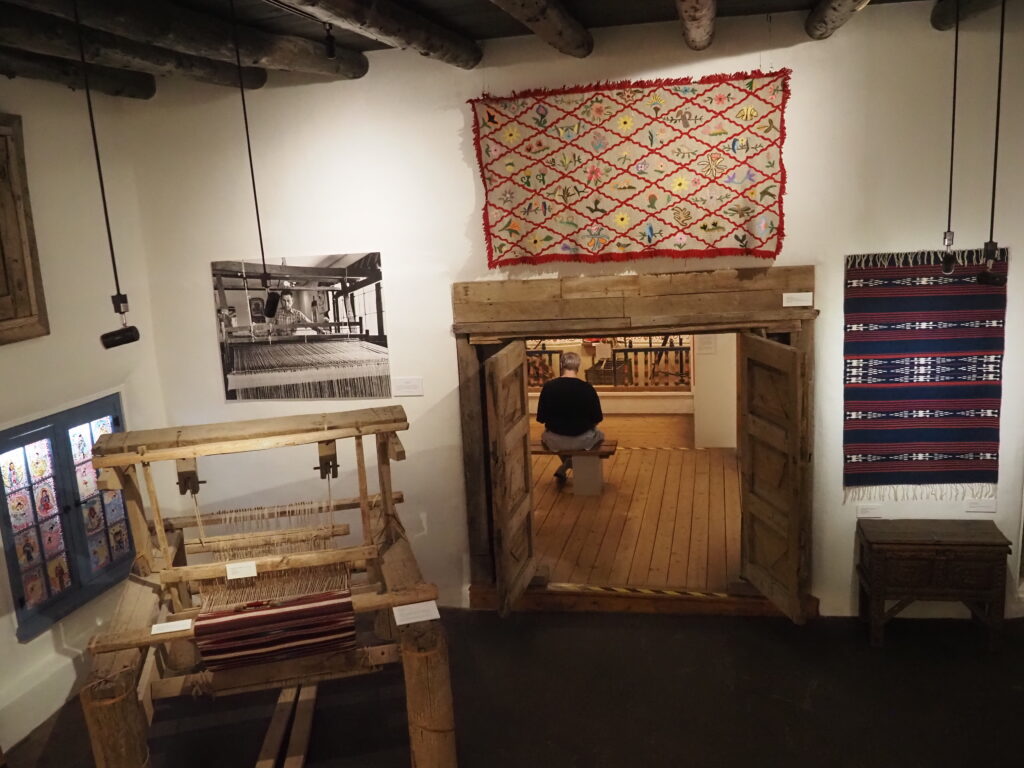


The Millicent Rogers Museum is one of those wealthy person has a collection and her son starts a museum stories, although it’s an excellent one and is just outside Taos. Millicent Rogers was, in fact, an heiress whose father was a founder of Standard Oil and who had a deep interest in New Mexico and its native peoples.
taos pueblo
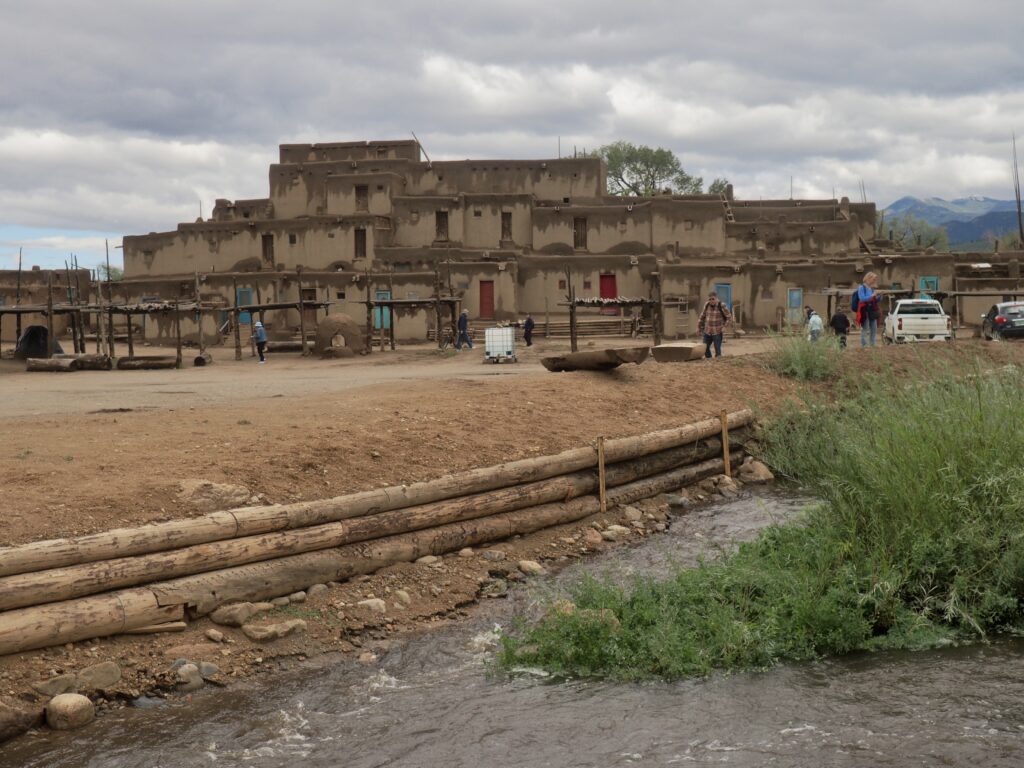
If there’s one reason to visit Taos it’s to visit the Pueblo, continuously occupied for over a thousand years, proudly persistent in maintaining traditional ways. We were asked to be respectful of the river, as the roughly 100-150 regular inhabitants come down here to their only source of water. The Pueblo is the northernmost of New Mexico’s 19 Pueblos, the largest extant multistory one anywhere, as well as the only one to regain all of its territory – this under the auspices of President Nixon.
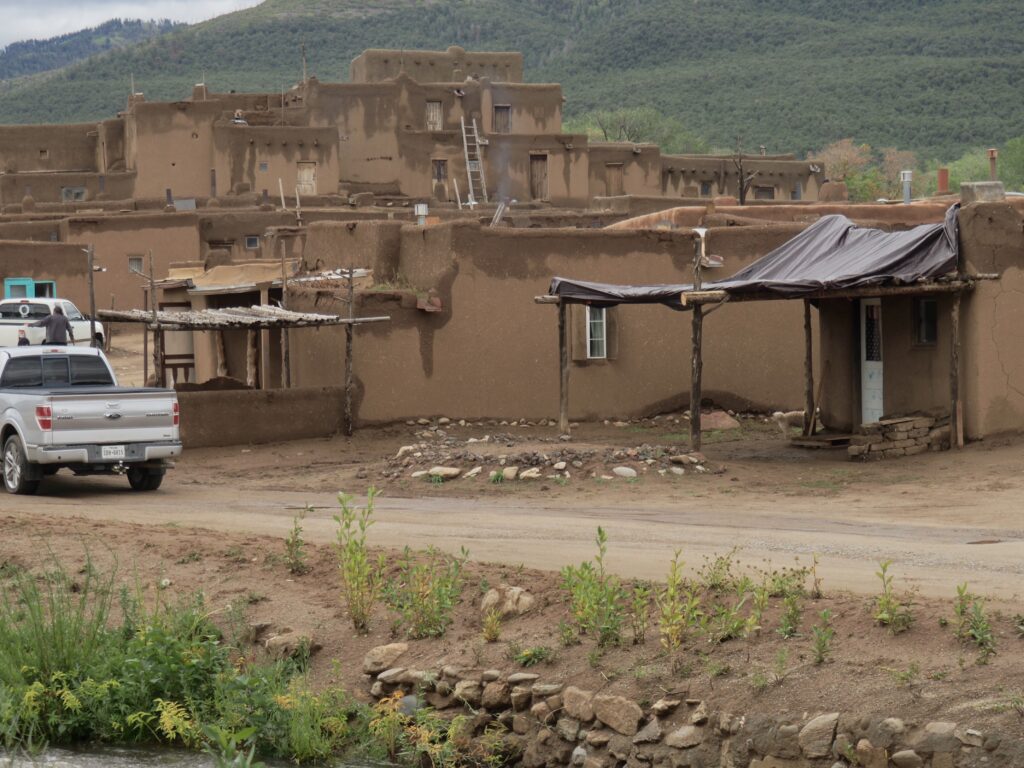
There are two multistory buildings, this one to the south of the river and the one above to the north. The individual residences are not internally connected and each is entered separately from the outside, so that people use ladders to access the only entrance to their home if it is on one of the upper stories.
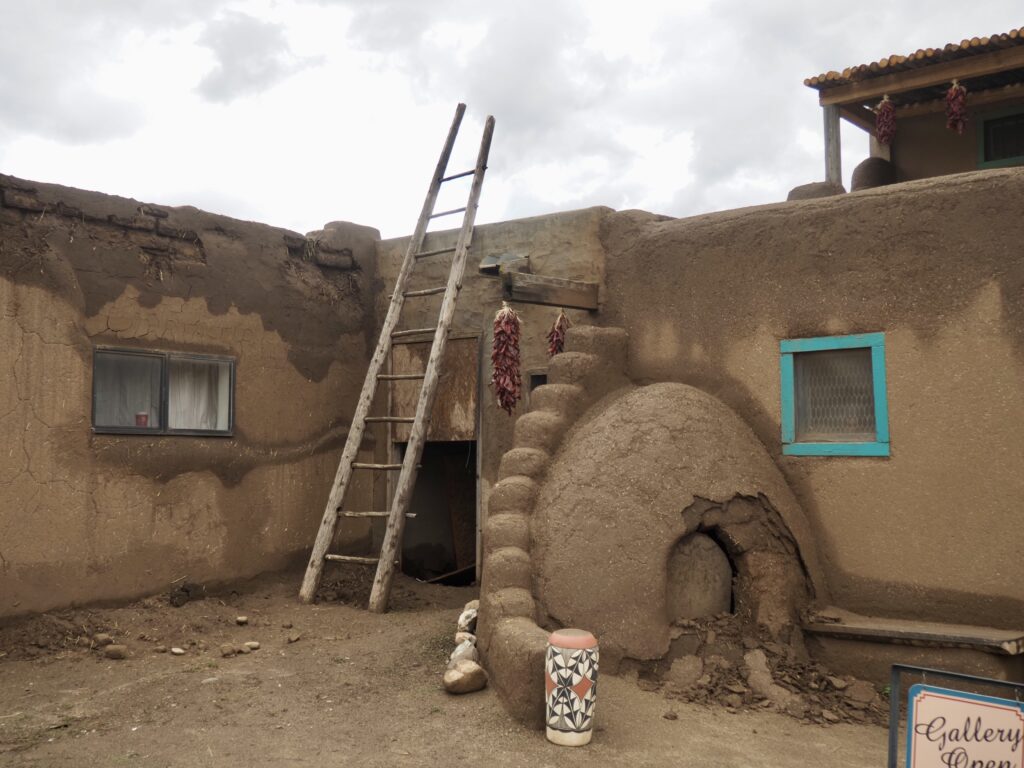
Yes, that’s an oven. And, they’re still in use (I guess that’s obvious). The hanging chilies are ubiquitous throughout the region.
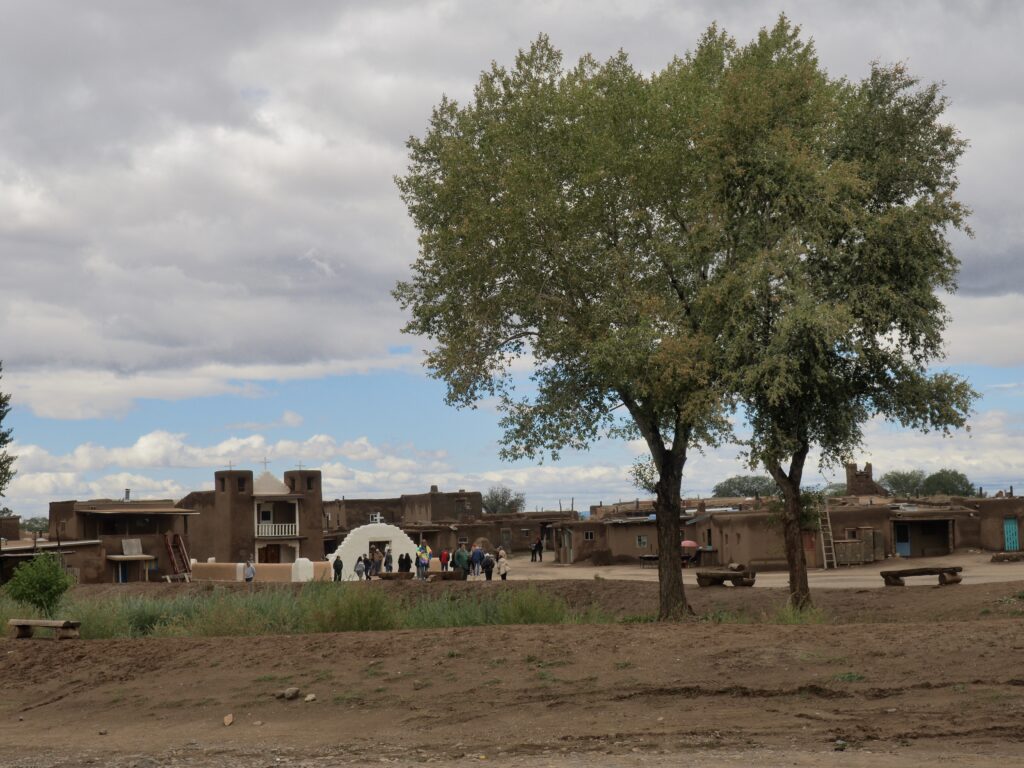
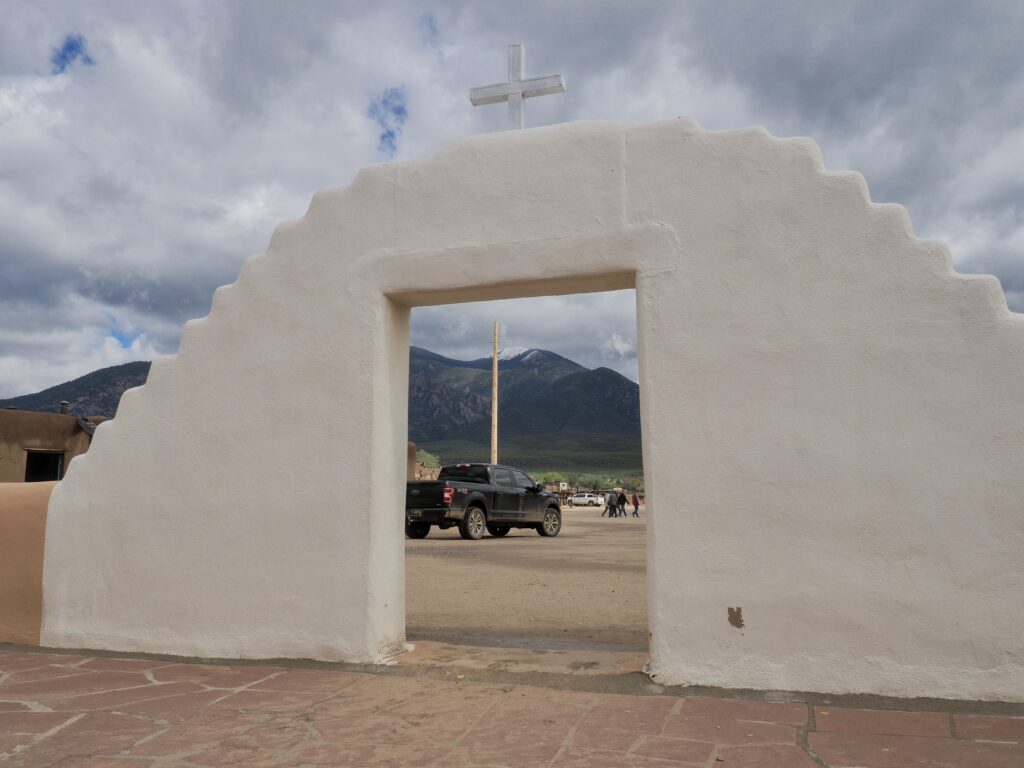
The church is the youngest structure in the Pueblo. The native college student guide gave the distinct impression that Catholicism is still begrudged by many in the Pueblo and they prefer their traditional religion (which has no name and is practiced alongside Catholicism). Like roughly 1,900 other enrolled members of the Pueblo, she and her family maintain a primary residence either on other tribal land or in Taos, but also maintain their traditional residence in the Pueblo where they live from time to time.
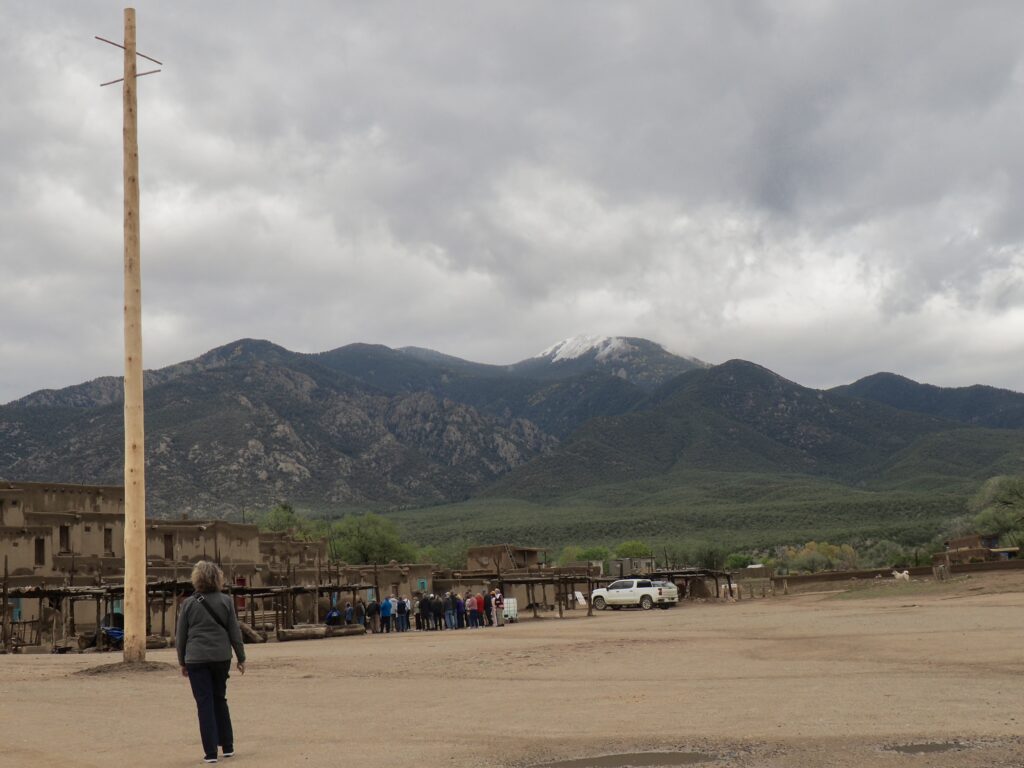
A very important place in every Pueblo is the central plaza where major events take place.
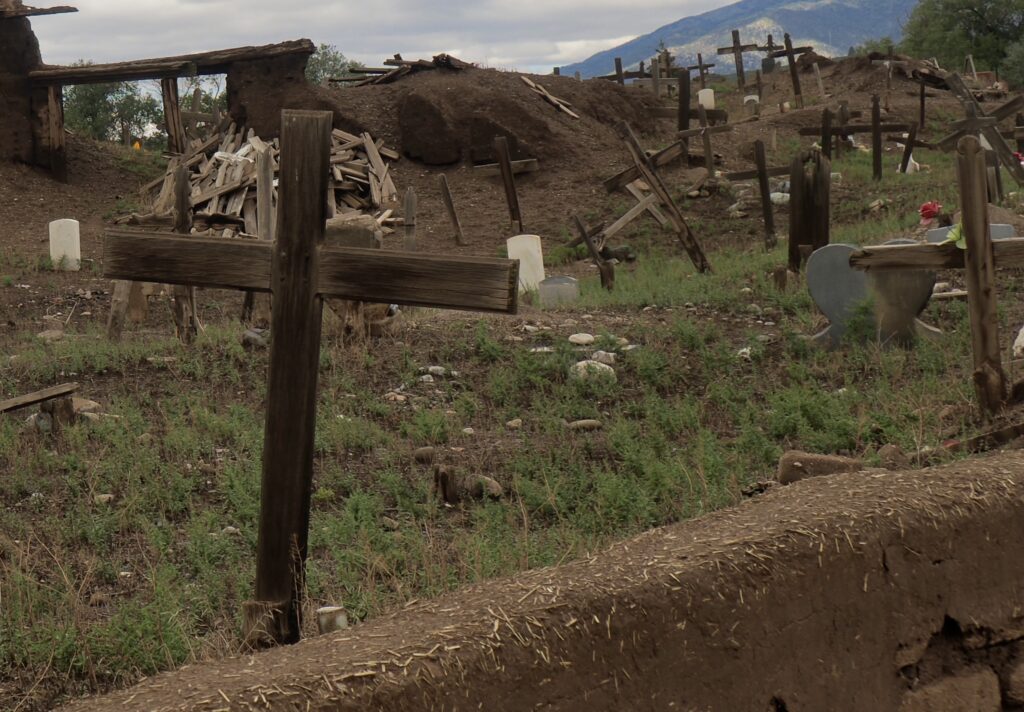
The Pueblo now has a new cemetery elsewhere on their lands, as the main one is at capacity. The wall, however, like all of the stucco surfaces has to be regularly renewed. Our guide suggested that the fabled “cities of gold” that attracted the Spanish may have been a reference to the glinting of the straw in stucco or perhaps the sheen imparted by the area’s micaceous clay, a mica rich clay that imparts a sparkle to much of the pottery from Taos.
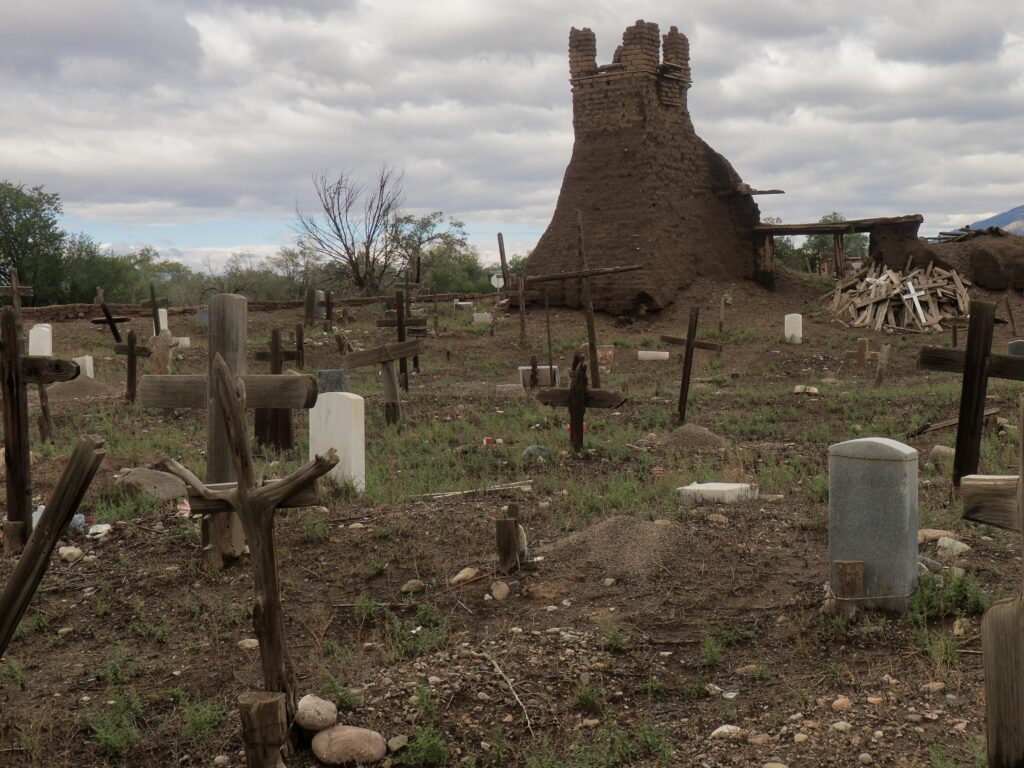
The original church which the residents were forced to construct has been destroyed three times. Twice in the 17th Century and once in the 19th Century (by Kit Carson) when many innocents died while taking refuge there. It has not been rebuilt.
Taos Pueblo is also historically important as the epicenter of the most successful revolt by native peoples against European conquest. Launched by Pope (Poh-pay) of the Taos Pueblo in 1680, it drove the Spanish out of Santa Fe until 1692 and Taos until 1698.
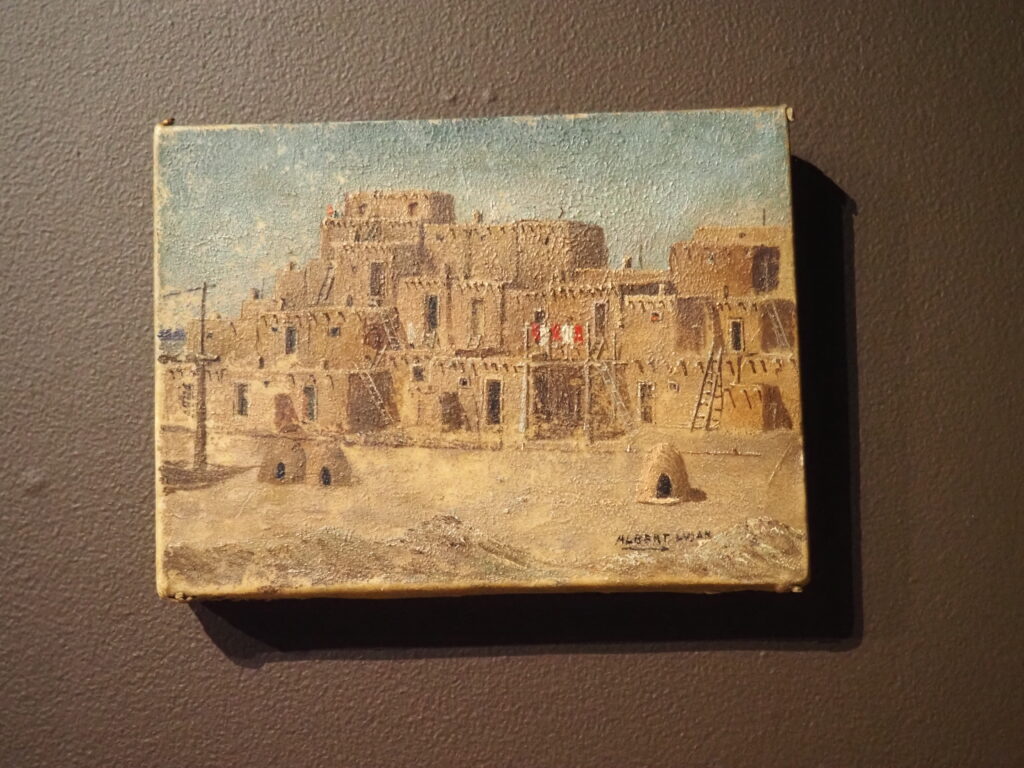
This small oil of Taos Pueblo by Albert Lujan from 1930 is in the Harwood Museum. It was painted on cowhide.
kit carson museum
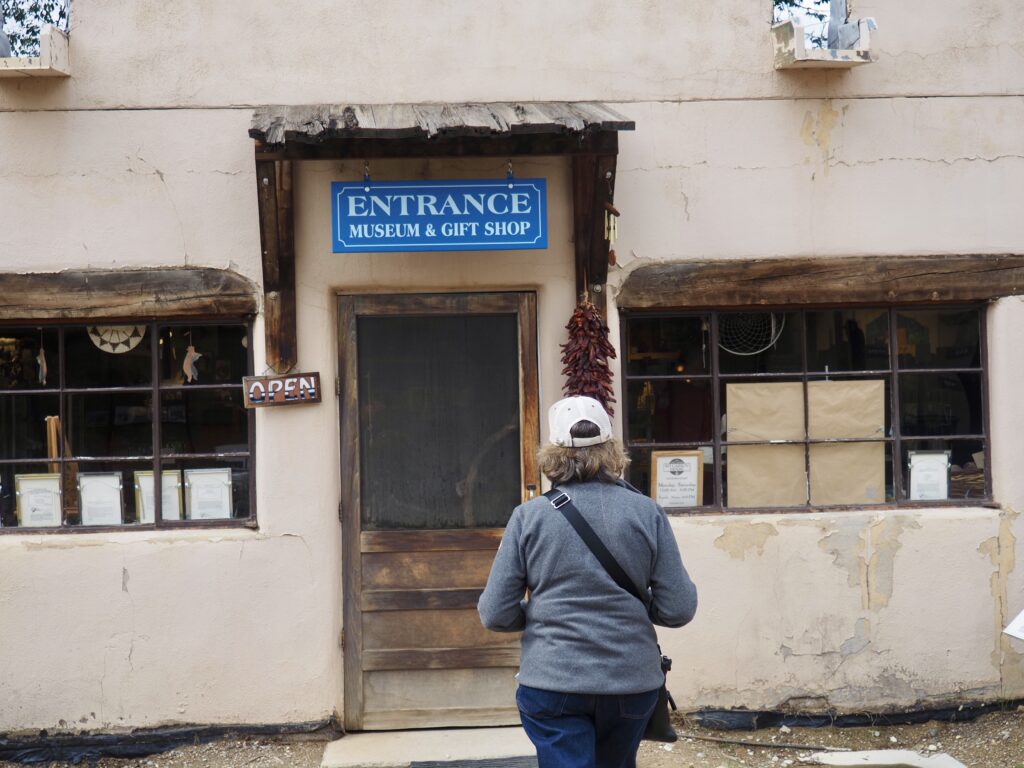
The Kit Carson House Museum is an unassuming place, but is where he lived for many years as a man famous in his lifetime and beyond as a 19th Century Indian fighter and guide. It’s only quite recently that a public park in the center of Taos has been renamed, no longer Kit Carson Park, but Red Willow Park.
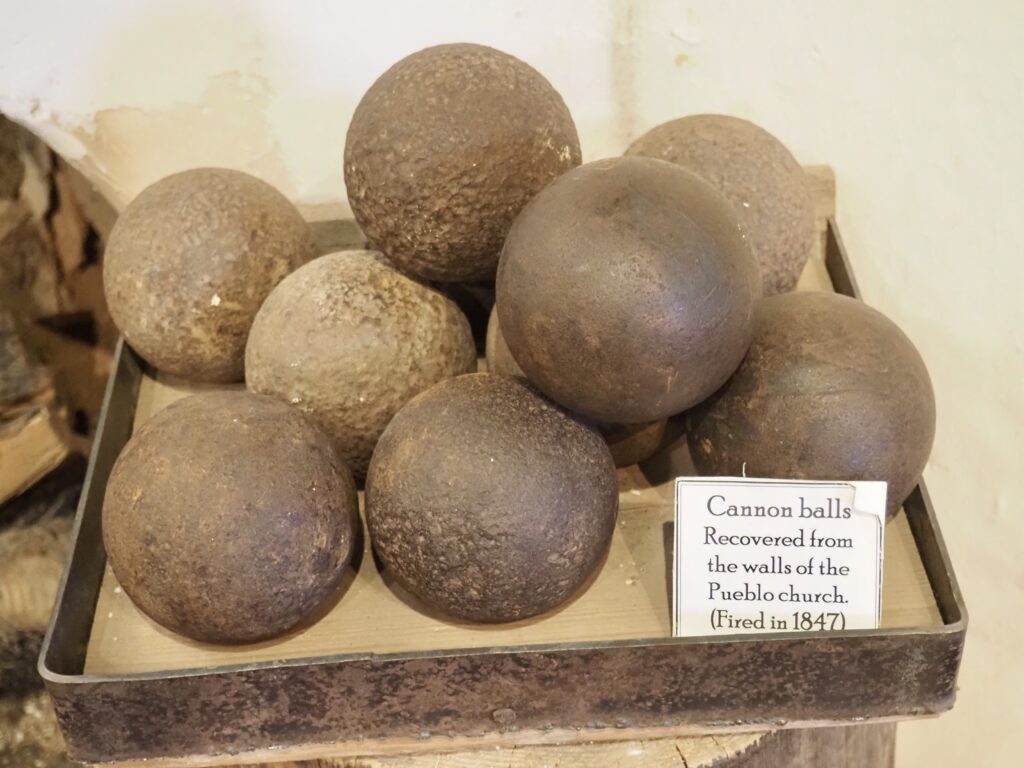
Alas, a clue about that renaming.
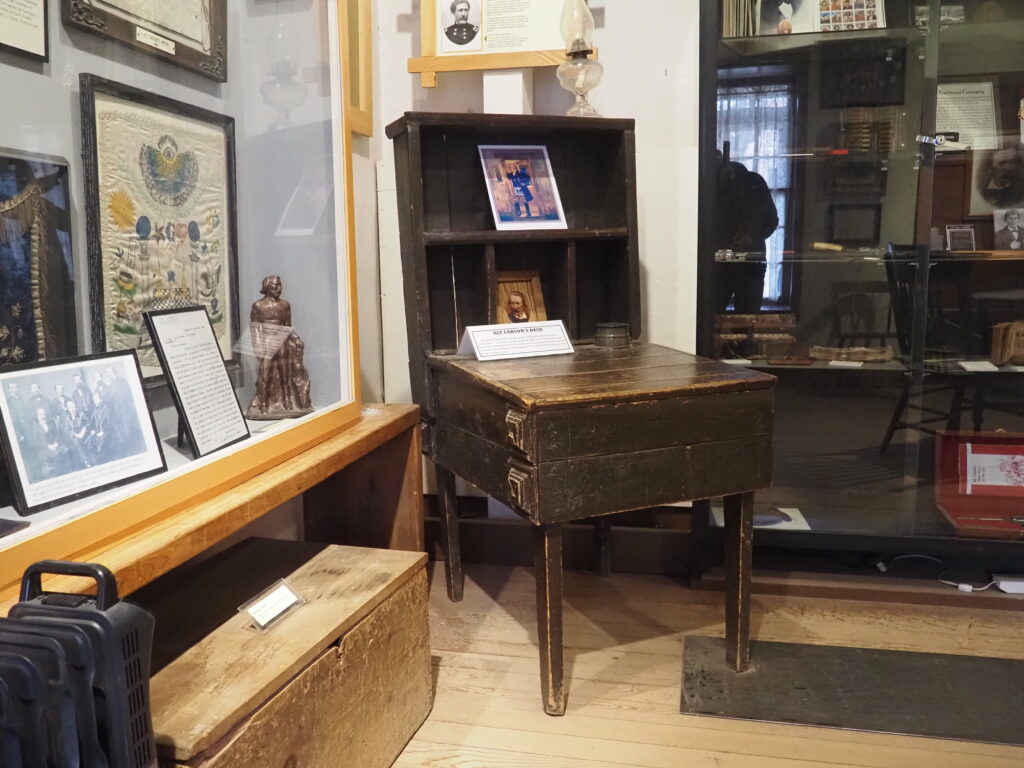
His desk when an Indian Agent.
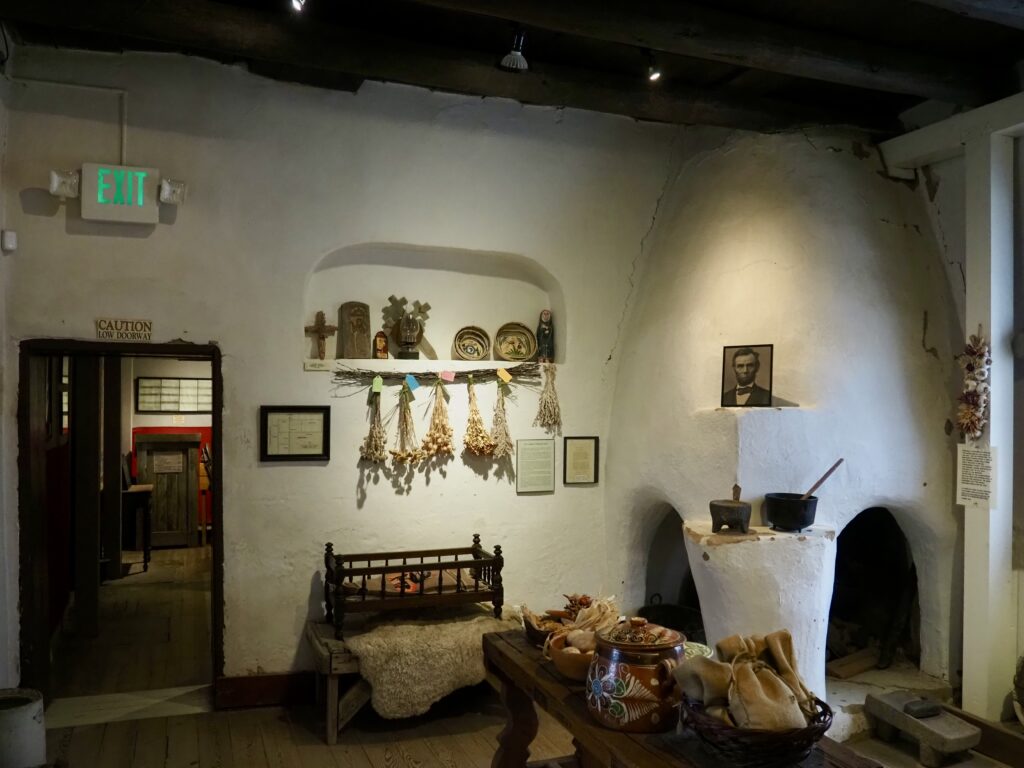
It’s not too hard to imagine this as a home.
north of taos
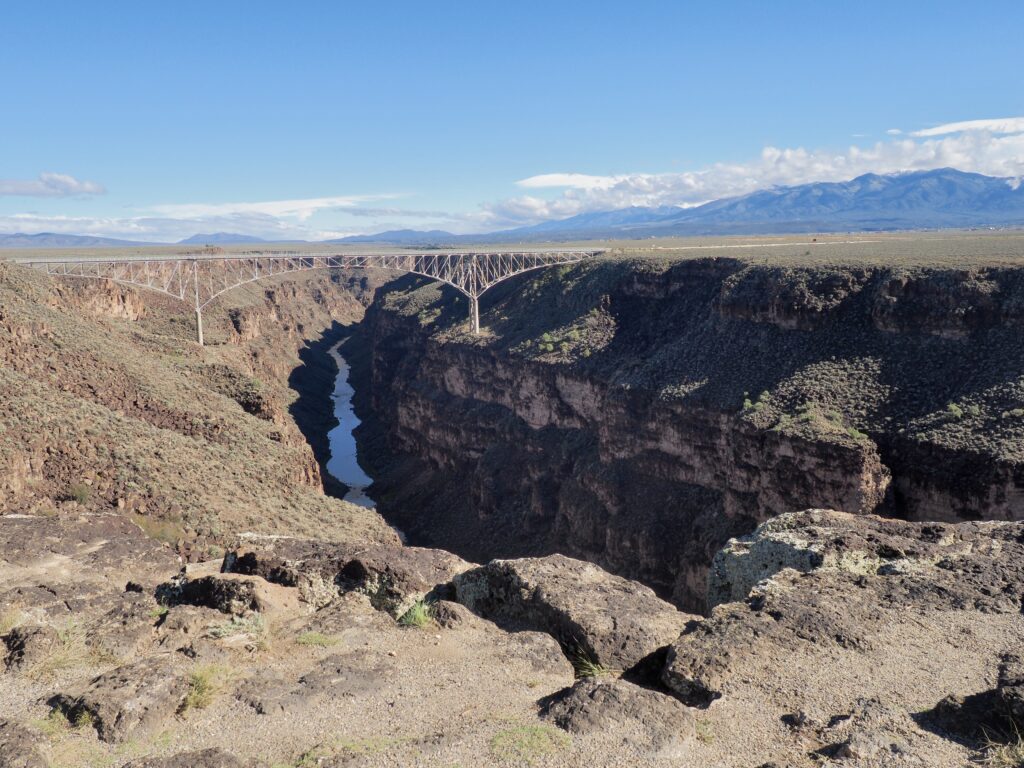
Out beyond the airport, northwest of town is a bridge over the Rio Grande. Saying that does it no justice. It was quite a windy walk along the canyon edge to take this picture, and worth the effort.
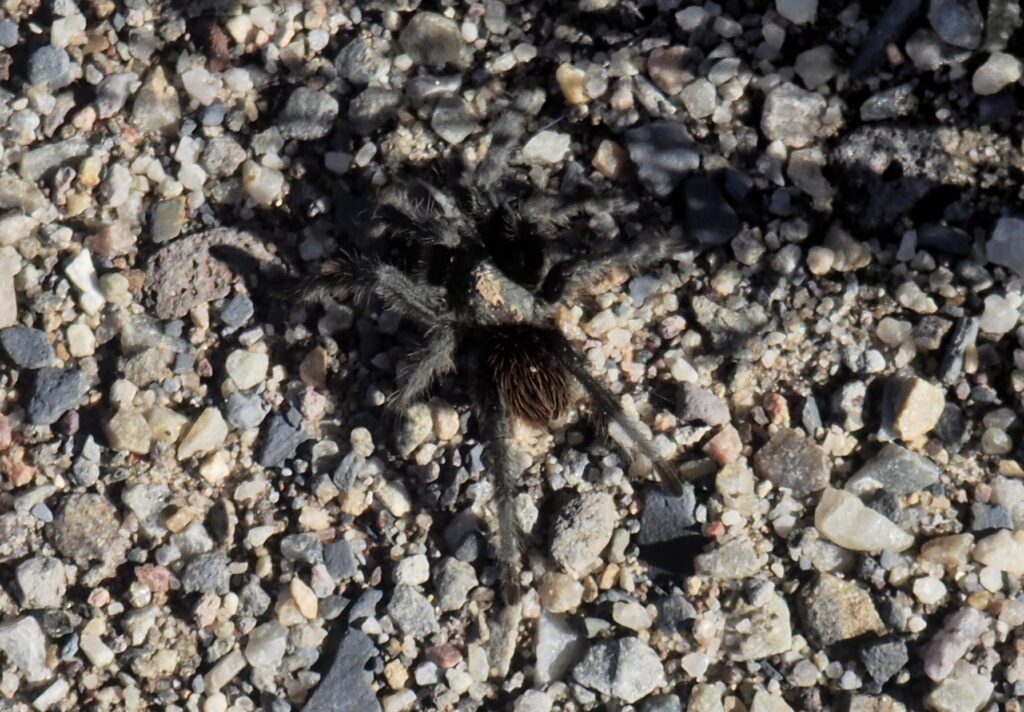
The same walk provided the opportunity for the only wildlife picture in this posting.
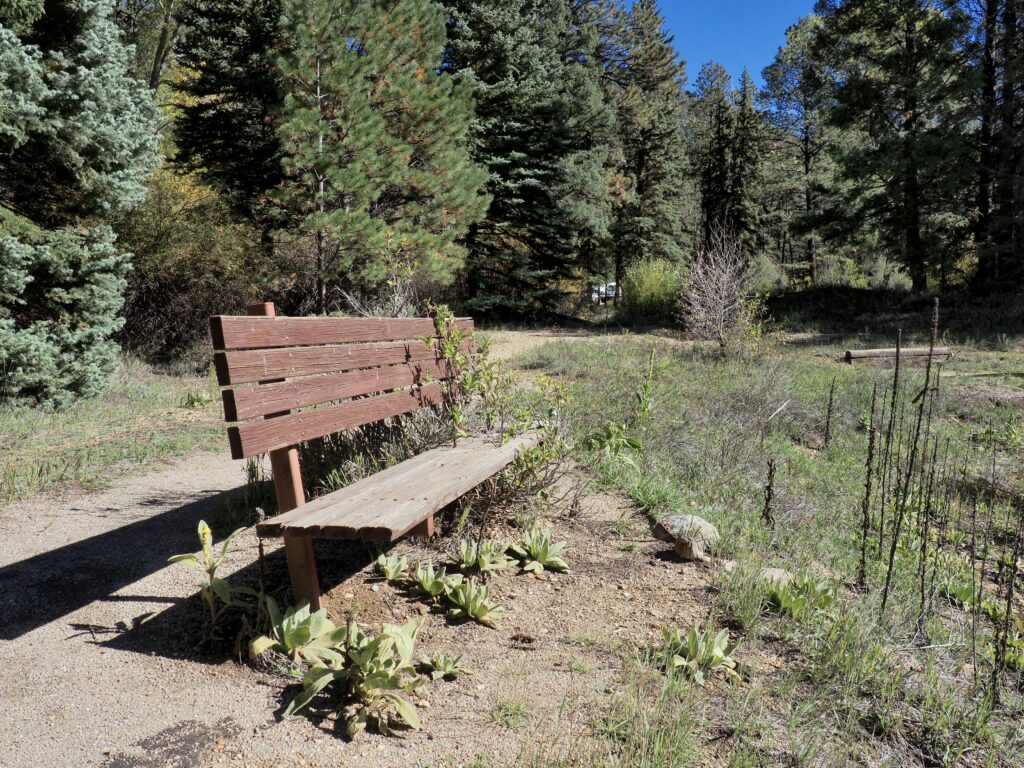
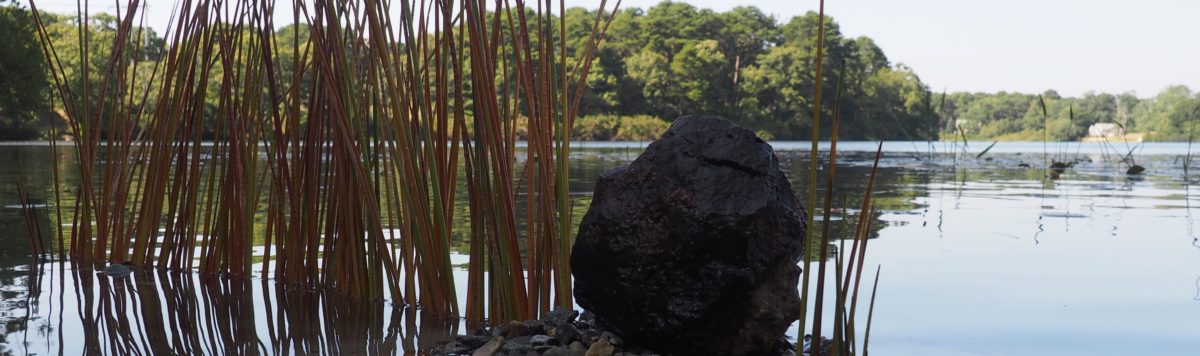
On our 85 mile loop, we stopped to see what used to be a lake.


The ski resort of Red River,
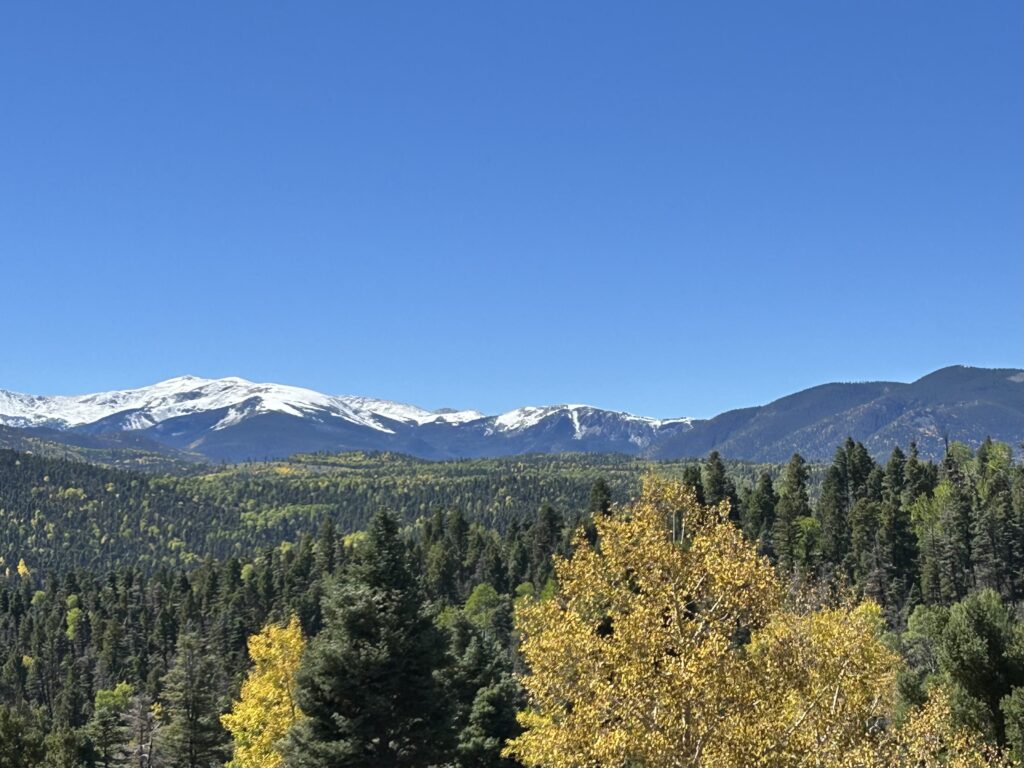
and views of snow capped mountains on the second of October.
The high road back to santa fe
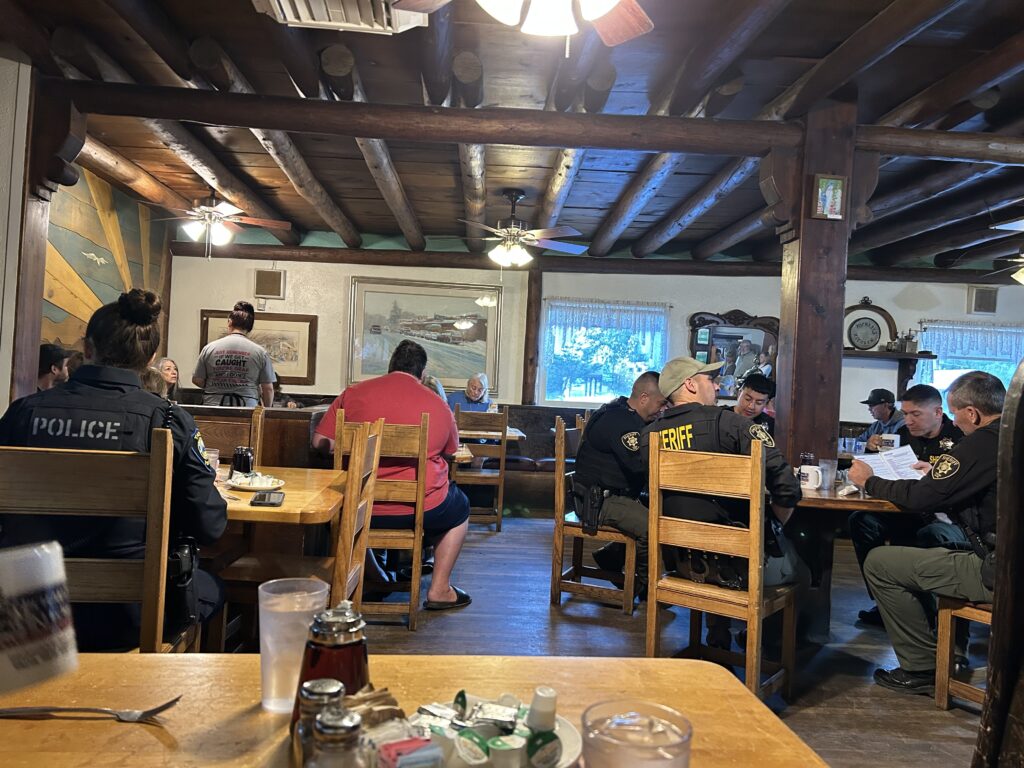
We grabbed a hearty breakfast at the safest place in Taos County before heading back south through the mountains, a place where a fortune’s worth of piñon nuts is buried in your pancakes, presumably because they’re from their backyard.


In addition to beautiful mountain driving, we enjoyed stopping at a few places along the way and talking with folks. Always interesting. Lots of people who seem to be trying to find themselves.
In and Around Santa Fe
international folk art museum
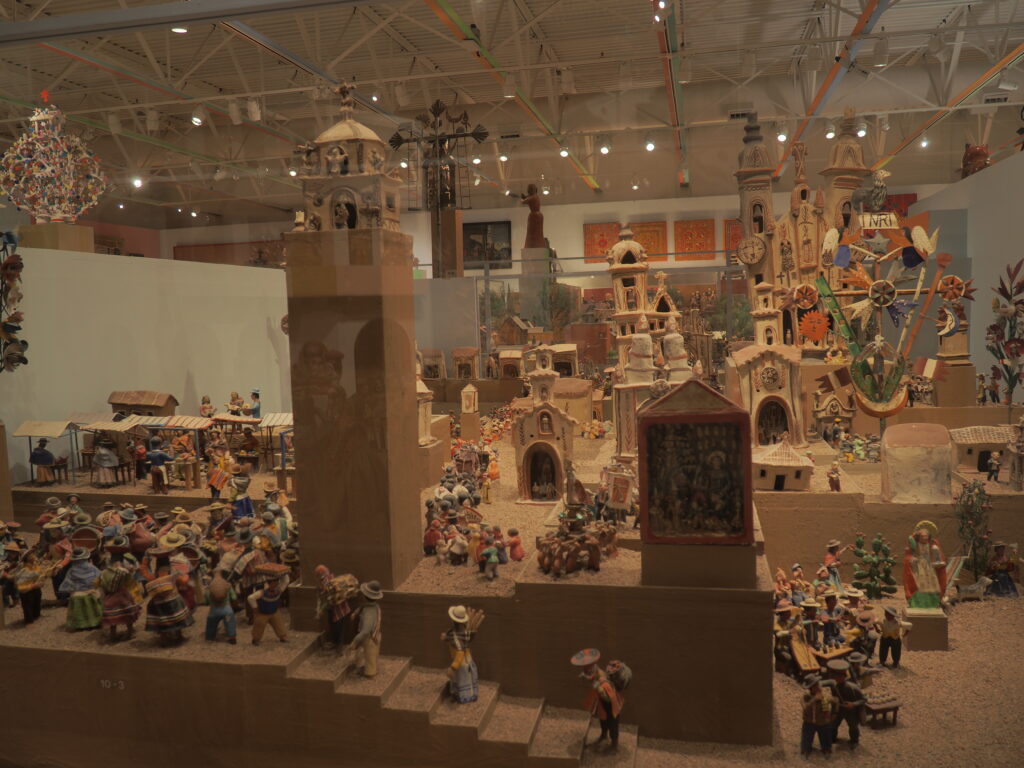


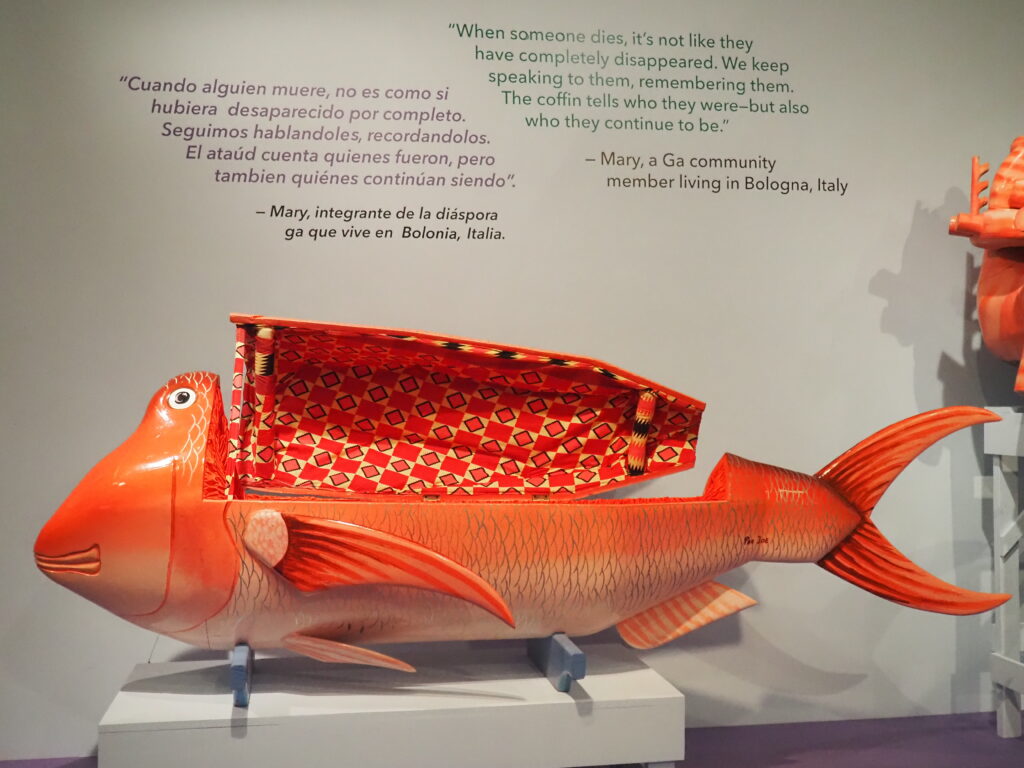
Okay, this place is crazy. Really interesting, well worth seeing, but (honestly), crazy. Much of the collection was a gift from one couple. Over 100,000 pieces. Overwhelming and crazy.
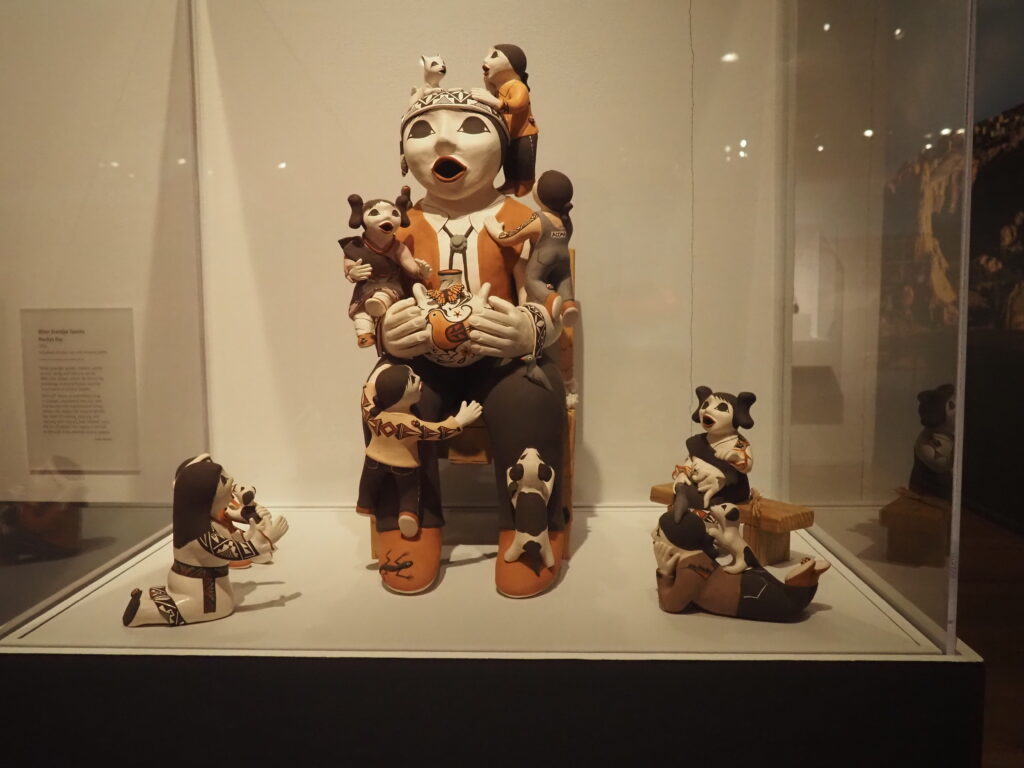
Except for this piece. “When Grandpa Speaks” by Marilyn Ray from 2006. It is wisdom itself.
bandelier national Monument
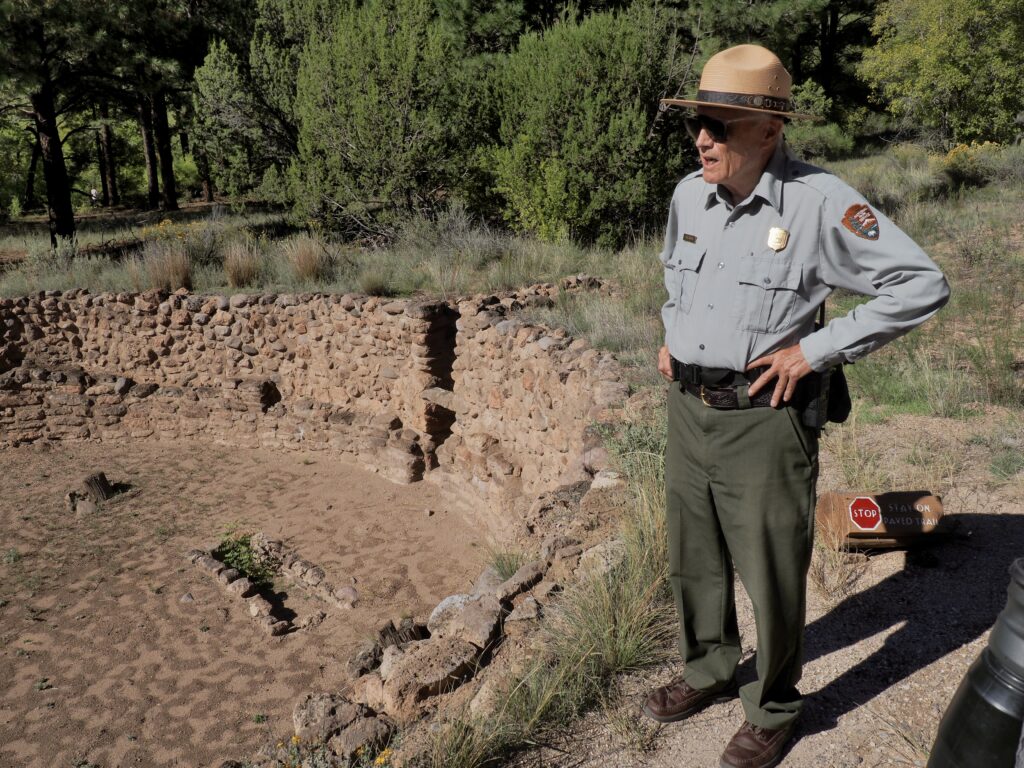
God bless the National Parks for always having a Ranger Doug to help us see what’s right there in front of us. In this case, it’s a lively village that was just one stage of a community’s life as they picked up and moved on every few hundred years, other iterations of this community having been, for instance, Mesa Verde.
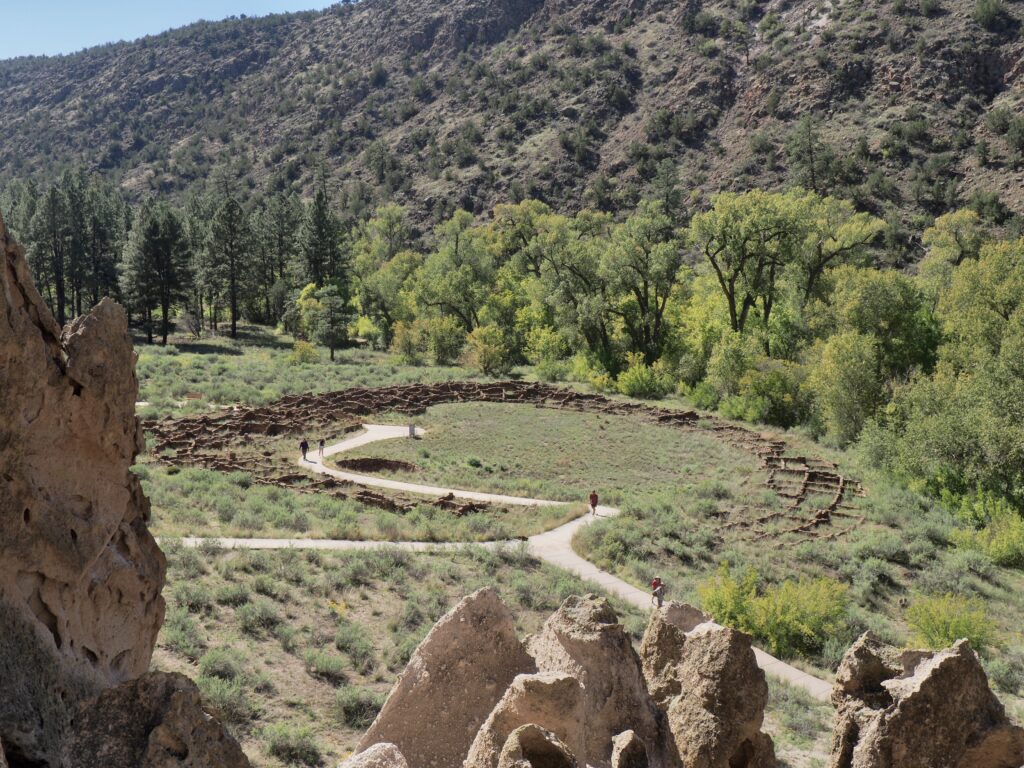
The excavated remains show us the multilevel village of Tyuonyi in Frijoles Canyon with one opening facing east and a jog in the path, presumably to ensure a respectful entrance. Entrances elsewhere, such as Mesa Verde, are almost always to the south to ensure maximum exposure to the winter sun. Bandelier has over 3,000 dwelling sites with some having more than 400 rooms. By the mid 1500’s, everyone had moved on to villages along the Rio Grande.
Above, Ranger Doug is standing next to a large kiva a short distance from the village, perhaps from a different time period. You can see a kiva within the village which has two more unexcavated kivas next to it. A kiva is a below ground, covered religious ceremonial space entered through the roof. Active kivas may not be entered by outsiders.
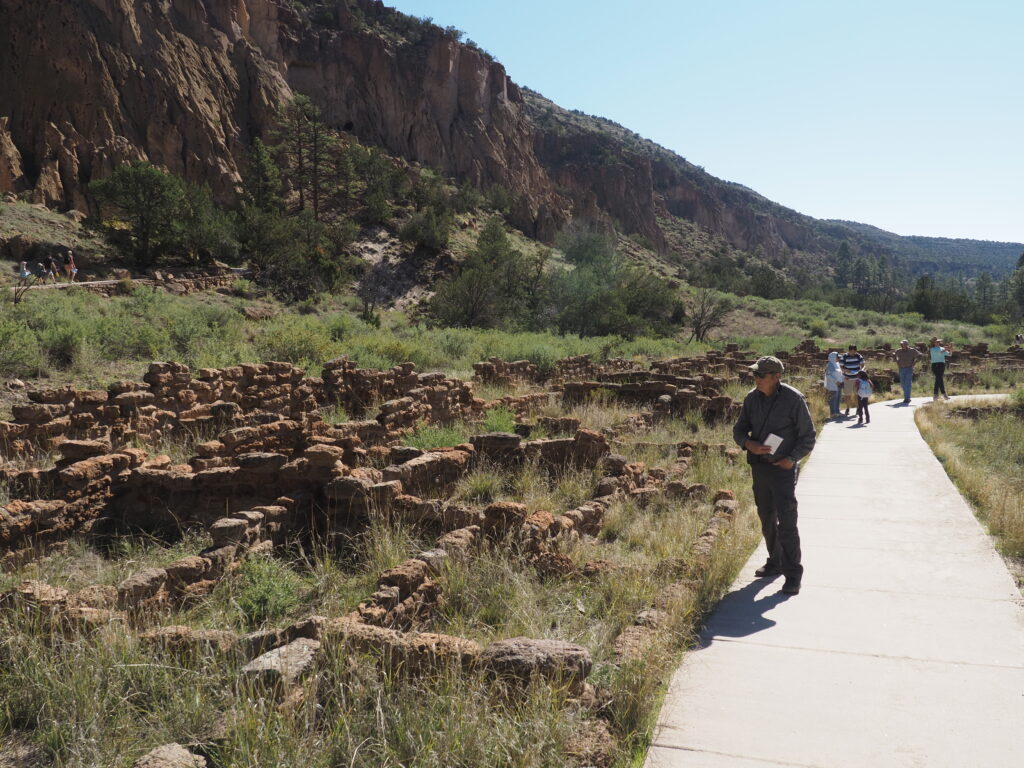
These remains of rooms are outside of the enclosed village.


The rooms carved out of the rock space we now understand to have been the back rooms of Pueblo dwellings. Lines form to climb the ladders and folks cooperate to take pictures, although some may have forgotten how to use a dedicated camera.


The small holes anchored the timbers forming the framing for the stucco rooms up against the cliffs.
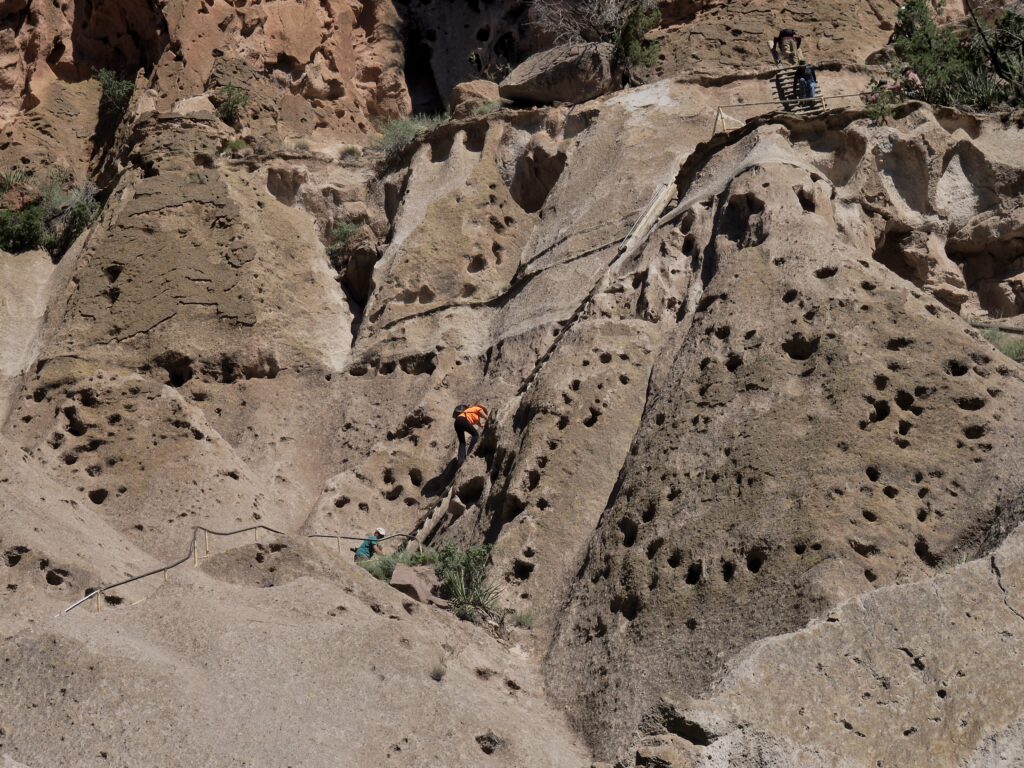
We chose not to climb the 140’ on ladders to Alcove House, a very large room high up on the cliff face, but it was a nice hike out to take a look.
santa fe canyon preserve
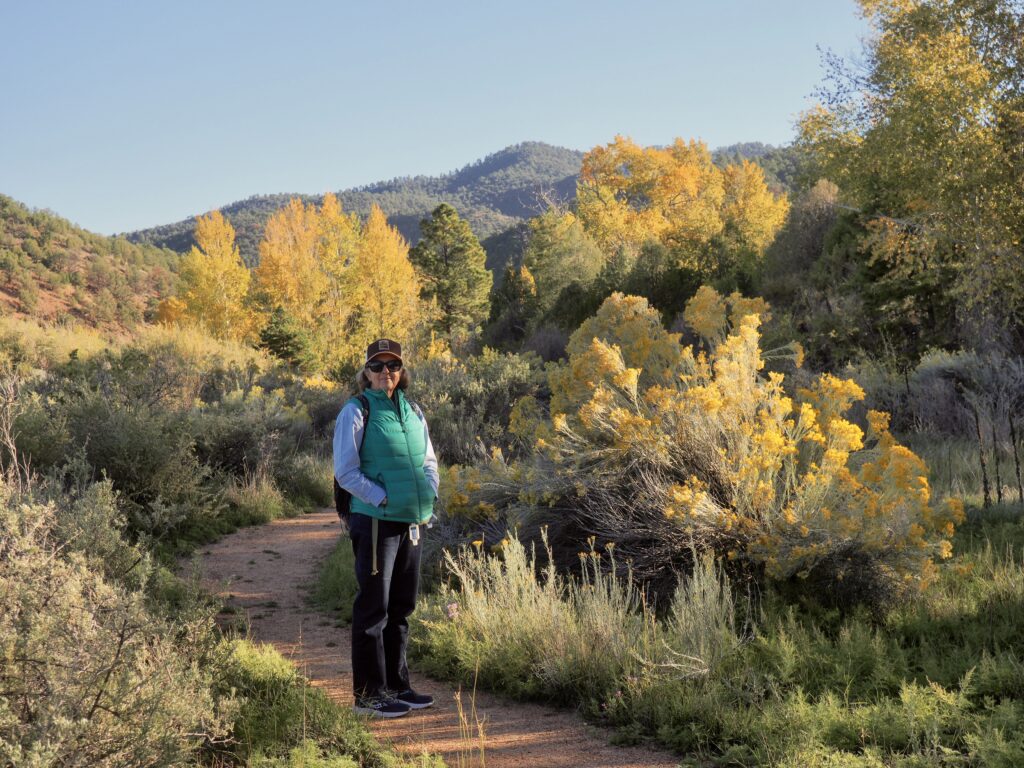
Just minutes from downtown Santa Fe is a beautiful Nature Conservancy property.


new mexico capitol, santa fe
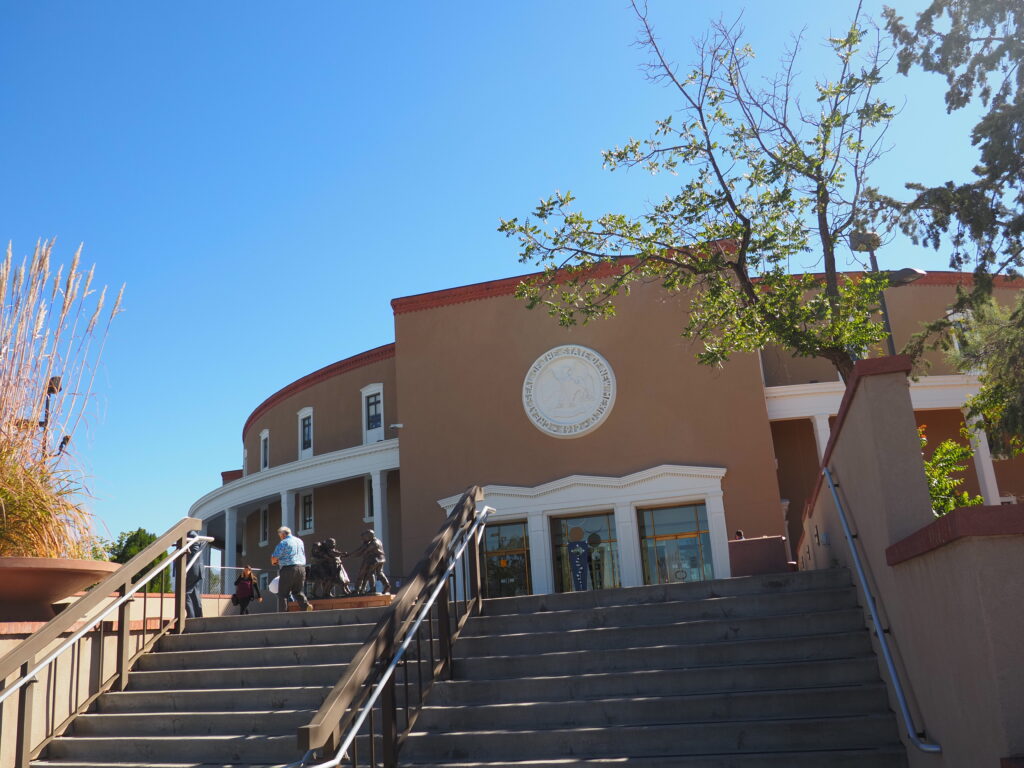
Santa Fe has always been the capital of New Mexico, from around 1610 or so. The Spanish Camino Real had Santa Fe as its terminus and, of course, coming from the other direction, the Americans had the Santa Fe trail.


It may be the seat of government, but the relatively modern (1966) Capitol building is filled with interesting art. It’s in the form of an ancient sacred sun symbol, the Zia. When we visited there was a wonderful exhibit of fiber art.


georgia O’keefe museum
Like our dive into Frida Kahlo and Diego Rivera in Mexico City, we found that Georgia O’Keefe’s life and her relationship with Alfred Stieglitz provided some insight into her work. Unfortunately, any possibility of admission into her home would have been months off, so we immersed ourselves in her work at the downtown museum and we offer a sample of the perhaps less familiar.


old santa fe
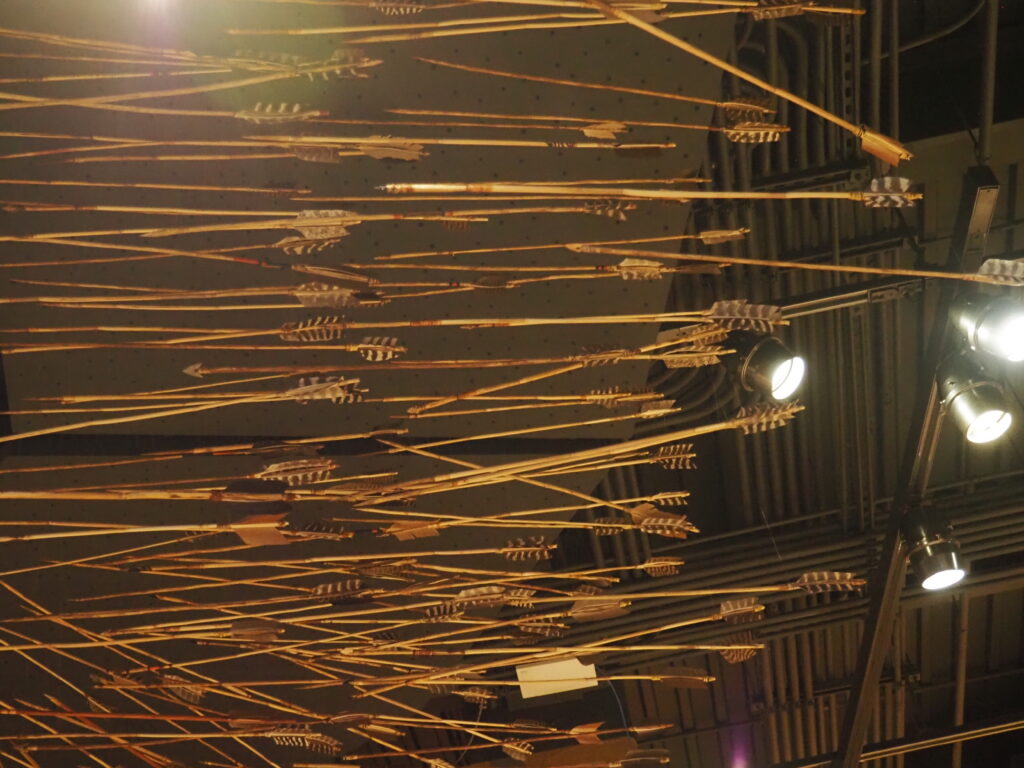
Santa Fe and New Mexico were contested territory for hundreds of years. Into the territory of the Anasazi and Pueblo and Navaho and Apache peoples came the Spanish, succeeded by the Mexicans, the Americans, briefly the Confederacy and finally the U.S. federal government once again.
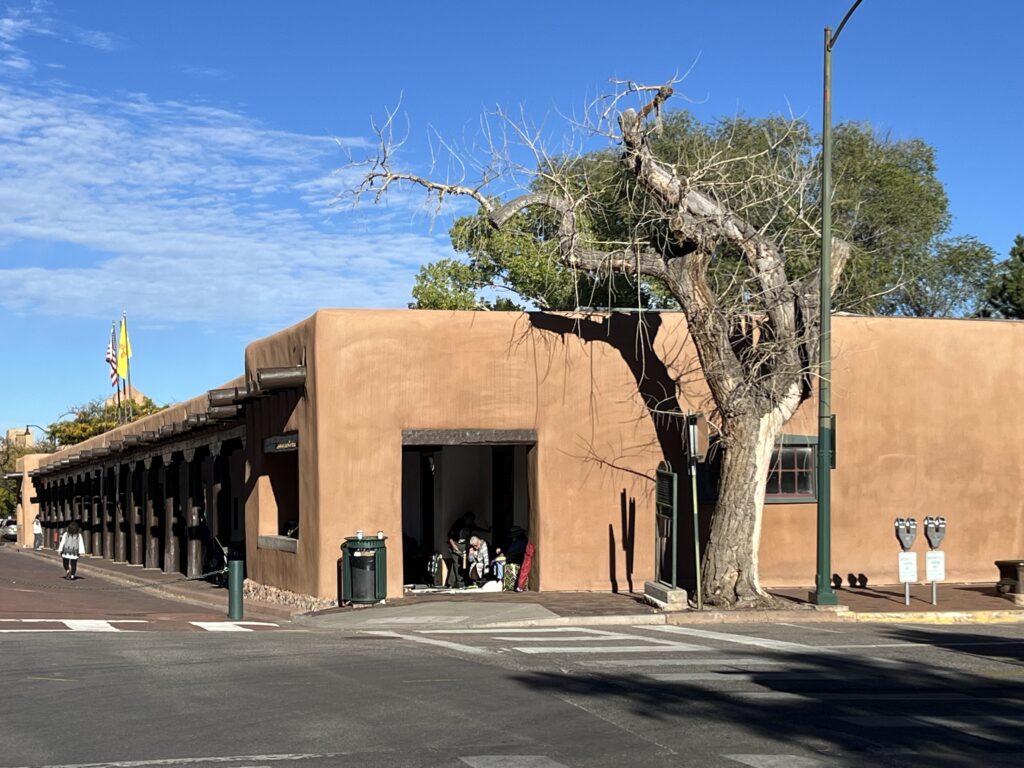


The Palace of the Governors (1610) is a block long affair that’s now part of the state history museum. Outside, native craftspeople have blankets spread in front of them, offering their handiwork. To us, the most interesting was a man selling small carved and inlaid stone fetishes of various animals.


The museum has a number of unique artifacts. This Swiss porcelain tea set belonging originally to his parents was carried by Adolph Bandelier while he was doing fieldwork in the Southwest.
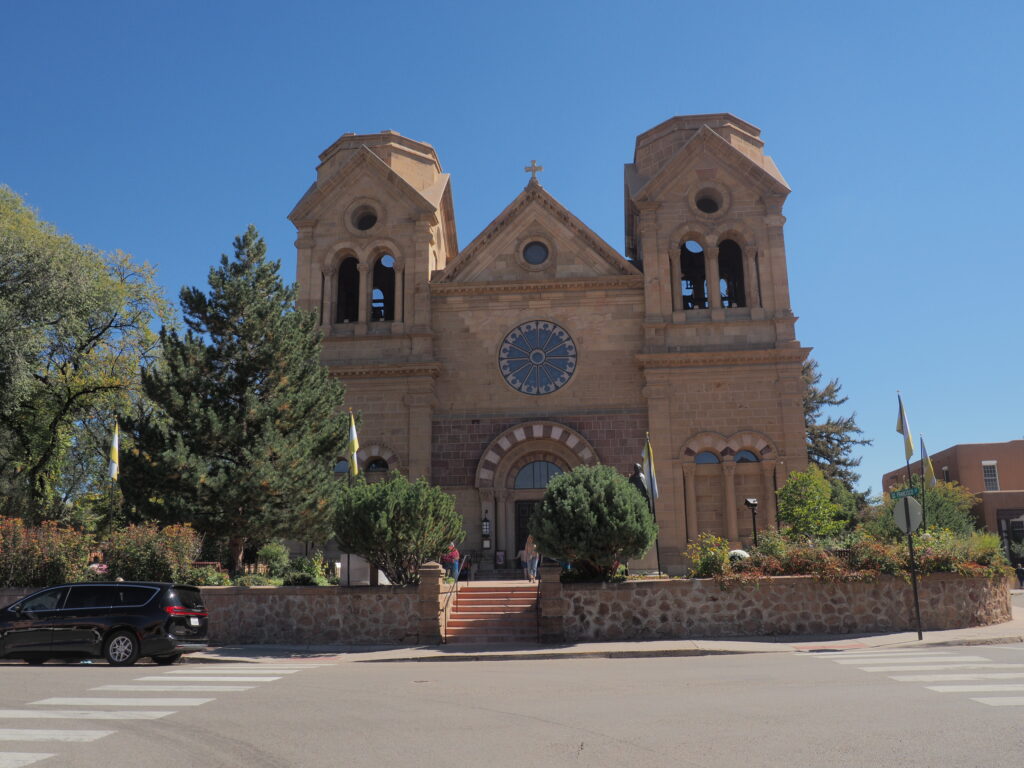


The first bishop and archbishop of Santa Fe, a Frenchman, vehemently disliked adobe architecture and so commissioned a Romanesque church. He’s best remembered as the model for the archbishop in Willa Cather’s Death Comes for the Archbishop.


The Palace of the Governors, of course, fronts on Santa Fe’s central plaza. On and around the plaza is a nice area of shops and fascinating people. We counted ourselves lucky to have found a park bench to enjoy the burritos we got from the vendor with the purple stand and to have remembered to bring cash, that not forgotten mode of exchange.
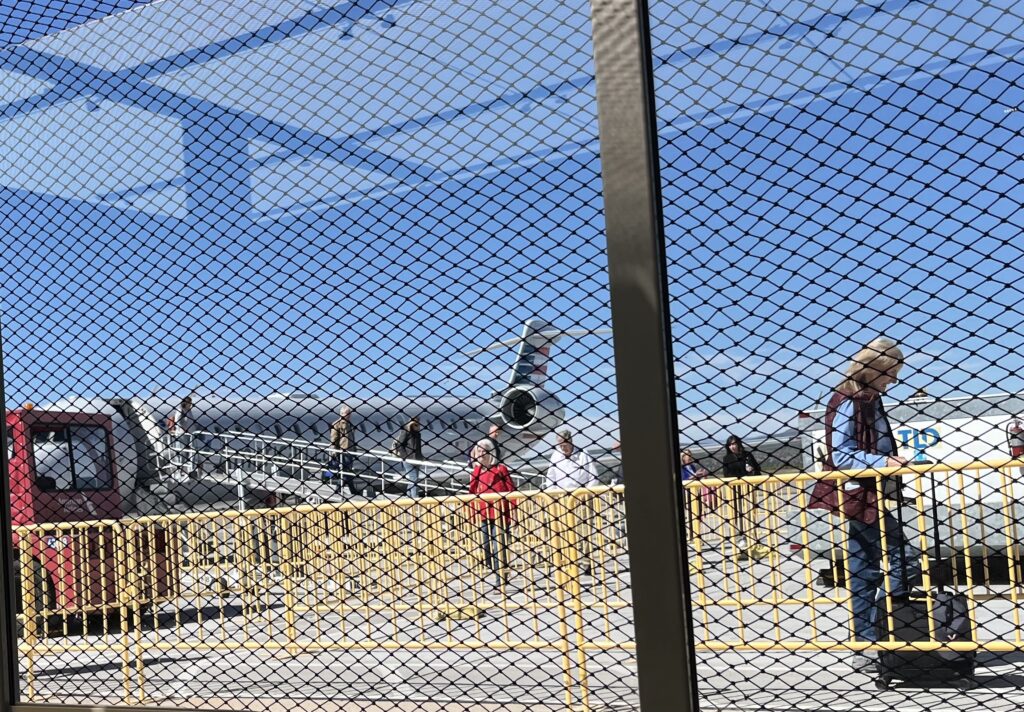
After a week in New Mexico it was time to leave the same way we arrived, except this time in sunny weather. Waiting for our flight in the outdoor tarmac-side lounge, it was hard to not be nostalgic for the days when all airplanes were boarded from the outside and you could smell the fuel. We also remembered the story from the night before, told us by our dinner companion at a shared table about how the balloon ride she took down in Albuquerque (where everybody but us had headed) ended up inadvertently landing at the airport, causing consternation and questions from the police. New Mexico: pretty nice place, after all.